

Les sujets abordés
- Nos observations
- Les perspectives économiques
- Notre stratégie d’investissement
Nos observations
Malgré de nombreuses raisons d’être pessimiste cette année, l’économie et les marchés mondiaux ont largement dépassé les attentes. Cette situation a ravivé l’attention sur les prévisions et les résultats financiers des sociétés, les investisseurs cherchant à comprendre comment celles-ci composent avec un contexte d’exploitation plus difficile en raison de l’imprévisibilité de la politique commerciale américaine, comment les droits de douane alimentent les pressions inflationnistes aux États-Unis et quelle pourrait être l’incidence potentielle sur la politique monétaire.
Les perspectives économiques
Une période de publication des résultats rassurante pour le deuxième trimestre
La période de publication des résultats aux États-Unis étant désormais largement terminée, les résultats ont été globalement meilleurs que prévu, le taux de croissance des bénéfices réalisés ayant largement dépassé les prévisions consensuelles. Même si les analystes attribuent la solide performance des bénéfices à l’efficacité des stratégies d’atténuation des droits de douane et à la dépréciation du dollar américain, ils ont également prévenu que les pleins effets des droits de douane ne se sont pas encore fait sentir, étant donné que les achats anticipés de marchandises plus tôt cette année a probablement reporté leur impact.
Les données sur l’inflation aux États-Unis sont contrastées
Ailleurs, les marchés surveillent de près la transmission des droits de douane à travers l’économie. Toutefois, les plus récentes données sur les prix à la consommation ont été relativement faibles. La divergence entre les prix à la consommation et les prix de gros souligne la difficulté d’évaluer la véritable trajectoire de l’inflation, un facteur qui complique les perspectives à l’égard de la politique monétaire des États-Unis.
Qu’en est-il du Canada?
Par ailleurs, les pressions sur les prix à la consommation au Canada se sont atténuées, en grande partie en raison de l’élimination de la taxe sur le carbone pour les consommateurs en avril. En ce qui concerne le commerce, l’ACEUM continue de garantir l’accès en franchise de droits au marché américain pour la plupart des exportations canadiennes. La Banque du Canada (BdC) a maintenu son taux directeur à 2,75 % pendant trois réunions consécutives depuis mars, et Services économiques RBC s’attend à ce que la BdC ne procède pas à de nouvelles réductions de taux au cours du présent cycle.
Notre stratégie d’investissement
Ignorer les perturbations
Les médias financiers ont tendance à être résolument axés sur les nouvelles récentes. Pour les investisseurs à long terme, la plupart des manchettes quotidiennes et des fluctuations des marchés ont davantage tendance à créer de la confusion qu’à fournir des renseignements utiles ou pertinents. Étant donné que les fluctuations à court terme des marchés reflètent souvent des perturbations et de l’imprévisibilité, le fait de modérer l’attention portée aux nouvelles quotidiennes peut empêcher les investisseurs de procéder à des transactions potentiellement inutiles qui peuvent nuire à leurs objectifs de placement à long terme.
Le temps joue en faveur de l’investisseur
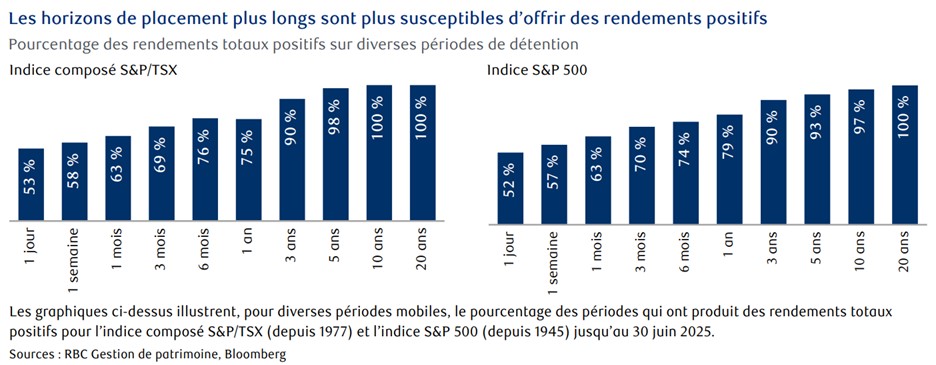
Dans un monde où les investisseurs sont souvent incités à adopter des stratégies à court terme, une vision à long terme peut offrir un avantage énorme. La probabilité d’obtenir un rendement positif un jour de bourse est essentiellement la même que par un tirage à pile ou face. Toutefois, à mesure que l’horizon de placement se prolonge, les investisseurs peuvent être de plus en plus sûrs d’obtenir un résultat positif. La probabilité que l’indice composé S&P/TSX et l’indice S&P 500 génèrent des rendements positifs s’améliore considérablement sur des périodes plus longues : elle augmente à environ 75 % à 80 % pour les périodes mobiles d’un an, à près de 90 % pour les périodes mobiles de trois ans et à près de 100 % pour les périodes mobiles de plus de cinq ans. Autrement dit, la probabilité de subir des pertes sur les marchés boursiers diminue considérablement à mesure que l’horizon de placement s’allonge.
Le pouvoir discret de la capitalisation à long terme
Comme l’incertitude est omniprésente, nous croyons que les investisseurs devraient toujours penser en fonction des probabilités. L’horizon de placement est un outil pratique pour gérer la volatilité inévitable sur les marchés boursiers, qui tendent à suivre la hausse des bénéfices et de l’économie à long terme. Non seulement un horizon plus long augmente les perspectives de rendements positifs des actions, mais il permet aussi aux investisseurs de bénéficier de la magie des intérêts composés pour accumuler les rendements au fil du temps.
« L’essence de la gestion des placements est la gestion des risques,
et non la gestion des rendements. Les portefeuilles bien gérés commencent par ce précepte. »
- Benjamin Graham, l’un des pères du value investing et
principal influenceur de Warren Buffett.
Dans l’ensemble, les excellents résultats enregistrés jusqu’à présent par les sociétés, conjugués à une série d’évolutions commerciales constructives, ont ouvert la voie à un optimisme prudent. Néanmoins, nous gardons à l’esprit que les marchés boursiers se situent près de sommets records et que les valorisations sont élevées, surtout aux États-Unis. Par conséquent, nous adoptons une approche préventive pour les prochains mois.
Comme toujours, nous sommes disponibles pour répondre à vos questions.
Bonne rentrée !
Benoit Legros, B.A.A., CIM, FCSI
Gestionnaire de portefeuille et conseiller en patrimoine principal