

Quarterly Commentary – June 30, 2025
After a turbulent start to April — marked by the U.S. President’s proclamation of “Liberation Day” on April 2 — pressure from corporate leaders, financial markets, and warnings from the bond market in the following days was enough to temper U.S. rhetoric. As a result, the President announced a first 90‑day extension to negotiate trade agreements. It didn’t take much for equity markets to view this easing of tensions as a first step toward compromise.
By the end of the quarter, equity markets showed solid resilience, looking past daily distractions. With the Senate’s early‑July approval of the Big Beautiful Bill, a strong signal was sent: the President intends to pursue the expansionary fiscal policies he first introduced during his 2016‑2017 term. The U.S. unemployment rate remains at a historically low 4.1%, meaning the American consumer — who accounts for 70% of the economy — is still in relatively good shape, and corporate profits remain strong.
While this improves near‑term U.S. GDP forecasts, it also raises concerns about the growing deficit and potential longer‑term inflationary pressures.
In contrast, Canada is taking a more cautious approach. Ottawa has avoided large‑scale stimulus measures, and the Bank of Canada’s more measured interest‑rate cuts appear to have supported domestic growth without triggering significant inflationary pressures. This relative stability has improved investor sentiment toward the Canadian dollar, particularly in resource‑ and export‑oriented sectors.
As of April, according to RBC Economics, over 90% of Canadian exports were covered by the Canada–U.S.–Mexico Agreement. By early July, more than 75% of exports were still exempt from tariffs. It remains to be seen whether tariff impacts will be more severe in the second half of the year.
RBC strategists still expect tariffs — but at manageable levels (around 15% on average). This, of course, reflects the most likely scenario given the stakes. For example, China’s supply of rare earth metals remains essential for U.S. aviation, defense, technology, and automotive industries — a key reason for the ongoing back‑and‑forth between Washington and Beijing, and an incentive to reach reasonable agreements.
Deficit and the U.S. Dollar at the Forefront
To finance its debt and annual deficits, the U.S. Treasury issues debt every 3 to 4 weeks. A significant share of this debt is held by foreign countries — led by Japan, the United Kingdom, China, European nations, Canada, and others. As of December 31, 2024, The Wall Street Journal estimated that 30% of total U.S. debt was held by foreign investors. This clearly factors into trade negotiations: if foreign partners were to reduce purchases or sell U.S. debt, it could push long‑term interest rates higher.
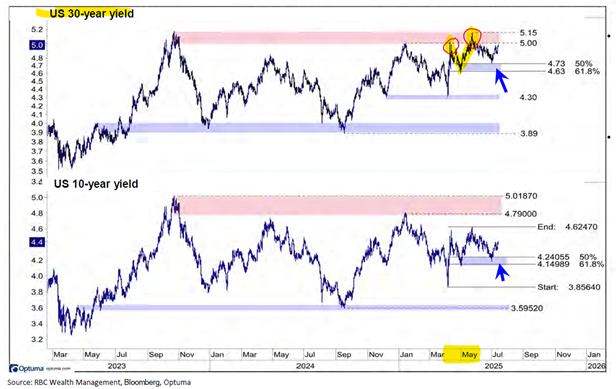
We had an early glimpse of this in April and May, when 30‑year U.S. Treasury yields broke above the psychologically important 5% level. Interest payments now account for more than 14% of the U.S. federal budget (source: JP Morgan Asset Management).
One of the most notable — and often underestimated — market developments in 2025 has been the U.S. dollar’s decline against nearly all major global currencies. This is evident in the Dixie index, which measures the greenback’s value against a basket of key currencies: the euro, Japanese yen, British pound, Canadian dollar, Swedish krona, and Swiss franc. For instance, since peaking at roughly 1.45 USD/CAD (on the now‑famous Sunday, February 2, when tariffs against Canada and Mexico were announced), the U.S. dollar has steadily lost ground, reaching the 1.36–1.37 range by mid‑July — a decline of about 5% year‑to‑date.
For the past two decades, given America’s dominant economic growth, investors saw little benefit in diversifying into the euro or yen versus holding U.S. dollars. But the apparent shift in U.S. policy is prompting renewed interest in currency diversification — especially since the U.S. dollar still trades at a significant premium relative to most major currencies.
Meanwhile, expectations for further U.S. interest‑rate cuts — more aggressive than those anticipated in Canada over the next 12 months — have also contributed to dollar weakness. In the July 2025 edition of RBC FX Global, the revised target for year‑end 2026 is now 1.31 CAD/USD (or roughly 0.76 USD/CAD).
Implications for Your Portfolio
U.S. assets have underperformed for Canadian investors once adjusted for currency, as the U.S. dollar’s decline has eroded part of equity returns.
Canadian exporters continue to benefit from steady global demand — particularly in energy, agriculture, and manufacturing.
Currency diversification has become even more important for portfolio resilience, especially for clients with U.S.‑dollar income or cross‑border investments.
Currency trends can shift quickly, but they also provide valuable insight into capital flows — and the forces behind them. As the U.S. and Canada continue to pursue divergent fiscal and monetary paths, we expect continued currency volatility in the second half of the year.
Q2 2025 Performance
The second quarter began with even greater volatility than Q1, fueled in part by President Trump’s protectionist rhetoric. However, markets looked past the noise, interpreting these threats as a negotiating tactic, and returned to a relatively calm upward trend with low volatility.
Canadian‑dollar returns for the quarter ended June 30, 2025:
- +10.2% – Canadian S&P/TSX Index
- +0.5% – U.S. S&P 500 Index (in CAD)
- +11.1% – Europe–Asia–Far East Index
- +1.4% – FTSE TMX Canadian Bond Universe Index
Portfolio performance: Balanced portfolios returned +1.5% to +2.5% in Q2 2025, and +11.0% to +12.0% over the past 12 months, in Canadian dollars.
On behalf of the entire team, we wish you a summer filled with love and joy.
“I wonder what it would be like to live in a world where it was always June.”
-Lucy Maud (L.M.) Montgomery
Mathieu & Anthony
This information is not investment advice and should be used only in conjunction with a discussion with your RBC Dominion Securities Inc. Investment Advisor. will ensure that your own circumstances have been considered properly and that any action is taken based upon the latest available information. The strategies and advice in this report are provided for general guidance. Readers should consult their own Investment Advisor when planning to implement a strategy. Interest rates, market conditions, special offers, tax rulings, and other investment factors are subject to change. The information contained herein has been obtained from sources believed to be reliable at the time obtained but neither RBC Dominion Securities Inc. nor its employees, agents, or information suppliers can guarantee its accuracy or completeness. report is not and under no circumstances is to be construed as an offer to sell or the solicitation of an offer to buy any securities. report is furnished on the basis and understanding that neither RBC Dominion Securities Inc. nor its employees, agents, or information suppliers is to be under any responsibility or liability whatsoever in respect thereof. The inventories of RBC Dominion Securities Inc. may from time to time include securities mentioned herein. RBC Dominion Securities Inc.* and Royal Bank of Canada are separate corporate entities which are affiliated. *Member-Canadian Investor Protection Fund. RBC Dominion Securities Inc. is a member company of RBC Wealth Management, a business segment of Royal Bank of Canada. â / ™ Trademark(s) of Royal Bank of Canada. Used under licence. © RBC Dominion Securities Inc. (insert applicable year). All rights reserved. RBC Dominion Securities Inc.* and Royal Bank of Canada are separate corporate entities which are affiliated. *Member-Canadian Investor Protection Fund. RBC Dominion Securities Inc. is a member company of RBC Wealth Management, a business segment of Royal Bank of Canada. â / ™ Trademark(s) of Royal Bank of Canada. Used under licence. © RBC Dominion Securities Inc. 2025. All rights reserved.