

- History demonstrates that while geopolitical shocks trigger sharp short-term volatility, markets typically recover quickly so long as the economic growth outlook is not impaired.
- The exceptions to this rule are periods where the economy is already at risk when the shock hits, with soaring energy prices pushing it over the edge.
- Canada’s heavy weighting in energy and materials often acts as a natural hedge, as global instability frequently drives up the commodity prices that underpin the TSX.
- The Canadian dollar often serves as a critical shock absorber; a weaker Loonie boosts the value of U.S. dollar holdings all else equal during volatile markets.
- For most investors, the primary risk is not the geopolitical event itself, but the emotional reaction to it. Maintaining a diversified, long-term portfolio designed to fulfill the requirements of a personalized financial plan is key to success.
- We believe portfolios are well positioned to withstand a variety of economic and market outcomes, but stand ready to pivot should circumstances demand it.
In our meetings with industry peers and clients, the conversation has seen a marked shift. For years, investors focused on the "known unknowns" such as interest rates, inflation, and corporate earnings. Today, portfolio anxiety is being driven by decisions taken in the Oval Office and beyond. From trade disputes in North America to energy disruptions in the Middle East, geopolitical events have moved from the periphery of the news cycle to something that investors ignore at their peril. Canada’s small, open economy is deeply integrated with a global system that currently feels more fractured than it has in decades, and anxiety about the future is as elevated as we have seen in some time. As we have seen many times over, markets don’t care about our feelings, be them good or bad. History suggests that while geopolitical events can dominate headlines, the long-term market response has been remarkably consistent.
Anatomy of a Market Shock
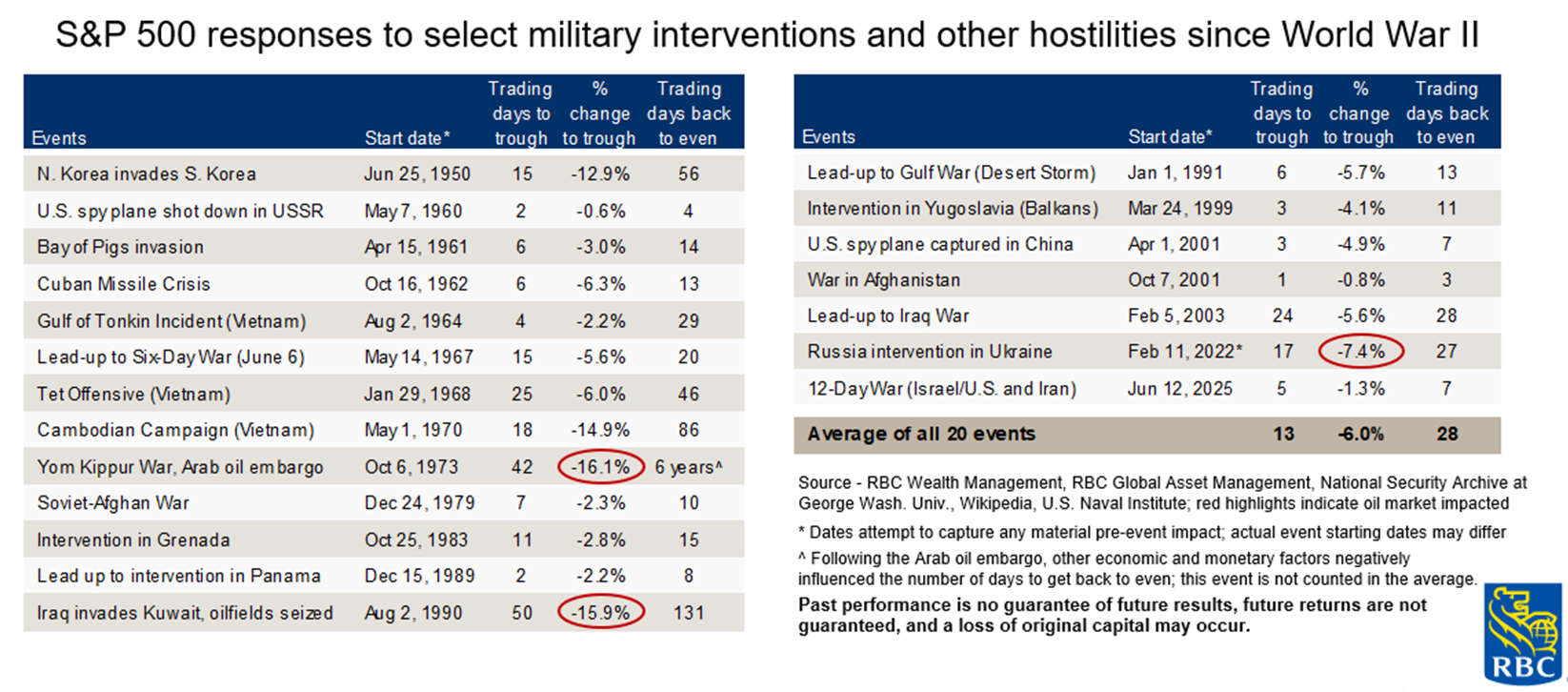
When a major geopolitical event occurs, such as a military conflict, a sudden change in trade policy, or a diplomatic breakdown, markets often undergo a reflexive correction. Uncertainty is the enemy of equity valuations and investors often take a “shoot first and ask questions later” attitude to these events. Fearing the worst-case scenario, we typically see money move toward safe-haven assets like gold, the U.S. Dollar, or government bonds. Historically, the initial drawdown following a geopolitical shock is sharp but brief. Looking back at major disruptions over decades, the S&P 500 and the S&P/TSX Composite typically see a bottom within weeks of the event. More importantly, data shows that on average, markets recover within a month of the event, with some notable exceptions. . The shock is a temporary repricing of risk, and not typically a permanent destruction of value. For the patient investor, these periods often represent an entry point rather than a signal to exit.
The exception that causes investors to raise their guard when tensions run high
With the evidence presented above, one would think that investors would be inured to these risks and know not to react when events take place. First, we all know that investors can get emotional, and only the most hardened among us can look at war breaking out and feel nothing. Second, on rare occasions, geopolitical events have seen significant declines in the stock market that took many months to recover from. When war breaks out, nobody knows at the outset how long it is going to last or what the economic outcome will be. That last phrase is key as the events in the table above that saw the most challenging path to recovery were often associated with an economy that was already on the ropes or saw a massive surge in oil prices. The current conflict has seen a sharp jump in oil prices, but we don’t know how long they will go or how long they will last. Currently, the outlook for the U.S. economy is healthy, but that could change if we see a sustained surge in oil prices. At this point it is too early to say.
The “double-double” Canadian advantage
Canada occupies a unique position on the global stage in that we are a military and political “middle power”, but at the same time we are a resource superpower. In times of global instability, the commodities Canada produces tend to increase in value, insulating our economy from global turbulence to a degree. Our stock market typically benefits even more as it is less exposed to consumer spending and much more aligned with global commodity prices. At the same time, episodes of market volatility often see the U.S. dollar rise in value versus the Canadian dollar, providing an additional layer of protection for Canadian investors. This "double-double" means that a well-diversified Canadian portfolio has a built-in defense mechanism that many tech-heavy U.S. portfolios lack.
Strategy Over Sentiment
In an environment that feels increasingly unpredictable, the most resilient investors are those who can distinguish the signal from the noise. Geopolitics creates volatility, but this is not the same as risk. We view risk as the permanent loss of capital, which usually occurs when an investor sells a quality security during a temporary panic. History shows that the vast majority of geopolitical events end up being a blip for markets, but there is always a chance that the current situation is an exception. We believe portfolios are well-positioned to withstand a large variety of economic outcomes, and we stand prepared to take action of the outlook changes.
The Harbour Group
416-842-2300
Putting you first, every time, to help you navigate the complexities of managing your wealth. All of our team members, all of our resources, all of our collective insight: ALL FOR ONE: YOU™.
The information contained herein has been obtained from sources believed to be reliable at the time obtained but neither RBC Dominion Securities Inc. nor its employees, agents, or information suppliers can guarantee its accuracy or completeness. This report is not and under no circumstances is to be construed as an offer to sell or the solicitation of an offer to buy any securities. This report is furnished on the basis and understanding that neither RBC Dominion Securities Inc. nor its employees, agents, or information suppliers is to be under any responsibility or liability whatsoever in respect thereof. The inventories of RBC Dominion Securities Inc. may from time to time include securities mentioned herein. RBC Dominion Securities Inc. and its affiliates may have an investment banking or other relationship with some or all of the issuers mentioned herein and may trade in any of the securities mentioned herein either for their own account or the accounts of their customers. RBC Dominion Securities Inc. and its affiliates also may issue options on securities mentioned herein and may trade in options issued by others. Accordingly, RBC Dominion Securities Inc. or its affiliates may at any time have a long or short position in any such security or option thereon. Mutual funds are sold by RBC Dominion Securities Inc. There may be commissions, trailing commissions, management fees and expenses associated with mutual fund investments. Read the prospectus before investing. Mutual funds are not guaranteed, their values change frequently and past performance may not be repeated. RBC Dominion Securities Inc.* and Royal Bank of Canada are separate corporate entities which are affiliated. *Member CIPF. ®Registered Trademark of Royal Bank of Canada. Used under licence. RBC Dominion Securities is a registered trademark of Royal Bank of Canada. Used under licence. ©Copyright 2019. All rights reserved.