

- Human emotion has historically had an outsized impact on investor outcomes and we don’t expect that to change.
- The two dominant emotions are fear and greed, and each come with their own pitfalls and opportunities.
- Studies show that over the long term, individual investors have underperformed major indices significantly, with most of the gap attributable to behavioural biases, i.e. buying high and selling low.
- Emotions can be difficult to overcome, but are also a useful tool for investors as measures of investor emotions (sentiment) are widely available.
- Historically it has paid to do the opposite of the prevailing consensus sentiment, particularly when markets are at extremes.
As investors, we spend a lot of time looking at different types of businesses and determining what characteristics make for a sound long term investment. Analyzing competitive position, cash flows, management competence, and valuation are all part of our day-to-day existence in building and managing portfolios. Investor emotion, or sentiment, is not something we monitor on a daily basis, but it is something that comes in handy when markets are at extremes.
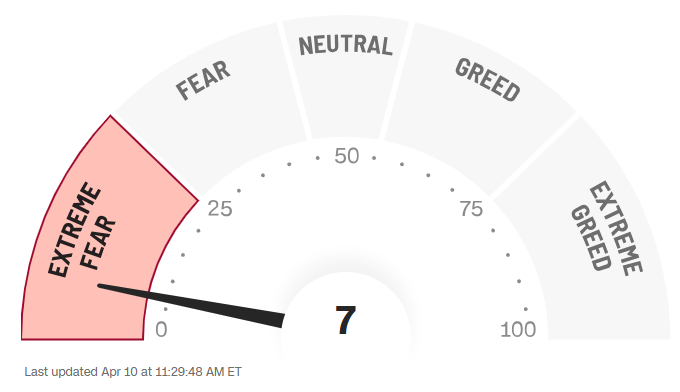
Sentiment was deeply depressed in the aftermath of “Liberation Day”
One great example of this was the post-Liberation Day selloff in stocks earlier this year. The tariff news shocked investors, and they quicky extrapolated the worst case, taking stocks down sharply and leading to “Extreme Fear” in CNN’s “Fear and Greed” gauge of investor sentiment. While high levels of fear can sustain for some time, situations like this typically mean that a lot of bad news is priced in and even news that is slightly “less bad” than feared can spark a rally. We didn’t know it at the time but within a week we would get the “less bad” news that tariffs were going to be delayed, and markets reversed course in spectacular fashion. The lesson here is that once everyone is terrified of what is going on in the markets, it is often too late to sell for all but the most nimble of investors!
Source: CNN
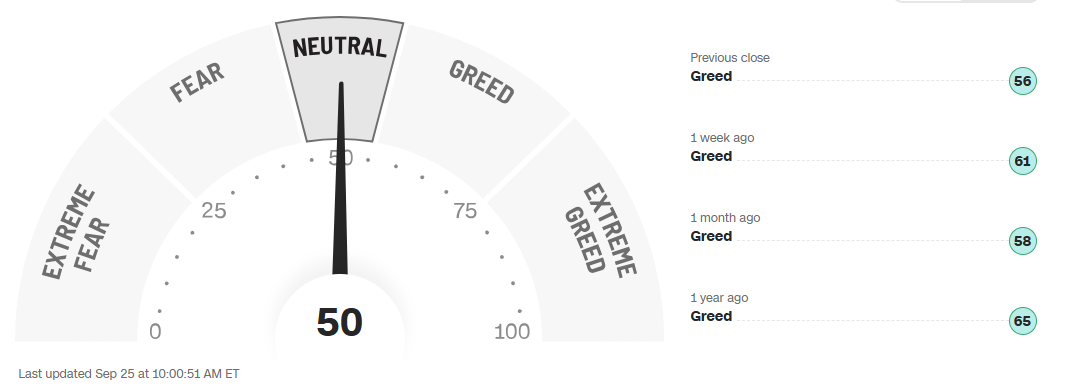
Sentiment is more neutral today, having recently been dipping into “Greed” territory
As stocks have recovered and volatility has been relatively absent, even in this notorious month of September, investor sentiment has improved, as one would expect. While we currently sit at Neutral, the last few weeks have seen a few forays into “Greed” territory. When we hit those levels of sentiment, the so-called “fear of missing out” can become the dominant emotion, leading investors to chase after the winners of the day with little regard for valuation or portfolio fit. While momentum in a stock or sector has a habit of continuing in the short term, these trends can often turn violently as an asset class priced for perfection only needs a slight blemish in the story to change direction.
Source: CNN
Keeping emotions in check key to fulfilling the promise of a financial plan
Studies have shown that the average individual investor has underperformed benchmark equity indices by a wide margin over time (20 years in this case). The primary reason cited is investor behaviour, characterized by the tendency to buy high and sell low, chase past performance and succumb to fear and greed at market extremes. While changing centuries of human behaviour is well beyond the scope of our profession, we do feel we have a duty to make investors aware of their biases and do our best to take advantage of the opportunities the market provides at the extremes.
The Harbour Group
416-842-2300
Putting you first, every time, to help you navigate the complexities of managing your wealth. All of our team members, all of our resources, all of our collective insight: ALL FOR ONE: YOU™.
The information contained herein has been obtained from sources believed to be reliable at the time obtained but neither RBC Dominion Securities Inc. nor its employees, agents, or information suppliers can guarantee its accuracy or completeness. This report is not and under no circumstances is to be construed as an offer to sell or the solicitation of an offer to buy any securities. This report is furnished on the basis and understanding that neither RBC Dominion Securities Inc. nor its employees, agents, or information suppliers is to be under any responsibility or liability whatsoever in respect thereof. The inventories of RBC Dominion Securities Inc. may from time to time include securities mentioned herein. RBC Dominion Securities Inc. and its affiliates may have an investment banking or other relationship with some or all of the issuers mentioned herein and may trade in any of the securities mentioned herein either for their own account or the accounts of their customers. RBC Dominion Securities Inc. and its affiliates also may issue options on securities mentioned herein and may trade in options issued by others. Accordingly, RBC Dominion Securities Inc. or its affiliates may at any time have a long or short position in any such security or option thereon. Mutual funds are sold by RBC Dominion Securities Inc. There may be commissions, trailing commissions, management fees and expenses associated with mutual fund investments. Read the prospectus before investing. Mutual funds are not guaranteed, their values change frequently and past performance may not be repeated. RBC Dominion Securities Inc.* and Royal Bank of Canada are separate corporate entities which are affiliated. *Member CIPF. ®Registered Trademark of Royal Bank of Canada. Used under licence. RBC Dominion Securities is a registered trademark of Royal Bank of Canada. Used under licence. ©Copyright 2019. All rights reserved.