

On the surface, the U.S. economy seems unstoppable — but a closer look reveals deep structural shifts distorting the usual business cycle. Our outlook for market gains continue to be positive, however, we recognize that future returns may come with more volatility. Investors need to look beyond the headlines and recognize the nuances that can influence the markets.
A Strange Kind of Strength
The U.S. economy continues to defy expectations. Unemployment is low, growth has held up, and inflation has eased from its pandemic highs. Yet the usual signals that guide investors — rates, jobs, housing, and inflation — tell a more complex story.
The Federal Reserve has kept policy rates high and at an economically restrictive level for over a year. As a result, housing activity has collapsed to levels last seen during the financial crisis. Meanwhile, the U.S. faces its most significant trade shock in a century, and inflation remains stubbornly elevated.
What’s going on? A series of long-term structural forces are muting the business cycle and masking a potential slowdown underneath. We see 5 distortions being:
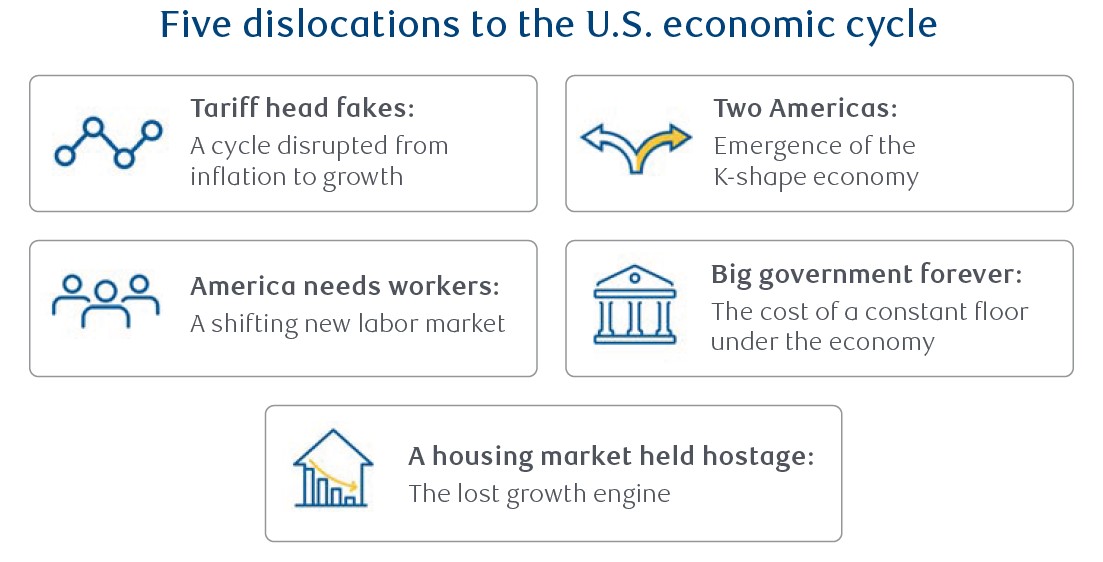
1. Tariff Head Fakes: Distorted Data, Hidden Risks
Trade policy is creating serious noise in the economic data. Century-high tariffs have triggered import surges, inventory swings, and volatility in GDP readings. In early 2025, imports spiked as businesses raced to front-run tariffs, temporarily inflating growth. Now, that buildup is unwinding, leaving weaker demand and a lingering inventory overhang. Over the next year, tariffs can push prices higher and slow job growth — a “stagflationary” combination. Meanwhile, companies are spending heavily to reconfigure supply chains, a process that makes it unclear whether they are spending from a position of strength or out of structural need. For investors, the message is clear: headline GDP and inflation numbers are noisy. Focus instead on domestic demand and sector-level profit trends to gauge true economic momentum.
2. Two Americas: A K-Shaped Consumer Economy
The U.S. consumer remains the backbone of growth — but not all consumers are participating equally. Wealthier households have benefited from rising asset prices and higher interest rates. Lower- and middle-income Americans, meanwhile, are struggling with higher rents, food prices, and slowing wage growth.
This divergence means soft data (like sentiment surveys) reflects stress, while hard data (spending and sales) looks much stronger — because the proportional volume of spending is driven by high-income consumers.
For markets, this creates a critical gap between perception and reality. Consumer-facing companies serving affluent customers may continue to outperform, while middle-market retailers face pressure. For investors, it serves as a reminder to understand who the customers are of a company and whether sales will continue to be well supported under various economic scenarios.
3. America Needs Workers: The New Labor Market Reality
The labor market looks tight with less available workers to fill job openings. Retirements are accelerating and immigration remains low. Job creation has slowed sharply, yet unemployment remains near historic lows. The takeaway: the economy needs fewer new jobs to stay fully employed. That makes traditional signals — like a rising jobless rate — less useful in predicting downturns. For investors, this also points to sticky wage inflation which can keep core inflation elevated even as growth slows. It will be important to focus on companies that have pricing power, control costs, and able to maintain margins.
4. Forever Big Government: Fiscal Guardrails and Market Tensions
Federal spending is running at or near historic highs, and the nature of fiscal policy has shifted. Instead of stimulus that only kicks in during recessions, today’s spending is largely pro-cyclical, supporting the economy even during expansions.
This “fiscal floor” keeps downturns shallow. Meanwhile, monetary policy (interest rate policy) appears ineffective as long term yields and borrowing rates stay elevated despite the government cutting interest rates. For investors, this environment suggests government spending is more influential than monetary policy. For bond investors, this means the bond market is cares more about a company’s ability to service and pay their debt. The result should be a preference towards quality and liquidity in bond portfolios.
5. A Housing Market in Deep Freeze
Housing, once a reliable economic engine, is now frozen. Existing home sales are hovering near post-financial-crisis lows, and affordability has collapsed. Yet home prices remain high — sustained by limited supply and the “lock-in” effect, where homeowners cling to ultra-low pandemic-era mortgage rates.
This structural freeze makes housing a weaker leading indicator of the cycle. Rate cuts may not reignite demand, as most borrowers are unlikely to refinance if they already have a low mortgage rate. Instead, investors may consider watching rental markets and regional housing differences — particularly as aging demographics reshape where and how much Americans are willing to spend on housing.
Investment Takeaways: Seeing Through the Noise
The U.S. economy isn’t immune to slowdowns— they’ve just become harder to see. Beneath the surface, growth is slowing, inflation is sticky, and structural distortions are clouding the usual data. For investors, that means adapting to a more nuanced and uneven landscape.
Portfolio positioning in this environment should emphasize:
- Quality and resilience: Companies with strong balance sheets and pricing power.
- Selective cyclicality: Seek special opportunities in trade-exposed and inventory-sensitive sectors.
- Duration discipline: Caution on long-term assets and bonds until yields and inflation stabilize.
- Inflation hedges: Maintain exposure to real assets and commodities that historically serve as a hedge to inflation.
The cycle is far from over. The result thus far has been an economy that is far stronger than anyone expected just 6 months ago. However, the challenge for investors is to not get overconfident in the headlines of resilience; rather, understand that a process of risk management is still needed more than ever