

Unemployment levels can be a popular indicator that people use to evaluate the overall health of an economy. Naturally, people assume a low unemployment rate indicates a good economy and in turn, a robust stock market. However, it is important to point out that the health of an economy and the direction of the markets do not necessarily move in tandem. The key reason is that economic indicators like the unemployment rate are “backward looking” whereas the stock market is reflecting the future expectations of the economy
A deeper dive into the unemployment rate and the returns of the S&P 500 produces some surprising results. Looking back at history, periods of low unemployment levels have actually been less favourable to the equity markets. Since the 1950s, the S&P 500 earned an annualized return of 12% when the unemployment rate was above the historical average. This is in contrast to an annualized return of 6% when the unemployment rate was below the historical average.
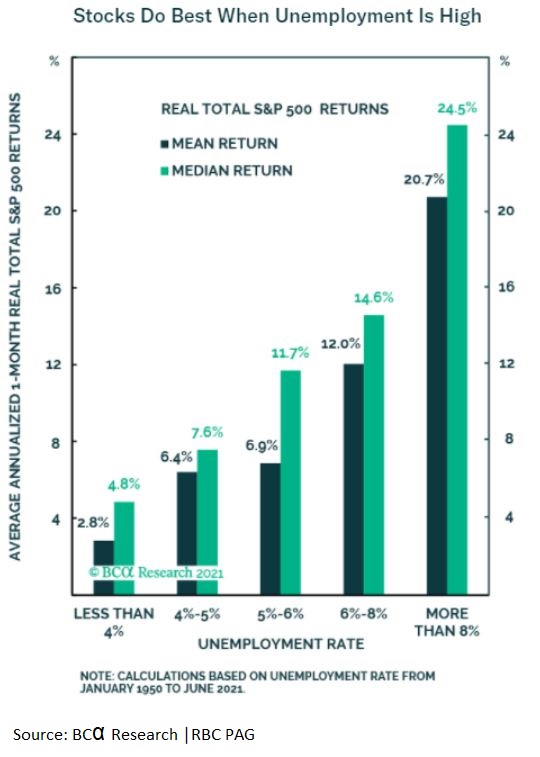
There can be a couple of reasons to explain this:
1) Unemployment is usually the lowest when the economy is the strongest. However, a stronger economy can coincide with higher inflation which can encourage the Fed to engage in monetary tightening in order to cool the economy. As a result, the stock market will price in the expectation of slower economic growth, which can lead to decreased market returns.
2) When unemployment is low, market valuations are generally already at elevated levels. Hence, future returns may be more muted and the increased opportunity for downturns and corrections.
We believe it is very important to not look at the unemployment level within a vacuum, but from a more forward-looking perspective. The Portfolio Advisory Group of RBC DS has noted that equity markets tend to perform the best when unemployment is high yet falling. This reflects an improving and expansionary economy. On the other hand, stocks do not fare as well when unemployment is low and rising, which could be signaling a potential retraction in the economy. At this current moment, unemployment is still higher than the pre-Covid levels of February 2020. Fortunately, the rate is trending lower and this points to a more optimistic view in the medium term.