

Investing and experiencing space is no longer a longshot. 2021 has already seen some tremendous milestones in terms of space exploration, a feat that was previously limited to large national space agencies. Although NASA’s Perseverance rover made a historical landing on Mars in February, private companies have also made significant progress. Space X successfully launched its first crewed mission to the International Space Station in April, and recently on July 11, Richard Branson (founder of Virgin Galactic) made a short trip to Space aboard his own ‘rocket plane’. This marks the beginning of the commercial space tourism industry, with Jeff Bezos’ Blue Origin and Elon Musk’s SpaceX slated to offer flights for purchase later this year.
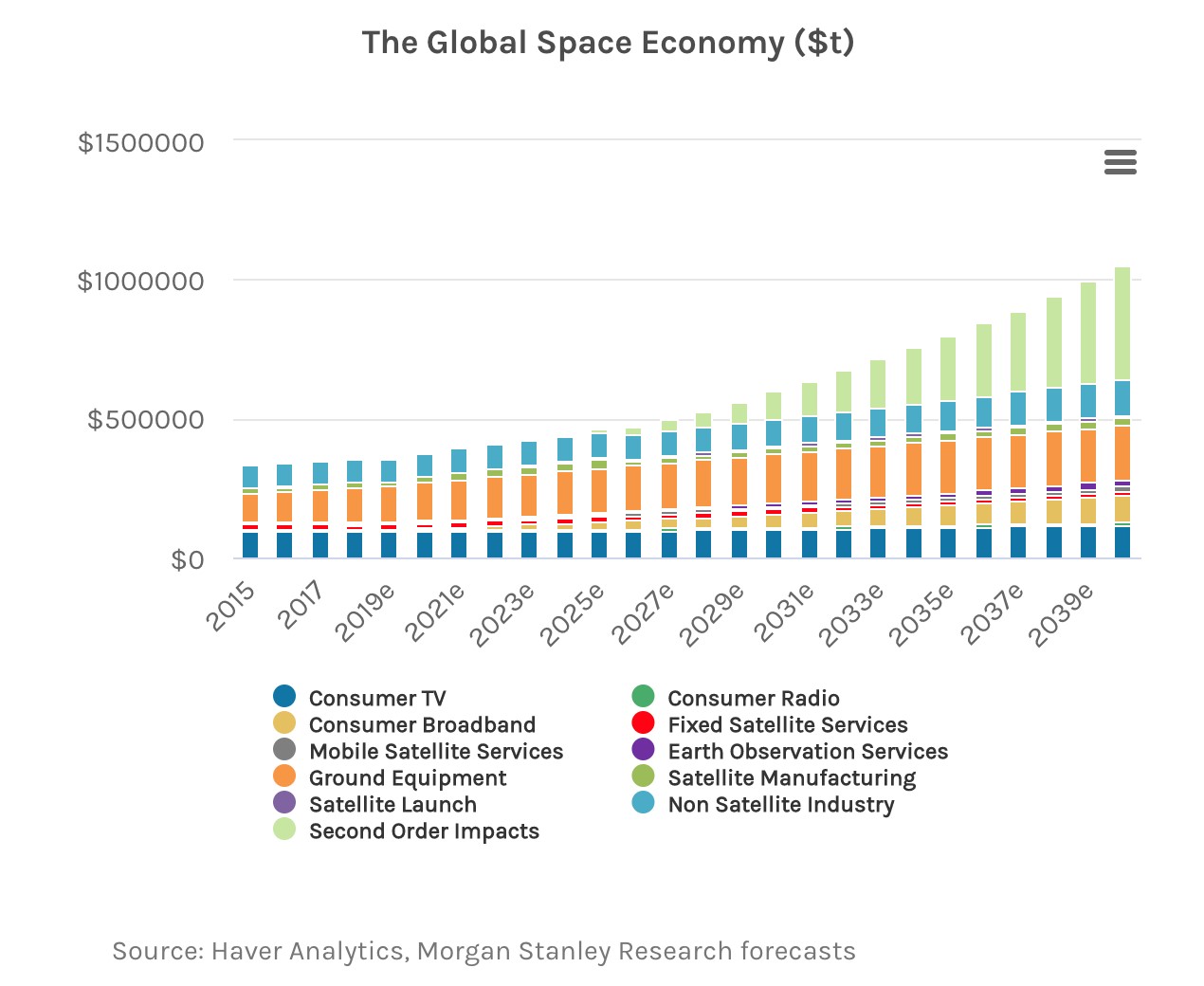
While most industries experienced lulls because of COVID-19, a report by the venture capital firm, Space Capital, stated that space industry investments reached USD $25.6 billion in 2020. This is the third-highest in the decade. The interest in space is likely to continue, as Morgan Stanley estimates that the global space industry could generate revenue of more than USD $1 trillion by 2040.
Cathie Wood, founder, and CEO of Ark Invest, has also picked up on this trend, launching the ARK Space Exploration & Innovation ETF earlier this year. The fund aims to invest in “leading, enabling, or benefitting from technologically enabled products and/or services that occur beyond the surface of the Earth.”
Although there are currently only a few publicly traded space companies there are more planning to go public. SPACs (Special Purpose Acquisition Vehicles) are likely to be a popular route for space companies to quickly access public markets, as Virgin Galactic went down this route in late 2019.
At present, investors have a few different options to gain exposure to the growing space industry. Although there are not many publicly traded companies involved in space tourism, the space industry is diverse. For example, investors can look at publicly traded defense contractors that develop aeronautics, mission systems, and space systems for the purpose of national security. There are also investment opportunities through satellite imaging and communication providers. Many of us may forget that many communications companies rely on a constellation of low earth-orbiting satellites. Finally, there are many companies that serve as vital inputs and services in space R&D including semiconductors, systems testing, design software, GPS, laser, and optical technologies. As always, speak to your advisor if you are curious about thematic investment themes like the space industry and are looking for ways to diversify your portfolio.