

- Interest rate “pause” is over for the time being as Bank of Canada surprises with a rate hike.
- Resilient economy (and real estate market) likely forced Bank of Canada’s hand and markets suspect the Federal Reserve is next.
- Short term, higher yields put pressure on bonds, but in due course they come due at 100 cents on the dollar, known as “par”.
- Long term, it sustains the best fixed income opportunities we have seen in years, rewarding savers after a decade of challenges.
- This certainty and ability to map cash flows is one of the reasons we prefer segregated bonds.
- The discounted bond opportunity continues to thrive, with tax-adjusted returns the likes we haven’t seen in a long time.
Bank of Canada presses “play” on further rate hikes
This past week saw a resumption of interest rate increases out of the Bank of Canada. The Bank of Canada was the first major central bank to signal a “pause” in its rate hiking cycle, waiting to see what the impact of a cumulative 4.25% of interest rate increases had wrought. Apparently they didn’t like what they saw, as employment and consumption remained strong. Perhaps most importantly, housing prices (and to a lesser degree sales activity) came roaring back, with many thinking a cessation of rate hikes was a flashing red “buy” signal, and we suspect this as much as anything else tipped the Bank to act, in a move that surprised markets and provoked a strong reaction in the bond market.

In the short term, bonds are under pressure again…
As seen above, 5-year bonds yields have accelerated in recent weeks as economic data pointed to economic resilience, with the Bank of Canada followed up on with this week’s rate hike. In the short term, these higher bond yields put pressure on bond prices, though we would note that the 5-year Government of Canada yield has been in a wide trading range since mid-2022. With yields now near their cyclical highs, savers are getting yet another opportunity to put excess cash to work in the bond market at yields unseen in over a decade.
…In the long term, they come due at par!
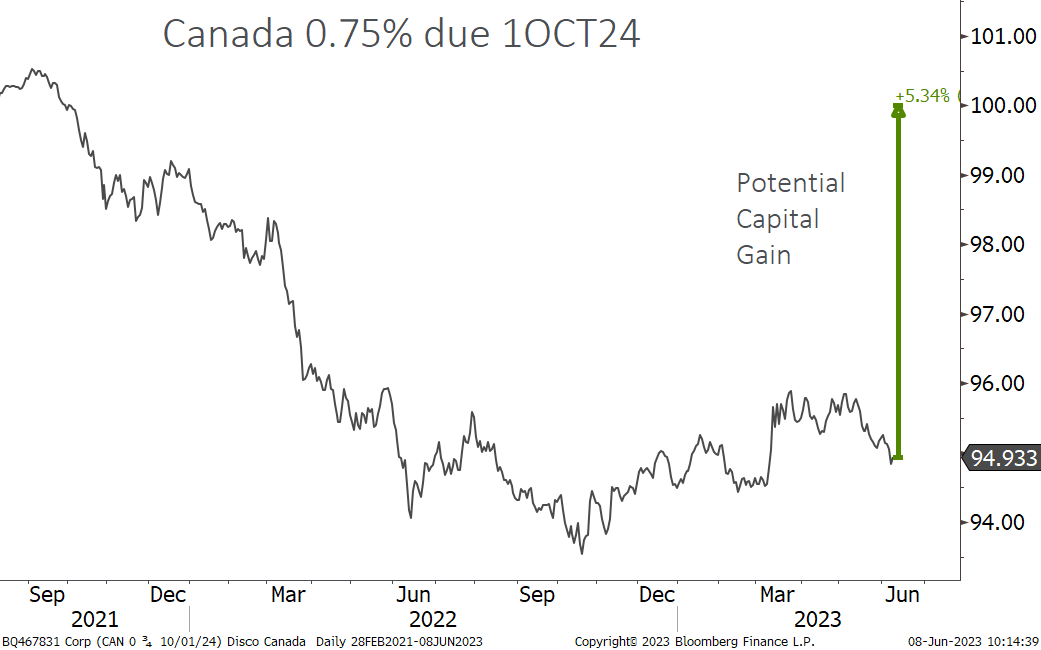
Despite all of the volatility and stress created by the bond market in the past 18 months, one rule has held true – barring an issuer default, no matter what happens to their price in the interim, bonds mature at par, or 100 cents on the dollar. While price moves can be disconcerting, the great feature of holding individual bonds in our portfolios is that we can map out their cash flows and maturity values. This not only provides peace of mind in the midst of volatility, but can also allow us to match cash flows with anticipated expenses.
Why are so many bonds trading under their par value?
After many years of being unable to find bonds trading near par, today we face the opposite issue. Most bond are trading at discounts to their par value, which is terrific from a tax perspective, but more challenging for those seeking current cash flow. That will be rectified in time as more bonds are issued at today’s higher yields, but for now, discounted bonds dominate. Why are so many bonds today at a discount (trading under 100 cents on the dollar)? Simply put, these are old bonds which were issued when yields were very low. In order to entice a buyer at today’s higher yields, these bonds need to offer a capital gain (in the form of a starting price under 100 cents) on top of the interest to bring the return potential in line with today’s new bonds.
A great time to re-evaluate cash holdings
While we think that in the fullness of time, stocks will outperform even today’s attractive yields, this doesn’t mean there is no action to take. With GIC and high interest savings accounts significantly lagging the recent move in bond yields, we feel it is an opportune time to move out of those instruments and into the bond market; this is true even for short terms of under one year. As an added bonus, the fact that nearly all short-term bonds are discounted today means that there is a tax advantage for investors who invest in discounted bonds and hold them to maturity. A portion (sometimes a large portion) of the return has the potential to be treated as a capital gain, resulting in an after-tax return that can be significantly ahead of what is available on a GIC, with the added benefit of market liquidity as bonds can be sold at any time. This is not to say it will be a smooth ride form here – central banks have proven they can be unpredictable, and this will keep volatility in the bond market elevated. However, for those invested in high quality bonds, we feel today’s opportunities are quite attractive for those who can remind themselves that their bonds will come due at par.
The Harbour Group
416-842-2300
Putting you first, every time, to help you navigate the complexities of managing your wealth. All of our team members, all of our resources, all of our collective insight: ALL FOR ONE: YOU™.
Please note: This article may contain strategies, not all of which will apply to your particular financial circumstances. The information in this article is not intended to provide legal, tax or insurance advice. To ensure that your own circumstances have been properly considered and that action is taken based on the latest information available, you should obtain professional advice from a qualified tax, legal and/or insurance advisor before acting on any of the information in this article. This document has been prepared for use by the RBC Wealth Management member companies, RBC Dominion Securities Inc. (RBC DS)*, RBC Phillips, Hager & North Investment Counsel Inc. (RBC PH&N IC), RBC Global Asset Management Inc. (RBC GAM), Royal Trust Corporation of Canada and The Royal Trust Company (collectively, the “Companies”) and their af liates, RBC Direct Investing Inc. (RBC DI) *, RBC Wealth Management Financial Services Inc. (RBC WMFS) and Royal Mutual Funds Inc. (RMFI). *Member-Canadian Investor Protection Fund. Each of the Companies, their af liates and the Royal Bank of Canada are separate corporate entities which are af liated. “RBC advisor” refers to Private Bankers who are employees of Royal Bank of Canada and mutual fund representatives of RMFI, Investment Counsellors who are employees of RBC PH&N IC, Senior Trust Advisors and Trust Of cers who are employees of The Royal Trust Company or Royal Trust Corporation of Canada, or Investment Advisors who are employees of RBC DS. In Quebec, nancial planning services are provided by RMFI or RBC WMFS and each is licensed as a nancial services rm in that province. In the rest of Canada, nancial planning services are available through RMFI, Royal Trust Corporation of Canada, The Royal Trust Company, or RBC DS. Estate and trust services are provided by Royal Trust Corporation of Canada and The Royal Trust Company. If speci c products or services are not offered by one of the Companies or RMFI, clients may request a referral to another RBC partner. Insurance products are offered through RBC Wealth Management Financial Services Inc., a subsidiary of RBC Dominion Securities Inc. When providing life insurance products in all provinces except Quebec, Investment Advisors are acting as Insurance Representatives of RBC Wealth Management Financial Services Inc. In Quebec, Investment Advisors are acting as Financial Security Advisors of RBC Wealth Management Financial Services Inc. RBC Wealth Management Financial Services Inc. is licensed as a nancial services rm in the province of Quebec. The strategies, advice and technical content in this publication are provided for the general guidance and bene t of our clients, based on information believed to be accurate and complete, but we cannot guarantee its accuracy or completeness. This publication is not intended as nor does it constitute tax or legal advice. Readers should consult a quali ed legal, tax or other professional advisor when planning to implement a strategy. This will ensure that their individual circumstances have been considered properly and that action is taken on the latest available information. Interest rates, market conditions, tax rules, and other investment factors are subject to change. This information is not investment advice and should only be used in conjunction with a discussion with your RBC advisor. None of the Companies, RMFI, RBC WMFS, RBC DI, Royal Bank of Canada or any of its af liates or any other person accepts any liability whatsoever for any direct or consequential loss arising from any use of this report or the information contained herein. ®/TM Registered trademarks of Royal Bank of Canada. Used under licence. © 2024 Royal Bank of Canada. All rights reserved. NAV0281