

Below is a summary of some of the relevant news items from the Capital Markets and the Economy from the past week extracted from RBC Global Insights and FactSet Research.
You can catch up on the past four weeks’ Weekly Update in the link to my Blog.
Read my latest Smart Investor newsletter on my website. The Q1 2026 edition covers Market Review for the year 2025, some long-term themes that drive investments, and how to achieve a balanced approach to wealth and health. Shiuman’s Corner covers the books I read last year.
Markets
Market scorecard as of close on Friday February 6, 2026.
| Country | Equity Indices | Level | 1 week | YTD |
| Canada | S&P/TSX Composite | 32,377 | 1.4% | 2.1% |
| U.S. | S&P 500 | 6,916 | -0.3% | 1.0% |
| U.S. | NASDAQ | 22,967 | -2.1% | -1.2% |
| Europe/Asia | MSCI EAFE | 3,029 | -0.5% | 4.7% |
Source: FactSet
- TSX finished sharply higher in Friday afternoon trading, near best levels. Most sectors higher. Materials the leader. Canadian equities rose 1.4% on a weekly basis.
- US equities finished higher in Friday trading, ending near best levels and more than reversing Thursday's sharp declines. S&P 500 finished little changed for the week and Nasdaq was lower, while Dow and equal-weight S&P logged fresh all-time highs. Software rebounded after struggling this week.
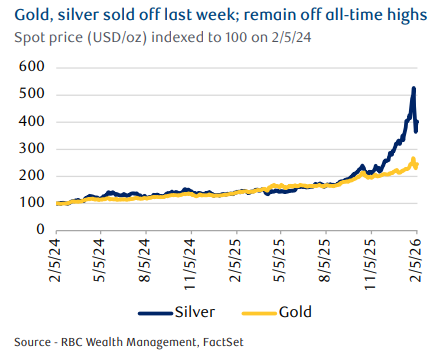
- The S&P/TSX Composite started the year strong with continued momentum out of the Materials sector. Following the brief rally, the index has given up much of those gains as a retracement in gold and silver dragged down mining equities. The selloff in precious metals was in part attributed to the announcement of Kevin Warsh as the U.S. Federal Reserve Chair nominee, a candidate markets perceived as credible, which softened fears around the U.S. dollar and inflation.
-
- ECONOMY
- Canada
- Canada’s economy saw no growth in November compared to the prior month, as contractions in goods-producing industries offset expansions in services-producing industries. The Canadian economy continues to endure headwinds from global supply chain disruptions, which have driven contractions in the manufacturing and the agriculture, forestry, fishing, and hunting sectors.
- Canada shed 24,800 jobs in January. The decline was the steepest since August, led by Ontario’s labour market that lost 67,000 jobs. Canada’s most populous province has been among the hardest hit by U.S. tariffs targeting the auto and manufacturing sectors. Nationally, manufacturing jobs have fallen 51,000 since January 2025. The unemployment rate fell to 6.5% as fewer people searched for work, Statistics Canada data shows.
- As Bank of Canada policymakers seek to balance a fragile output outlook with underlying inflation trends that remain slightly above target rates, futures markets currently anticipate no changes to the benchmark rate in 2026.
U.S.
- President Trump announced plans to secure domestic critical mineral supply. As another part of the administration’s reshoring efforts, Project Vault will receive nearly $10B in loans from the U.S. Export-Import Bank, along with private equity investment, to strengthen the domestic critical mineral supply chain.
- On Kevin Warsh, the U.S. president’s pick to be the next Chair of the Federal Reserve:
-
- Warsh’s reputation is largely that of a traditional “hard money hawk,” which naturally has raised eyebrows given Trump’s very public—and unambiguous—desire to see interest rates lowered.
- Our view had been that regardless of who replaced Powell, the power within the FOMC was likely to shift to the voting members and away from the chair, simply from the nature of the process thus far.
- Fed decisions this year will be determined based on the incoming data, but as a new Fed chair is a relative rarity throughout history, it will almost certainly come with its own uncertainty for markets to navigate.
Further Afield
- The European Central Bank (ECB) remains in “a good place” according to ECB President Christine Lagarde, and the central bank unanimously voted to maintain the deposit rate at 2%—in line with expectations.
- China’s economy has endured a weak start to the year, bolstering the case for the People’s Bank of China (PBoC) to ramp up policy support, especially with the Lunar New Year approaching in the coming weeks.
- Japan’s Nikkei hit a record high on Monday in response to Prime Minister Sanae Takaichi’s Liberal Democratic Party supermajority election win this weekend. Takaichi, a hardline conservative who called the snap election after just three months in office to capitalize on her popularity, earned a fresh mandate from voters to push through her fiscal expansion agenda. The LDP, which now has a two-thirds majority in the lower house, can override votes in parliament’s upper house and propose constitutional amendments.
Notes About Companies in Model Portfolio
- Alphabet (GOOG) reported Wednesday 2025 Q4 earnings with net income of $34.455 billion for Q4 up 30% from a year ago. Full year net income of $132.17 billion, up 32% over FY 2024. The AI Gemini App has grown to over 750 million monthly active users.
- Eli Lilly (LLY) reported Wednesday 2025 Q4 financial results with revenues of $19.3 billion in Q4, up 43% driven by volume growth from Mounjaro and Zepbound. In Q4 2025, net income and earnings per share (EPS) were $6.6 billion and $7.39, respectively, compared with net income of $4.4 billion and EPS of $4.88 in Q4 2024. For Q4 2025, worldwide Mounjaro revenue increased 110% to $7.4 billion.
Feel free to contact me with any questions and/or to discuss investment ideas.
Regards,
Shiuman
PS: To unsubscribe, simply reply with “Unsubscribe” in the subject line.