

A (sometimes) regular compendium of my current thoughts on markets, the economy, and other random marginalia.
Missives & Marginalia
July 2nd, 2021
My second COVID vaccine happens on Monday. The process was seamless to book, and seamless to re-book when I realized I had set myself up for a Canada Day vaccination. But for now I’m sitting at the cottage with Leila eating grandma-prepared orange slices, thankful for the semi-return to normal that Moderna, Pfizer, and AstraZeneca (and all of the researchers at institutes and universities supporting their work) have given me. We spent basically the whole day in the water yesterday escaping the heat and spent the lion’s share of today doing the same, at the other grandparents’.
Things are healing
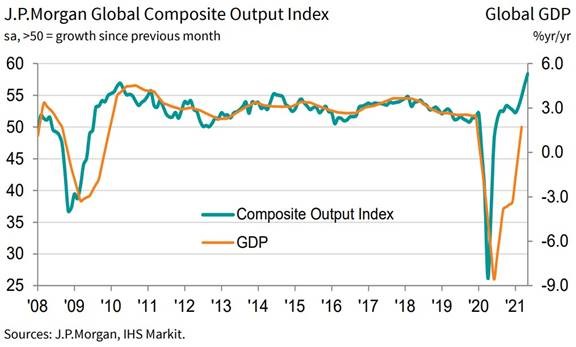
Apologies if you’ve had a portfolio review with me in the last few months, as you’ve likely heard and seen some of this information already. I am cribbing directly from my meeting slides for this note. The most common thing everyone wants to know these days (and I don’t blame them) is: when does the music stop? I try not to be flip about it. Altitude sickness when markets are rising is a real thing, and can even be the cause of markets reversing course. And, there are certainly sectors and individual companies that have risen past any probably earnings growth should support. Priced for perfection, any stumble could be the catalyst for them to test out what significantly weaker performance looks like. But the economy in general? I think the general consensus is that open economies are going to be more productive than closed ones. And economies are opening. Quickly. As the chart below demonstrates, purchasing managers at businesses the world over have decided that the consumers they sell to are going to be flush and excited to buy their products. For context, compare to the 2008/09 recession.
When making these decisions, these allocators are almost certainly looking at the massive amount of cash that consumers the world over have accumulated over the past fifteen months. While countless people fell through the cracks, and help was more uneven that one might hope, in the aggregate people were kept from the worst outcomes through huge government cash transfers (CERB, CEWS, etc.). At the same time, those of us whose jobs proceeded apace in our home offices and kitchen tables found our jobs productive, and we had nothing to spend money on. Because of this, consumer savings are at unprecedented levels in most of the rich countries of the world.
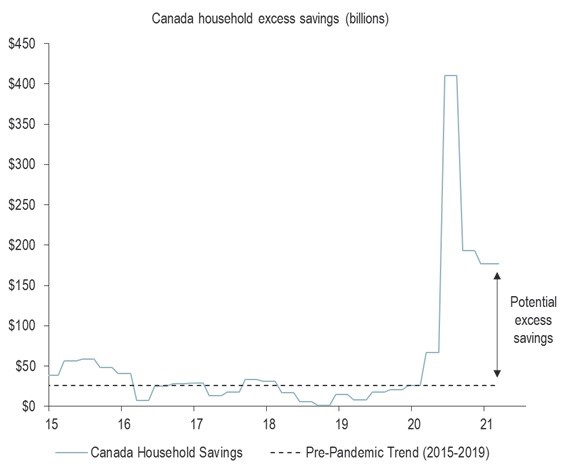
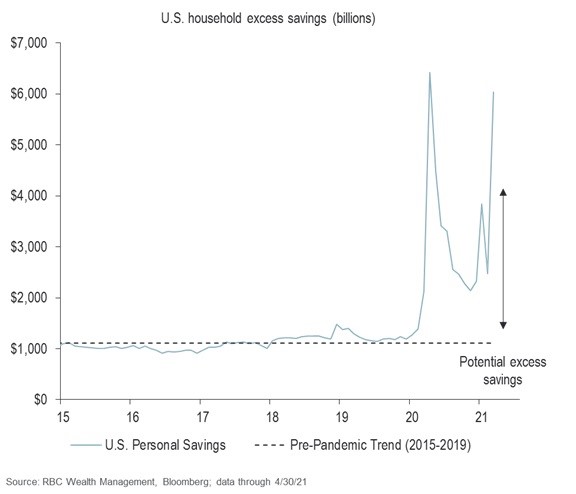
Basically, we all have a tonne of cash sitting in our collective bank accounts that would otherwise have been spent on vacations, celebrations, restaurants, and recreation, along with downtown parking, new clothing (the non-sweatpant variety, anyway), and business travel. As this cash is deployed, there will likely be two effects: mild inflation, and extreme GDP growth. Inflation is the boogeyman stalking everyone’s investment decisions right now, but so far central banks seem pretty comfortable being extremely dovish and supporting reopening and recovery over trying to calm down overheating economies. The next 12-18 months, while volatile and painful in localized parts of the market, should prove to be extremely productive. We’re looking for global earnings to grow double-digits, something I have as yet never seen in my career, at least in a coordinated fashion around the world.
But don’t take it from me. Our friends across the RBC Wealth Management strategy teams have put their Mid-Year Outlook together, which can be found here: 2021 Midyear Outlook. As usual, it is an excellent publication. This issue, they highlight some history lessons that they think are pertinent to the current conditions, some things to watch out for, and their thoughts on where they think everything is going over the next year or so.
Marginalia from around the web
- What the Crypto Crowd Doesn’t Understand About Economics (Tyler Cowen, Bloomberg). Anyone who spends any time on Finance Twitter or any of the various investing subreddits will appreciate that there are some very smart people there, as well as at least as many people who apply 2/3 of a concept to prove some sweeping generalization.
- How moving back in with my parents during the pandemic healed our relationship (Raegan Hedley, P.S. I Love You). Reggie is a wonderful local writer, and I found this piece especially poignant. Dragged back from Australia by illness, Reggie moved in with her parents and was effectively trapped in that situation for a half year.
- What Did COVID Do to Friendship? (June Hu, The New Yorker). In a similar vein, this is a really good article. I think a lot of us found that one thing COVID brought was a re-evaluation of some of our prior relationships, as well as a number of new—often quite unexpected—ones. What will stick and what will we drop when the world gets a little more normal?
- California’s yoga, wellness and spirituality community has a QAnon problem (Laura J. Nelson, LA Times). As we exit COVID lockdowns and navigate the world beyond them, I feel like a lot of people have one question at the back of their minds: what about that friend? The one whose initially completely valid concerns, questioning, and criticism cross the line to extreme conspiracy theory. There are no solutions here, but root causes help find understanding.
- Podcast: The Invention of Hydration (Decoder Ring, Slate). Leila can’t leave the house for 10 minutes without a water bottle, so I definitely listened to this podcast in parental horror for the pain I’d put myself through, maybe for no reason at all. Another fun Decoder Ring episode, if you want: The Soap Opera Machine.
- Podcast: The LSE’s Minouche Shafik on How to Fix Our Broken Society (GZero World with Ian Bremmer). Ian Bremmer, head of the Eurasia Group, interviews the Economics Director at the London School of Economics about a range of topics, including her skepticism over Universal Basic Income schemes.
- Podcast: Shorts—Hallie (Heavyweight w. Jonathan Goldstein, Gimlet)
- Twitter Thread: (click the image for the full thread and a great Canadian story that I honest-to-God want to see made into a feature-length movie)