


Woah, Cowboy! Steady!
This past week is one I think we all would like to forget. Volatility jumped meaningfully higher and stocks sold off in the worst week for global equity markets since the end of March, when the pandemic was in its infancy. The second wave of COVID-19 continues to spread in a much more rapidly than even pessimists anticipated. The situation is particularly troublesome in Europe but is also concerning in the U.S., while Canada is faring a bit better. The market selloff is understandable as the trajectory for the global economy and corporate earnings is now at greater risk of faltering over the next few months. Some market commentators rightly opined that the market was “priced for perfection” so any stumbles would be amplified in stock prices. That said, I think the situation today is sufficiently different than the winter and spring. Below, I'll lay out the thesis.
First, a COVID-19 update
Paris has become the epicenter of Europe’s COVID-19 health crisis, with daily cases topping 50,000 over the past week. To put things into perspective, France has a similar number of new daily cases to the U.S. but only accounts for a fifth of the population. In an effort to limit the spread and rising pressure on its health care system, France announced it will re-impose a national lockdown until the start of December, and has banned all public and private gatherings. Its European neighbours are also fighting significant increases in infections with cases continuing to climb in Germany, the U.K., Belgium, Italy, Czech Republic and Spain. All are either considering or have already implemented some restrictions, but more may be needed should the trends not change soon.
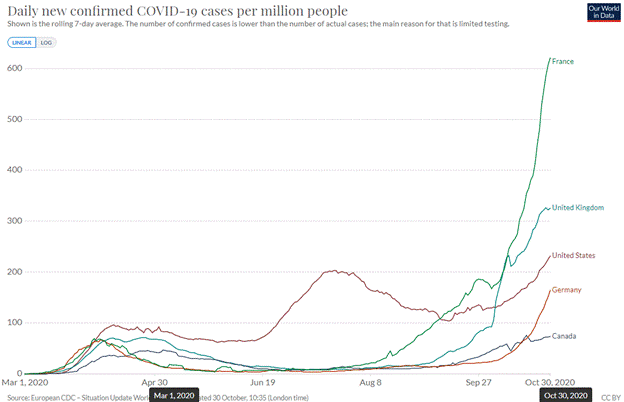
In the U.S. there were roughly 500,000 new COVID-19 cases over the last week. There has been a big surge in cases from the American heartland. And deaths are up to their summer levels again. The U.S. never truly left their first wave behind, and this is their third spike in cases (where most countries are only facing their second). Illinois is currently seeing the highest absolute number of new daily infections in the country. Meanwhile, smaller states such as the Dakotas and Wisconsin rank as having the highest numbers of new infections on a population adjusted basis. The latter recently set up a field hospital because of capacity constraints on the state’s hospital infrastructure. Wisconsin is currently averaging 32 deaths a day from COVID-19. As bad as we feel here, Manitoba would have to have had 425 deaths in October alone to equal to toll that North Dakota is currently facing.

In Canada, the trend does not appear to be as bad as some other regions. The moderation in new infections witnessed recently did not continue over the past week. Instead, the growth rate in new daily cases accelerated with the 7 day moving average of new infections sitting at just over 2700 versus the 2400 from a week ago. Nevertheless, there is some good news. The East Coast continues to see few signs of problems. Meanwhile, Quebec saw its peak in new daily cases about three weeks ago, though the number of new infections still remains the highest in the country. In Ontario, the new infection rate did rise this week. But, the fastest rate of growth continues to lie outside these big provinces, with British Columbia and Manitoba leading the way, followed by Alberta and Saskatchewan. A few of these provinces are contemplating additional new restrictions to stem the virus’ spread.
Differences versus the spring markets
The virus trends have understandably reignited the feelings of anxiety, exhaustion, stress, frustration, and concern that most people shared during the initial wave in late winter and early spring. Investors on the other hand remain preoccupied with the risk this wave poses to economic and earnings growth, both of which were expected to rebound in the not too distant future. That forecast is now in jeopardy as the restrictions imposed by governments in various parts of the world will weigh on growth. Nevertheless, it seems the current situation is markedly different than the spring. I believe there are a number of reasons why.
1. More experience: While the pressure on health care systems is mounting in certain areas, the level of fatalities remains below levels seen earlier this year despite the substantially higher number of current cases. A combination of better preparedness, experience, therapeutics, and the sheltering of vulnerable people has led to this improvement in hospitalization and fatality rates.
2. Range of containment measures: Governments are likely to employ less draconian measures than used earlier in the year unless the situation reaches an extreme, as it has in France. Even here, we expect to see progress over the next month. Israel serves as a good comparison. It went into a nationwide lockdown nearly 5 weeks ago, and has seen its new daily infections decline by over 90%. Admittedly, it has come with a heavy economic cost.
3. The stability of the financial system: The financial system is much better prepared today with central banks having aggressively lowered rates and employed a variety of means to ensure the proper functioning of credit markets. Access to capital should present less of a challenge.
4. Government aid: Furlough programs, debt relief, rent deferrals, loans and guarantees, business subsidies, and income support are just a few of the various ways governments have stepped in to offer support to households and businesses impacted by the pandemic. Chrystia Freeland was clear that the taps aren’t being turned off, and I expect additional aid going forward given the anticipated impact from renewed restrictions.
5. Vaccines: Hundreds of vaccines are being studied and more than a handful are in clinical trials with some expected to release data in the coming months. There is no guarantee, but given the coordinated efforts by the global scientific community, I remain hopeful that a vaccine will be available for mass distribution in 2021.
6. We probably don’t need to be 100% clear to be better: If, say, a vaccine was approved late this year, and if only 10% of the population could be vaccinated in the first few months of 2021, we couldn’t go back to life as usual. We’ll still likely be wearing masks, and we’re not going to concerts or hockey games. But if a vaccine is distributed equitably (more likely in a country like Canada than one like the U.S.), we could start to creep back into normal life knowing that the most vulnerable were safer. Any uptick in travel, business, and commerce would be viewed optimistically.
The near-term has become more uncertain in the wake of the accelerating virus spread. Compounding the challenge for investors is next week’s U.S. election. Any clear and final outcome, whatever it may be, would be a welcome development for investors as it would remove one source of uncertainty. A contested outcome on the other hand, or one that remains unclear for days if not weeks, would likely add to the volatility that has already weighed on markets of late.
Nate Silver has updated the 538 Presidential Forecast to 89% probability for Biden, 10% for Trump. Similar polling has been put forward by the Economist, Fox New, and others.
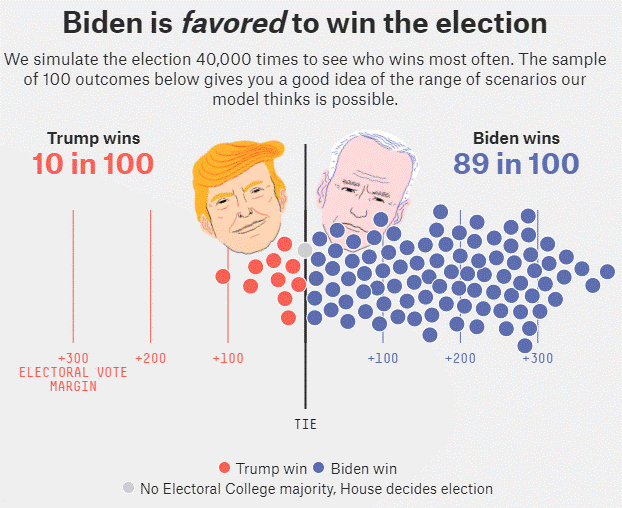
Remember, we likely won’t know on election night who the winner is, and that uncertainty is sure to cause market dislocation. And remember as well, the lesson from 2016—10% isn’t 0%, and a possible Trump win is something that while we find as unlikely as Nate does, is important to consider when building portfolios. You wouldn’t get on a plane that landed 89% of the time, and you shouldn’t position portfolios as if 10% is an impossibility.
On a final note, we can’t help but remind ourselves of March 23rd, 2020. This date marked the low for global equity markets this year. A significant market recovery unfolded in the days and weeks thereafter. Yet, at that time, anxiety levels were high and it seemed like there was no end in sight for the spread of the virus. It serves to remind us that timing a recovery, or a setback for that matter, is nearly impossible given human emotions that often get in the way. It is also too short-term sighted. Instead, focus on your longer-term needs and an investment plan that can help you accomplish your objectives. We see the prospects for less uncertainty with the passage of time.
Global Insight Weekly
RBC Wealth Management has their weekly market roundup posted, and this week it's quite informative:
· Global equity sell-off
· Bank of Canada tweaking asset purchases
· The upside of U.S. volatility spikes
· U.K. markets actually look a little brighter
· China's 14th Five-Year Plan
Find it here: Global Insight Weekly
Marginalia From Around The Web
Explore The Ways Trump Or Biden Could Win The Election
(fivethirtyeight.com)
I mentioned the election modeling above, but if you want to pick the winner of any mix of states and see how the simulations change, 538 has a wonderful site for that. It might be useful if you’re watching the results roll in sporadically on election night and after. Link
The Real Reason There Was a Beer, Hand Sanitizer, Yeast, and Pasta Shortage
(Aaron Mak, Slate)
Stealing Aaron’s lede, it all came down to packaging. Read the article, though, for a fascinating rundown of unexpected cause-effect relationships. Link
A Very Old Man with Enormous Wings
(Gabriel Garcia Marquez, Translated by Gregory Rabassa)
Read along with me. He is one of my favourite authors, and I stumbled across this short story a month ago. It’s been sitting in my queue, and I’ve promised myself I’ll take the 20 minutes to read it this weekend. Link
New analysis shows ancient dogs and humans shared a surprising bond
(Sarah Wells, Inverse)
We all knew that dogs were the best (sorry cat lovers, but you know in your hearts I’m right). New research shows that we’ve been actively shaping dog evolution for basically as long as they’ve been with us. And dog evolution could tell us important clues about early human migration and even commerce. Link
#YouCanBeABCs from Sam
(YouTube)
This is the coolest thing I’ve seen all month. Six year-old Sam (no relation) sings a 2:31 rap song. If you’ve had a hard week, this is a little bit of light to bring to your day. I want to hire this kid for all the jobs. Link
Finally...
Forget your worries and build a snowman.
It’s working for Leila.

(The umbrella is to keep him from melting in the sun, apparently.)