

August Market Update
August was a volatile month for equities with most of the global indices finished the month in negative territory. S&P500 ended the month down 1.9% and S&P/TSX finished the month flat. On September 1st, US increased tariffs on imported goods from China by 5%.The bulk of China’s retaliatory tariffs won’t go into effect until Dec 15th, 2019. If an agreement is not reached at that time, the trade negotiations may mark the point of no return for the two countries.
A Strong Second Quarter Canada GDP
Canada GDP produced an annualized increase of 3.7% in Q2. There are quite a few bright spots in the economy in the second quarter GDP report.
· Employment increased by almost 250k over the first 6 months of the year and wage growth strengthened in Q2
· Foreign direct investment inflows had the strongest first half of a year in 2019 since 2013
· GDP-by-industry breakdown showed a strong (almost 3%) jump in ‘non-commodity’ industry output, mostly services
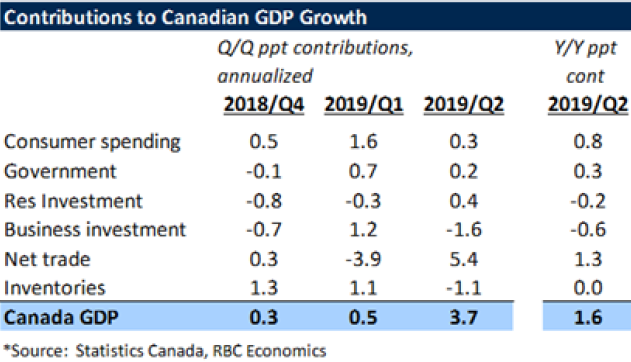
From a Bank of Canada perspective however, the strong second quarter GDP does not offset the externalities such as slower global growth and trade uncertainties. The base scenario is still for Bank of Canada to cut rates in line with the US and other global peers.
As USD strengthens, what is in store for the Loonie?
Despite the general USD strength, USD/CAD exchange rate has been unable to break above $1.3345. For clients with cash in USD, should they take advantage of the higher exchange rate into CAD or hold on to the USD as the stronger reserve currency?
There are many drivers for the directions of USD/CAD, the main drivers are:
- 2 year interest rate differentials between US and Canada. US has lowered federal funds rates while Canada has resisted the pressure to lower benchmark rates so far, the interest rate dynamic has been a force for stronger CAD
- The S&P500 and general USD direction. USD strength and weakness are driven by broader market factors other than direct relations with Canada. In times of uncertainty, the demand for USD tends to be higher
- WCS – WTI price differentials for the Canadian and US crude benchmark. The loonie’s correlation with crude prices still hold albeit to a weaker extent
RBC Capital Markets have decomposed the main currency drivers for USD/CAD to provide a breakdown of how each factor has influenced currency movements.
USD/CAD underlying drivers decomposed
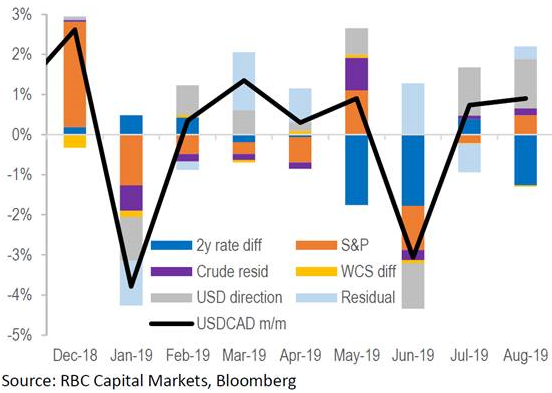
The base scenario is still for Bank of Canada to hold off on lowering interest rate until Q1 2020 but the risk of an earlier move has increased. The trade uncertainties and slower growth projections will likely place 1.30 as a floor for USD/CAD for the balance of 2019.
Rita Li works with high net worth individuals and families to provide tailored investment advisory service and wealth management planning. Her team comprises of professionals with in-depth taxation and legal expertise, together, they deliver a high standard of service to clients. Rita is a Chartered Financial Analyst CFA® and Certified Financial Planner CFP® with experiences at top ranked investment firms in Canada and HongKong. Rita has her MBA from Richard Ivey School of Business.
Contact Rita for a consultation to see if her services can be the right fit for you and your family.