

February Market Review
February was another strong month in the market. S&P500 was up 3.0% and S&P/TSX was up 2.9% respectively in February. World markets from Asia to North America have staged strong rallies since the market corrections in Q4 2018.
Major North American market indices are now within 5% of previous year’s market peaks. While I rejoice with my clients on the strong market rallies, it is worth noting we have priced in much of the optimism with respect to trade and interest rate expectations. We need to continue to be mindful of slowing economic growth and protectionist policies which fundamentally impede economic activities.
Given the current economic fundamentals, a 16.5x P/E and price target of 2850 for S&P500 is a reasonable target for 2019 in absence of stronger than expected earnings growth.
Is it possible to time the market?
The concept of timing the market comes up in conversations with clients from time to time. Questions such as: Over what time period should we deploy capital? Is it time to liquidate portfolio holdings? When do we rebalance the portfolio?
In terms of market timing, it is unrealistic to predict the price action of the market over a day or even a week. One key reason is that news of the day can dictate market action. In my conversations, I refer to historical performance as a benchmark for long term expectations. Studies have shown that when market participants try to time the market, they tend to produce subpar results.
The role of asset allocation
While timing the market is difficult, it is well within reason to make portfolio adjustments given fundamental assumptions of the health of the economy. While it is difficult to predict what the market will do over a day, it is possible to more reliably predict what the market will do over a longer term. By changing asset allocations tactically, we can stay nimble and position portfolios accordingly.
Optimizing asset allocation
From a long term perspective, a 60% stock and 40% bond portfolio will produce 2%[1] less in annualized return than a 100% stock portfolio using S&P 500 as the benchmark, however, the volatilities experienced in a “balanced” portfolio are much lower and this helps clients sleep more soundly at night.
Allow me to share a few stats from Fidelity Investments on market corrections. While the stock market historically has gone up more than it has gone down and over the long term S&P 500 has delivered a compound annual growth rate of 10%, market corrections are still very common:
- The historical odds of a 10% correction are 2 in 5
- The odds of a 20% “bear market” are 1 in 5
In other words, the market goes through corrections all the time yet still manages to deliver returns that, over the long run, are superior to a risk free asset.
Is it time to buy or to sell?
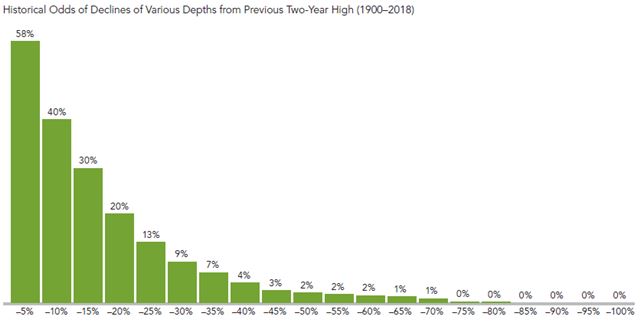
Source: Fidelity, Bloomberg Finance, LP, daily data from 1900 through 2018
Portfolio Recommendations
Given the strong price action in the markets in January and February, it is advisable to temper return expectations for the remainder of the year. The market recovery is also a great opportunity to discuss portfolio positioning strategies with your advisor.
Rita Li works with high net worth individuals and families to provide a high touch service in holistic wealth management planning. Her team encompasses professionals with in-depth taxation and legal backgrounds, together, they strive to deliver a high standard of service to clients. Rita is a Chartered Financial Analyst CFA® and Certified Financial Planner CFP® with expertise in asset management. Rita obtained her MBA from Richard Ivey School of Business. Contact Rita for a complimentary consultation to determine whether the services she provides can be the right fit for you and your family.