

The Markets
The TSX is down 0.2% for April and up 0.6% year to date.
The S&P500 is down 0.9% for April and down 5.5% year to date.
The NASDAQ is down 0.8% for April and down 9.6% year to date.
I am attaching our Global Insight Weekly dated May 1, 2025.
We have a 10 minute podcast entitled Forecasting in volatile times; are tariffs a game changer for growth and inflation? See link below.
Podcast: The 10-Minute Take - RBC Thought Leadership
Our latest article out on April 29 after the Federal Election on what’s ahead for Canada.
From our Portfolio Advisory Group (as of May 1, 2025)
The month of April has come and gone, and so too has some of the drama and market volatility resulting from the threat of a global trade war. Below, we discuss why the past month served an important lesson for investors. We also briefly address the Canadian elections and developments on the tariff front.
April saw wild moves but remarkably ended flat
Global stock markets finished the month close to where they started. That is an impressive feat given what transpired. More specifically, the global stock market fell nearly 10% during the first week of April as the U.S. unveiled its initial reciprocal tariff plan. The global market subsequently recovered those losses, finishing the month marginally higher in constant currency terms (i.e. ignoring the effect of the Canadian dollar, which itself moved higher). Moreover, bond yields and currencies also saw relatively large moves. Uncertainty remains elevated, but the past month should serve as a reminder that while periods of heightened volatility can be unnerving, it is best to resist the urge to react to the noise and avoid straying too far from targets in investment plans.
Canadian elections
Canada has elected a minority Liberal government. It is too early to discuss the implications for the short and long-term. Nevertheless, there are a few takeaways worth sharing. First, there is an expectation that this Liberal government will shift towards the centre and be more focused on economic than social policy. Beyond tariffs, the objectives at a high-level are expected to include lower immigration, the reduction of interprovincial barriers, and increased spending in areas like infrastructure, housing, resources and defense. Given its minority position, the Liberals are expected to negotiate with the Bloc Québécois and New Democrats, both of whom lost a number of seats in the election, to get policy pushed through. Near-term, Prime Minister Carney is expected to meet with U.S. President Trump to discuss trade and evaluate a range of potential concessions that could lay the groundwork for a new potential trade agreement between the U.S., Canada, and Mexico next year.
A de-escalation taking hold
The U.S. administration has been scaling back some of its trade demands recently. For example, many of the reciprocal tariffs announced on “Liberation Day” have been temporarily reduced, exceptions have been granted for key electronic components, and certain accommodations have been made for the automotive sector. Moreover, the U.S. administration is showing more willingness to negotiate than it did just a few weeks ago. In other words, it would appear there is a de-escalation of the aggressive approach to trade undertaken by the U.S. earlier this year. This trend has moved us further away from a worst-case scenario that would have been marked by elevated blanket tariffs across all sectors and countries for an extended period of time.
Improved sentiment but caution still warranted
Despite some improved market sentiment, many questions remain unanswered. Most importantly, how much damage will the U.S. approach on tariffs cause to the U.S. economy? The recent first quarter U.S. GDP figure revealed a significant uptick in imports, suggesting consumers and businesses were front-loading their purchases of goods ahead of the arrival of tariffs. This indicates that tariff threats have already had an impact. Whether they continue to have an impact will depend on how long the tariffs remain in place and whether the levels of trade hostility from the past month can subside more meaningfully. Given the heightened level of uncertainty and overall market valuations, we continue to approach the management of our client portfolios with caution.
Wealth Management
2025 DS National Online Client Survey is launching May 5.
I’m happy to speak with clients on Estate Plans and how Royal Trust can help.
We have a newish series out on Matters Beyond Wealth and Healthy Aging and here is a podcast entitled The Dementia Grey Area. See link.
Matters Beyond Wealth: Episode 63
Women’s Age Lab Talks, a new webinar series presented by Women’s Age Lab at Women’s College Hospital in partnership with RBC Wealth Management, brings together experts to discuss key health, social, and economic issues affecting older women and caregivers. This series is hosted by Dr. Paula Rochon, Founding Director of Women’s Age Lab, and provides valuable insights and practical guidance for older adults and those who support them.
Women’s Age Lab Talks - Academics at Women's College Hospital
In the Community
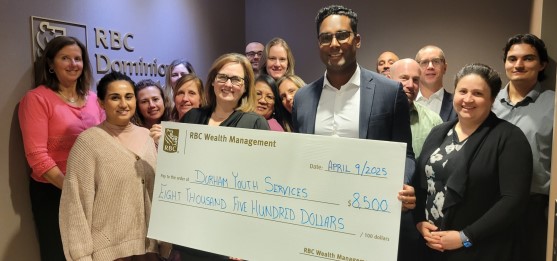
Our office chose Durham Youth Services for our “bigger” donation recipient this year. Shannon Jackson, Executive Director presented to us to educate us about what they do. They serve approximately 500 youth ages 16-24 to help prevent homelessness. We presented a cheque for $8500 to them. See attached photo.
The Hearth Place Gala is May 3, 2025 and I am a Gold Sponsor as well as the RBC Foundation is sponsoring. Thank you to those who have donated. For more information on the event.
https://hearthplace.org/events/gala/
Team News
Our office and the markets are closed on Monday May 19th for Victoria Day.
Enjoy this nice spring weather that has finally arrived.