

The Markets (as of close March 28, 2025)
The TSX is down 2.5% in March and up 0.1% year to date.
The S&P500 is down 6.3% in March and down 5.1% year to date.
The NASDAQ is down 8.1% and down 10.3% year to date.
I have attached our latest article on Tariffs; Bracing for market impact.
In this video linked below, Eric Lascelles, Chief Economist, RBC Global Asset Management Inc., provides his outlook on the economic impact of the tariff war, the possibilities of an approaching recession for Canada, and much more.
Economic Outlook - Spring 2025
From our Portfolio Advisory Group (as of March 21, 2025).
Global markets have benefitted from the lack of trade-related noise over the past few weeks, with markets outside of the U.S. continuing to outperform year-to-date. Despite the relative calm on the tariff front, there were important developments elsewhere. Notably, another interest rate cut by the Bank of Canada, the appointment of Mark Carney as Canada’s Prime Minister, and reports that a federal election will take place next month. Overseas, a partial ceasefire was negotiated between Ukraine and Russia. Meanwhile, some budget changes were approved in Germany that set the stage for a significant increase in military spending and infrastructure investment. We plan to discuss these over the weeks to come. Below, we address the U.S. Federal Reserve’s latest update, which pointed to some stagflationary effects – where growth slows, and inflation rises - this year.
The U.S. Federal Reserve kept interest rates unchanged at its recent meeting. Nevertheless, it revised a few of its economic projections. Its forecasts for economic growth (i.e. GDP) were revised lower: to 1.7% (from 2.1%) for 2025, and to 1.8% for both 2026 and 2027, respectively (from 2.0% and 1.9%, previously). Meanwhile, its inflation projection for this year was revised higher, to 2.7% from 2.5%, but its estimates for 2026 and 2027 were left unchanged. In summary, it expects lower growth through the next few years, and a temporary bump in inflation this year before it reverts to lower levels. The Fed also revealed that, on average, its policy makers expect two interest rate cuts this year, followed by two more in 2026, and one in 2027, which was unchanged from its prior assessment late last year.
The Federal Reserve’s official statement suggested it felt that U.S. economic activity was “solid”, with a healthy labour market, and inflation that remained “somewhat elevated”. It acknowledged that uncertainty had risen, and it was paying close attention to the risks of both sides of its dual mandate: unemployment and inflation.
Chairman Jerome Powell’s comments during his press conference were more interesting, in our view. He acknowledged some slowing in consumer spending, recent deterioration in sentiment, and higher levels of uncertainty resulting from a U.S. government that is making big changes in policy. But he reminded people that the U.S. economy was at least starting from a position of strength. Meanwhile, he was less concerned about an uptick in consumer inflation expectations and characterized any potential inflation stemming from tariffs as “transitory”. The latter remark was not particularly comforting as he also used the same term to describe inflationary pressures that emerged during the early stages of the pandemic.
Our simple takeaway is that the Fed is nearly as uncertain over the trajectory of the U.S. economy as everybody else. It is hard to fault them as government policy has been erratic through the first few months of the year. As a result, the Fed now finds itself in a more difficult position where growth is slowing, and inflation is rising. A recent RBC report compared the Fed’s position as being akin to a goalkeeper trying to save a penalty kick in football (i.e. soccer). If they overcommit to one side, they increase the odds of saving the economy from that scenario (i.e. slower growth), but it may then become more difficult to prevent the other scenario (i.e. higher inflation) from unfolding. As a result, a more suitable approach may be to stand pat, which is what they are doing for now.
We are not necessarily standing still. Given a more cautious mindset, we continue to review portfolios, ensuring that asset allocations are in-line with the targets set in our investment policies and financial plans. As a general rule, we tend to get more enthusiastic about investing opportunities when negative sentiment is at an extreme and valuations are cheap. The sentiment side, while not yet at an extreme, has turned more negative this year, but valuations still have a way to go in our view.
Wealth Management
All tax slips are out now. Here is our guide to tax reporting from investments. Please take the entire tax package to your tax preparer with the amended fee report.
Tax reporting guide – RBC Wealth Management
Handy Financial Planning Facts
Attached here. Clients often ask about taking CPP at age 60 vs deferring to 65. At age 60, the maximum CPP is $917/month at age 65 it’s $1433/month and $2034 at age 70. I would normally recommend waiting to take it till at least age 65 barring circumstances such as shortened life expectancy.
I am attaching two updated articles on CPP and CPP sharing with your spouse. Everyone’s situation is different and CPP is contributory; you have to have worked and contributed to receive it. Your CPP entitlement information can be found on My Service Canada. Talk to me about your situation for individual advice.
In the Community
Our office celebrated International Women’s Day on March 5 with a lunch with guest speaker Victoria Marshman. She spoke about how a single act of kindness set her on a course towards purpose driven entrepreneurship and philanthropy where she has raised over $300,000 for Canadian Charities. See picture attached.
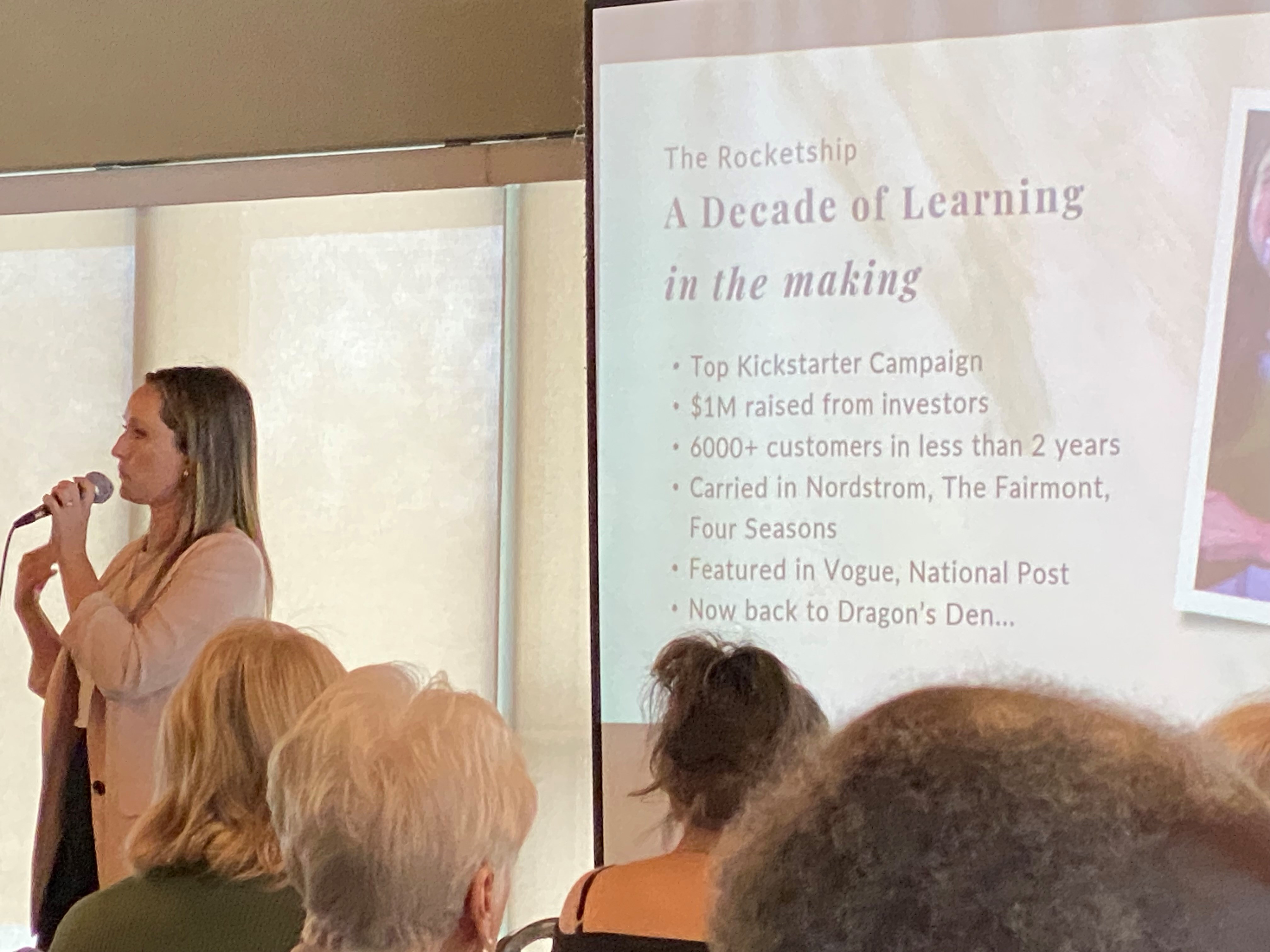
I volunteered along with other RBCers at Durham Feed the Need on March 13 for a couple of hours. RBC Foundation donated $1500 to Feed the Need that day. See picture attached.

I attended a Women’s Leadership Initiative in March organized by the Town of Whitby with Mayor Liz Roy hosting a panel of women who spoke of their careers, how they got there and their inspirations. The panel had 4 wonderful women, all very accomplished in their roles, share their stories of encouragement and determination and some in a male dominated occupations.
Tracy Clegg, CEO Ontario Shores Foundation,
Martha Degannes, Regional Senior Justice of the Peace in Central East Ontario
Lorraine Gray, Vice President of System Operations and Station Services at Hydro One
Rebecca Richardson, Staff Sergeant, DRPS

The Hearth Place Gala is May 4, 2025 and I am a Gold Sponsor as well as the RBC Foundation is sponsoring. Thank you to those who have donated. For more information on the event.
https://hearthplace.org/events/gala/
Team News
Kim will be off on Friday April 4. In April I will be taking two weeks’ vacation the weeks of April 14 and 21st. Good Friday falls in there as well and our office will be closed for Good Friday on April 18.
While I’m on vacation I will log on and check emails once/day. If anyone anticipates needing anything, please contact me prior to April 14. Kim will be here when I’m off.
Thank you.