

The US currently makes up approximately 63.3% of the Bloomberg World Equity Index, which is impressively higher than the 39.2% weight it held in 2008. This dominance can be attributed to the strength and resilience of the US economy, currency and corporate earnings. Foreign purchases of US assets have been persistent, attracted by higher yields and strong equity performance. Despite the narrative to ‘Sell America’ in response to the recent trade wars, net foreign purchases of US assets still increased from $1.2 Trillion to $1.6 Trillion between 2024-2025. That being said, this narrative of persistent US outperformance is starting to be challenged.
As the chart illustrates, the EAFE Index (Europe, Australia, Far East) has been a long term underdog. However, when you stretch out the time horizon, one can see that there are shifts in relative outperformance between US and International stocks. These rotations underscore that relative returns across global equity markets can change across different market environments.
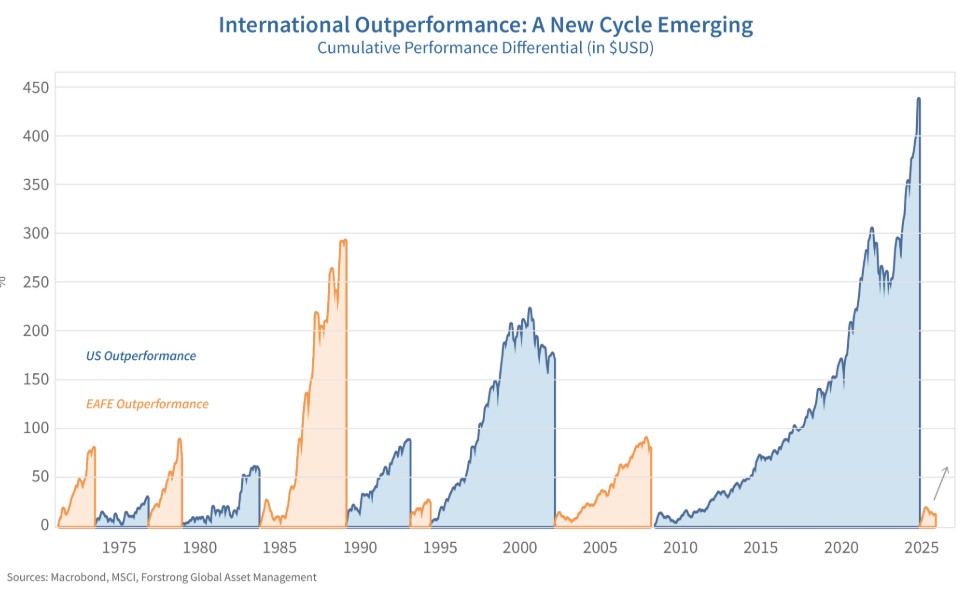
Over the last 12 months, International stocks have outperformed US stocks by 12.6%. This is indeed a departure from the US outperformance that has held since 2008. For many investors, the idea of buying anything but US stocks is an unfamiliar concept. Afterall, US earnings growth has been and continues to be greater than the rest of the world. However, investors should take note of the chart below that shows the improvement in earnings is growing internationally, whereas it is flat in the US. Should this trend persist, this rise in earnings growth combined with lower equity valuations is the best argument for continued international outperformance.
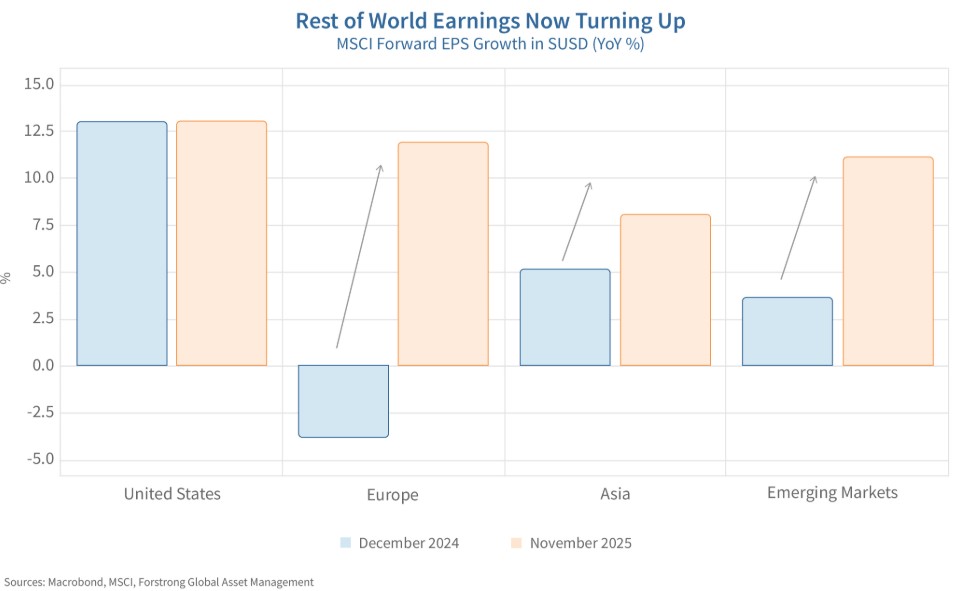
We believe investors should not anchor themselves to just the winners of the past decade. Investors should not underestimate the changing tides seen internationally which includes currency competitiveness, economically stimulating government policies, improved corporate governance and a rise in domestic demand for stocks. The next bull market may not look anything like the last as it has the makings of being more globally distributed.