

What is Artificial Intelligence (AI)?
AI is about putting human intelligence into machines.
Benefits of AI
There are many benefits associated with AI. Here are a few examples:
- Increase efficiency and productivity
- Access to large quantities of information quickly to gain knowledge and do research
- Problem-solving
- Risk management
- Ease with planning
Is Machine Learning the same as AI? What about Deep Learning and Generative AI?
Let’s start with the fundamentals.
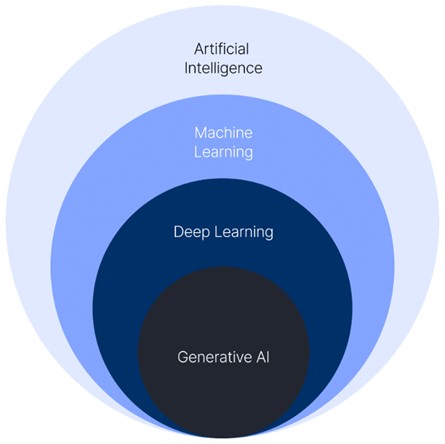
AI - The application of computer systems able to perform tasks or produce output normally requiring human intelligence
Machine learning (ML) - A branch of AI that develops algorithms and statistical models with data to solve problems. Human-curated data is used to train the models, which can then identify patterns and make predictions based on new inputs or data.
Algorithms - The instructions that guide the AI on how to learn from data. Through new research, novel ML models and optimization algorithms are being built.
Deep learning - A subset of machine learning that uses multilayered neural networks to simulate the complex decision-making power of the human brain.
Generative AI (Gen AI) – Gen AI is a subset of artificial intelligence that can create original content in response to user prompts. Examples include text, images, videos, audio, or software code. This technology relies on sophisticated machine learning models called deep learning models, which simulate the learning and decision-making processes of the human brain. These models identify and encode patterns and relationships in vast amounts of data, enabling them to understand natural language requests and generate relevant new content.
Large Language Model (LLM) - Advanced AI systems designed to understand and generate human language. LLMs predict the next word in a sequence based on preceding words, making them effective at generating coherent and contextually relevant responses.
How Gen AI Models work
Gen AI models create responses based on patterns and information learned through the data on which they are trained. This is usually internet-scale data, such as books, articles, websites, and more. However, these models do not “know” facts about the world – they just predict what text should come next based on patterns they’ve seen in this data. Since they do not truly understand the information that they produce, the output may be inaccurate, or what is called a hallucination
Examples of AI Applications
- Summarize large amounts of information quickly
- Perform repetitive, time-consuming tasks more efficiently
- Ask open questions
- Conduct research
- Generate content, new ideas, and insights
- Analyze data
- And more
The Importance of Data
Large quantities of high quality data are essential in producing good Gen AI results. If the data is incomplete, outdated, or biased, the model’s decisions can reflect these issues.
Prompting is important to achieve good AI results
Here are some best practices:
- Be specific
- Use clear and simple language
- Provide context (e.g. details)
- If the initial query doesn’t produce a good outcome, refine the inquiry
- Verify the results
Risks
Gen AI has unlocked incredible potential for creating text, images, and more. However, it comes with risks that individuals should be aware of when using Gen AI tools.
- Veracity - Gen AI can generate false information or struggle with complex reasoning. If the output is used incorrectly, this could lead to risk and liability for the user.
- Intellectual Property - AI models can inadvertently replicate copyrighted material from their training data, raising infringement of third party rights concerns and leading to lawsuits and fines for the user.
- Privacy: Sensitive data used for training models could be unintentionally exposed or leaked. This could lead to legal and regulatory risks as well as potential privacy law violations. Use of personal information may also represent an unauthorized use of this information and require additional consent to maintain trust and transparency.
- Control: Outputs can be unpredictable, including toxic speech or offensive imagery, creating reputational and regulatory risks. Users should provide human oversight and use their best judgment when reviewing outputs of Gen AI tools.
How AI can play a role in wealth management firms
AI can improve practices in many areas in the organization.
Risk transparency - Improves detection of existing risks such as compliance violations and fraud
Decision making - Enables personalized decision-making (e.g., for specific departments, roles, and clients by tailoring products or services that address their needs).
Productivity - Drives increased automation potential (e.g., reporting, document analysis, scenario testing, etc.) and expertise (e.g., simulation training).
Customer experience - Gen AI tools can offer clients a first-rate banking/investment experience. By having a better understanding of their current and future financial needs, investment advisors can help them achieve their goals.