

Artificial intelligence (AI) has taken center stage in almost any discussion of new technologies to help combat the sluggish global productivity growth. While AI holds promise as a transformative technology across various sectors, other innovations in healthcare also bear significant societal and economic implications. Among these advancements are mRNA technologies, CRISPR gene editing, and advancements in protein folding.
A notable breakthrough in healthcare is the development of GLP-1 weight-loss drugs, which offer substantial and sustained weight reduction (albeit through ongoing use). Leading drugs in this category have achieved an average weight loss of 21%, with ongoing research indicating potential for even greater efficacy.
Currently, these drugs face limitations such as high costs, restricted usage labels, and limited coverage under certain healthcare plans. However, as prices decrease and usage approvals broaden, these drugs are expected to become more accessible through expanded insurance coverage. The prospect of converting these drugs from injections to pills could further enhance their adoption.
The stock market has reflected optimism about these advancements, as evidenced by increased values of the two major drug manufacturers in this field over recent years.
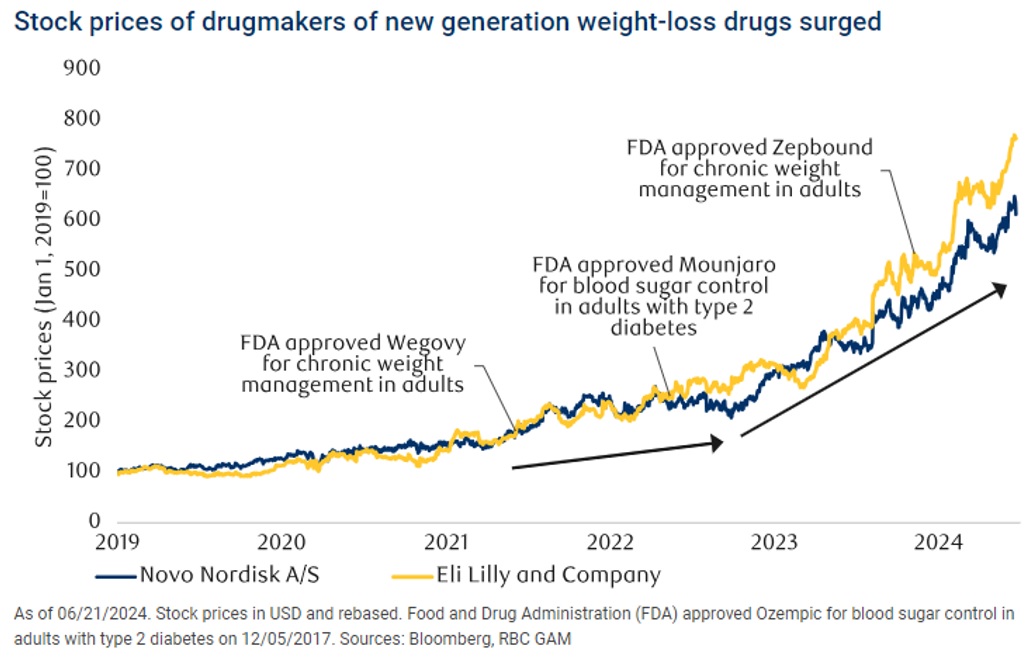
As these drugs become more widely available, their impact extends beyond individual weight loss to potentially address broader societal and economic implications (both positively and negatively).
- Reduced food cravings: beyond reducing weight, these drugs also suppress food cravings. However, from an investment/business profitability standpoint, this could have negative implications for food production and food retail companies as studies have shown a 40% reduction in caloric intake for users of the drugs.
- Lower weight-related diseases: use of GLP-1 drugs have shown links to reducing diseases such as diabetes, heart disease, stroke, and other kidney problems. While this represents a significant health benefit, from an investment standpoint, this could pose a threat to companies currently treating such illnesses.
- Increased longevity, productivity, and cognitive capabilities: GLP-1 drugs also show promise in enhancing cognitive function in some Type 2 diabetes patients and in mitigating other reward-related disorders in animal studies, which could have significant implications for treating addiction for humans. One could surmise that these positive side-effects would help reduce health care costs while healthier individuals could help increase the labour force participation rate. However, if a healthier population is living longer, they may encounter age-related diseases at a greater rate later in life and potentially cause a strain on pension plans. Furthermore, a larger and older population could pose a challenge from a housing standpoint.
Overall, the evolution of GLP-1 drugs represents a promising development with far-reaching implications for healthcare and the economy. From an investment perspective, aside from the two obvious beneficiaries so far, additional investment opportunities (and threats) will surely exist in other adjacent or opposite industries that surely deserves a healthy dose of investigation.