

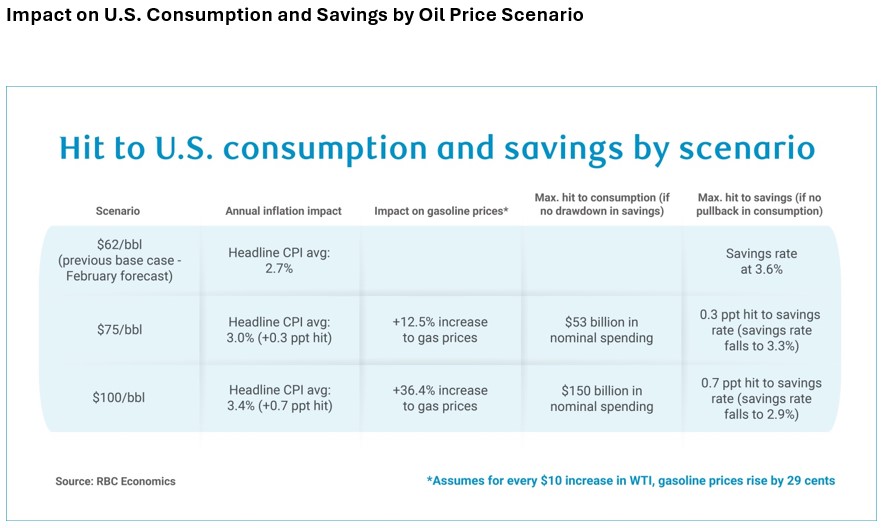
This table shows how different oil price scenarios could affect the U.S. economy, specifically inflation, gasoline prices, consumer spending, and savings. The analysis comes from RBC Economics.
The key idea: higher oil prices → higher gas prices → higher inflation → pressure on consumer spending or savings.
1.Baseline Scenario: Oil at $62 per barrel
This is the original forecast.
- Inflation (CPI): 2.7% average
- Gas prices: No major change assumed
- Savings rate: 3.6%
This is the normal expected economic path before oil price shocks.
2️. Scenario: Oil rises to $75 per barrel
If oil increases moderately:
Gasoline prices
- Increase about 12.5%
Inflation
- Average CPI rises to 3.0%
- That’s +0.3 percentage points
Consumer impact
Consumers must adjust in one of two ways:
Option A — Keep spending the same
- Households spend $53 billion more overall
Option B — Maintain spending without using savings
- Savings rate drops 0.3 percentage points
- Falls from 3.6% → 3.3%
3️. Scenario: Oil rises to $100 per barrel
This is a large oil price shock.
Gasoline prices
- Increase about 36.4%
Inflation
- CPI rises to 3.4%
- That’s +0.7 percentage points
Consumer impact
Option A — Maintain spending:
- Consumers spend $150 billion more
Option B — Protect spending by using savings:
- Savings rate falls 0.7 percentage points
- Drops from 3.6% → 2.9%
Important assumption in the table
The analysis assumes:
Every $10 increase in oil (WTI) raises gasoline prices by 29 cents per gallon.
Main takeaway
Higher oil prices force households into a trade-off:
- Spend more money on fuel and goods, or
- Reduce savings, or
- Cut consumption
The bigger the oil price increase (from $62 → $100), the larger the hit to inflation, spending pressure, and savings