

Last week, we focused on the historical examples of how new technology disrupted different eras, culminating in the most recent example – the Internet. This week, we are going to look at how AI is coming for “your job” and how something called the “J-curve” may shed some light on how this is going to play out.
Before we dive in, we wanted to pay homage to outgoing Department of Homeland Security (DHS) ghoul, umm, head, Kristi Noem. For those not familiar with Gnome, apologies, Noem, she was once rumored to be a potential VP candidate for Trump; although, her proclivity for murdering dogs (something she bragged about in her book, “No Going Back, so take that Bailey!”) likely cost her the nod. Instead, Trump put her in charge of DHS because “why not” and her tenure was marked by lots of things that are not appropriate for an all-audiences publication (but it rhymes with “hurdering Damerican Witizens”). Despite her many ill-accomplishments, Noem would probably still have the job, except for committing the ultimate cardinal sin – spotlight. You see - Noem went before Congress this week and members of her own party (no, not the Dog Murderers of America party, the other one) and they questioned a $200 million ad campaign that prominently featured Noem rather than prominently featuring her boss. This is what we like to call a “Bozo no no” in the orbit of Donald Trump and thus, while Noem was on stage presenting to the Dogs are the Secret Villains Society, Donald Trump, umm, euthanized her career as DHS chief. Anyway, good luck, Kristi and if you are a canine in the South Dakota area, be careful out there.
Okay, with that out of the way, let’s tackle part II of our AI Serial.
Section III: But AI is now coming for “your job”
If we think back to the prior technological revolutions, we cited in part one, they tended to have something very big in common – they mainly went after routine, repetitive tasks that displaced those jobs that did not require years of education and lots of fancy letters next to one’s name:
- The Industrial Revolution automated physical, repetitive manual labor. Factory workers and craftsmen were displaced.
- The computing revolution automated routine cognitive tasks — data entry, bookkeeping, simple calculations. Administrative and clerical workers were most affected.
- The Internet automated information distribution and matchmaking. Middlemen and intermediaries (brokers, travel agents, classifieds) were displaced.
Let's look at the chart then comment:
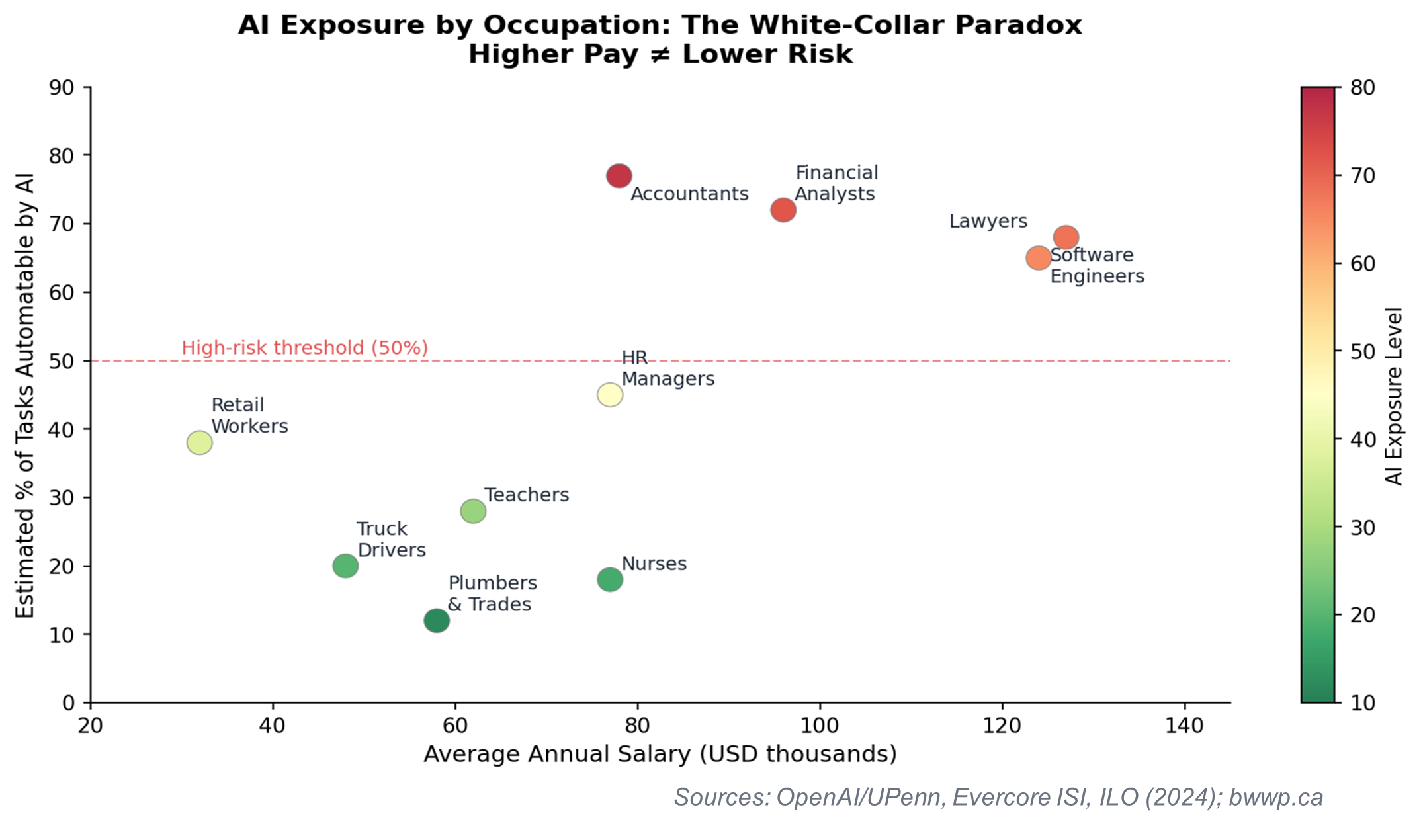
AI is genuinely different from prior automation waves in several ways that matter and understanding those differences is essential to exploring what comes next. The biggest distinction can be stated simply - for the first time in the history of a new, potentially revolutionary technology, the primary target is cognitive, white-collar work. In other words, AI because it automates complex cognitive reasoning, language, analysis, and judgment, reaches into the work of highly-educated, well-compensated professionals — accountants, financial analysts, lawyers, software engineers, et al - the very people who, in every prior wave, were the net beneficiaries of technological disruption.
Why This Is Particularly Unsettling for the Knowledge Class
The professionals most exposed to AI disruption are, in many cases, the same people who study, write about, and make policy regarding Artificial Intelligence.
Anthropic (a major player in AI) CEO Dario Amodei warned publicly that AI could "wipe out 50% of entry-level white-collar jobs within five years." Microsoft AI Chief Mustafa Suleyman suggested in February 2026 that "most tasks" in professions such as law, accounting, and consulting would be "fully automated within 12–18 months." These are not fringe predictions — they come from the people who actually build these systems.
That said – there are some studies that suggest fears are overblown. For example, a 2025 Thomson Reuters study found that actual AI adoption in legal and accounting firms had produced only "marginal productivity improvements" so far. Further, a landmark study of 5,000+ customer service agents found AI tools improved productivity by 15% on average, while MIT Research found that when AI automates only some tasks in a role, employment often increases as workers redirect to higher-value activities.
Section IV: Meet the J-Curve
The one caveat we would have with the above and something we will touch on more in part three is – AI is evolving at such a rapid pace that any study of its impact may be judging a technology that is now leaps and bounds more advanced than when the study was conducted.
Throughout history, every major new technology has generated a distinctive productivity signature - a long period of investment and adoption with little visible payoff – essentially a net negative as significant investment dollars generate little in terms of return on investment (ROI) - followed by a sudden, dramatic surge once the technology achieves critical mass and the economy begins to reorganize around this new technology. This pattern or “J-curve” translates into plain English as – things will get worse, before they get better.
Sources: Federal Reserve Bank of Chicago, Goldman Sachs Research; bwwp.ca
The computer age and the Internet, which were really one prolonged event, represents a great case study in the J-curve.
The Internet's Productivity Lesson: Slow, Then Sudden
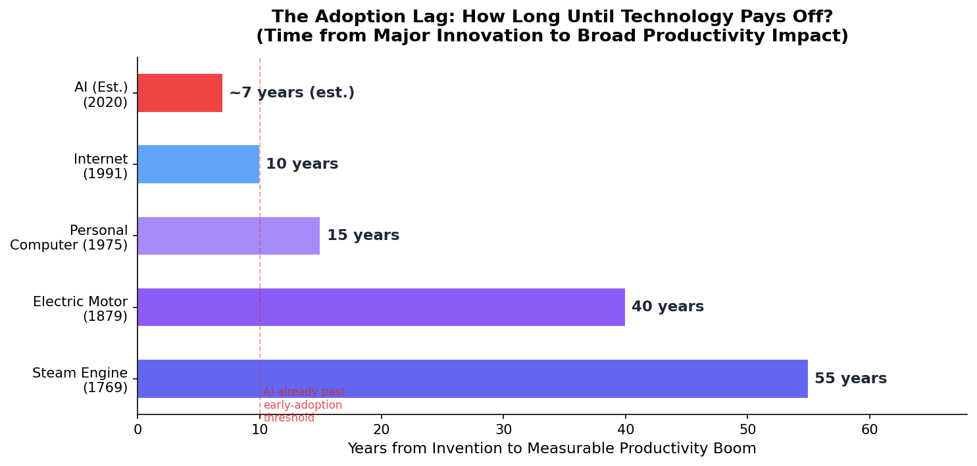
The personal computer was introduced commercially in the mid-1970s, yet the productivity boom associated with IT did not show up in macroeconomic data until roughly 20 years later. MIT professor and Nobel laureate Robert Solow's famously quipped in 1987 - "you can see the computer age everywhere except in the productivity statistics" - which captured the frustration of economists watching massive investment produce no visible aggregate results.
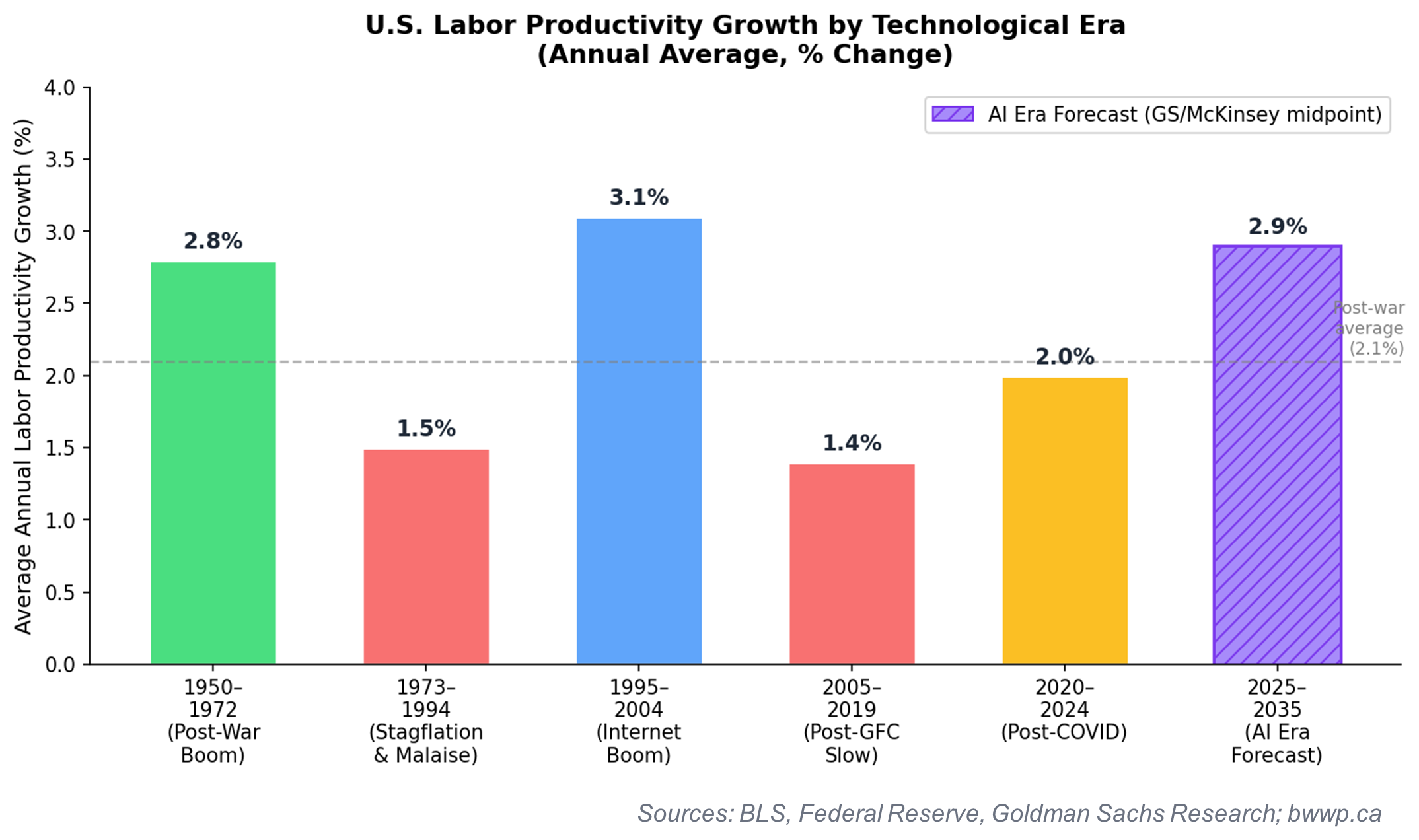
Then, somewhat all of a sudden, this changed. Between 1995 and 2004, U.S. labor productivity growth averaged 3.1% per year — its highest sustained rate since the postwar boom - after decades averaging only 1.5%. The Council of Economic Advisers estimated that information and communication technology contributed approximately 0.53% per year to this acceleration. IT-intensive industries — wholesale trade, retail, finance, professional services — showed the most dramatic gains, as companies finally restructured their operations to fully leverage the technology they had been investing in for a decade.
The lesson from prior technologies has been clear - the productivity boom typically lags the breakthrough innovation by a decade or more — it arrives only after roughly half of affected businesses have adopted the technology and reorganized workflows around it.
AI’s potential: a new UK every year
Goldman Sachs estimates that generative AI could raise U.S. labor productivity growth by approximately 1.5% annually over a ten-year period following widespread adoption — an effect comparable to the entire Internet productivity boom of the late 1990s. Goldman’s model suggests this could translate into a 7% increase in global GDP over a decade, or roughly $7 trillion in annual added value at current scale.
McKinsey's estimates are more bullish, projecting $2.6 to $4.4 trillion in annual global value creation from generative AI alone — equivalent to adding an economy larger than the United Kingdom every year. Other estimates are less robust, but still in the 0.5% to 1% range in terms of productivity gains.
Regardless of how bullish ones chooses to be on AI’s potential, the productivity payoff is likely to be real and potentially large, with the major caveat of – the timing is uncertain. The key bottleneck is not the capability of AI – we are seeing that already - but institutional reorganization: the same reason it took 20 years for PCs to show up in the productivity statistics is why AI's productivity boom may lag its capability development by years.
Okay, that’s enough for part 2. Next week, we will look out the growing income/wealth gap and how AI is likely to contribute to a worsening of conditions. Further, we will explore potential government responses to AI.