

Well, thanks be to the Gods that 2025 is over and nothing weird, horrifying, completely crazy or just plain awful is left to happen in 2026 (apologies, getting word from the control room that we may be wrong on this last point). While we would not be surprised by anything anymore (other than maybe the Leafs winning back-to-back games), a U.S. invasion of Greenland would probably not have been on our bingo card a year-ago, whereas now, we would probably put it at somewhere between maybe and oh, the U.S. is definitely attacking Greenland. The why to this tends to vary from day to day; however, we would ascribe it to one or all of four things (note, that while it sounds like we may be kidding with some of these, we are most certainly not kidding with any of them):
- Because of global warming and the opening of sea lanes, the Arctic has become the new strategic frontier for global superpowers and Greenland serves as a beachhead to this new strategic frontier.
- Donald Trump really wants folks in 2076 to look back and ask – “hey, how did we end up with Greenland?”
- Greenland is rich in rare earth elements (REEs) and gaining reserves in REEs is going to be vital in the future.
- Donald Trump saw a flat map and Greenland was like 10x the size of Africa on this map largely because of Gerardus Mercator. 500 or so years ago, Mercator created the Mercator projection largely to make navigation easier. The Mercator projection distorts the size of land masses the further you get from the equator and Greenland is really far from the equator whereas Africa literally straddles the equator. In reality, Africa is about 15x bigger than Greenland, which does not make Greenland small (it’s still about the size of Alaska), but rather just not Africa-big. Trump saw a Mercator map and said to former Fox News host and current Secretary of War Pete Hegseth – “hey Pete, get me that much bigger than Africa place”, and Pete quickly drew up invasion plans (we are speculating about this last part as we have no proof that Secretary Hegseth can use a writing implement of any sort).
Anyway, rationales aside for conquest, we thought we would spend some time today exploring reason #3 – rare earth elements. REEs are one of those things that most people have now heard of, but if you found yourself in a room with them, you would probably not know who they were or what they did.
With that in mind, let’s explore REEs:
Rare Earth Elements – Returning to Grade 10
Let’s start with – rare earth elements (REE) actually refers to 17-different metallic elements that generally all occur in differing quantities within every rare earth bearing mineral. If you remember your periodic table from high school (and let’s face it, who doesn’t?), the so called REEs were half of the elements that appeared at that very bottom separated part of the table (you are probably now saying, “oh, you mean the lanthanides!”) as well as Yttrium (the only word in the English language that contains the construct “ytt”) and Scandium (ironically, my nickname in high school).
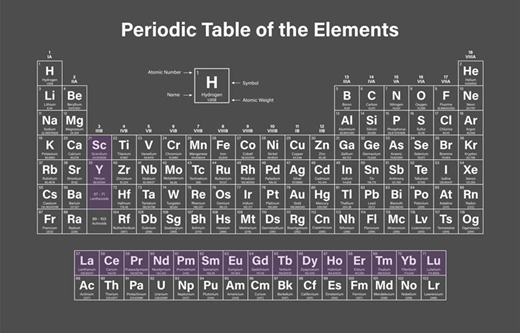
Further, while they carry the moniker “rare”, they are actually not rare at all (rare earth minerals are abundant throughout the earth’s core); however, they are extremely difficult to extract and refine, so ending up with economically viable REEs is the “rare” part. This is particularly true of so called “heavy rare earth elements”, which include Dysprosium (Dy), Terbium (Tb), Yttrium (Y) and Erbium (Er) – these heavy REEs tend to appear in lower quantities than lighter REEs and they also tend to be much more difficult to separate and refine.
REEs are in, well, almost everything
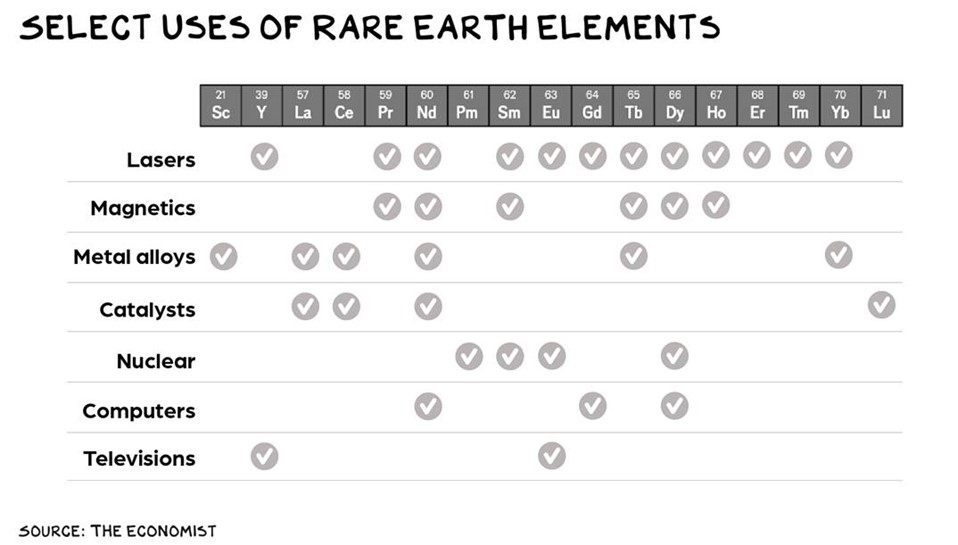
Okay, now that we have defined REEs (and potentially reactivated that bad case of acne you had in grade 10), the next question is – why do they matter? Basically, REEs are vital to pretty much all modern technology. Electric vehicles, wind turbines, cell phones and hard drives require permanent magnets to function and these magnets are reliant on REEs; the defense industry need REEs for guidance and a variety of other systems (some estimates have every F-35 fighter requiring nearly 1,000 pounds of REEs); the healthcare industry is also a massive user with technology such as MRI machines heavily reliant; the computer and semiconductor industries need REEs for LEDs, enhancing efficiency and performance and probably 5,000 other reasons. In other words, without REEs most of our modern conveniences, not to mention national defense, would cease to exist in their current forms.
Chinese OPEC
Okay, so we have established what they are, that they are not rare, but a real pain to extract and refine, and that we desperately need them, the next obvious question is, who currently controls the world’s supply? Let’s look at a chart and then comment:
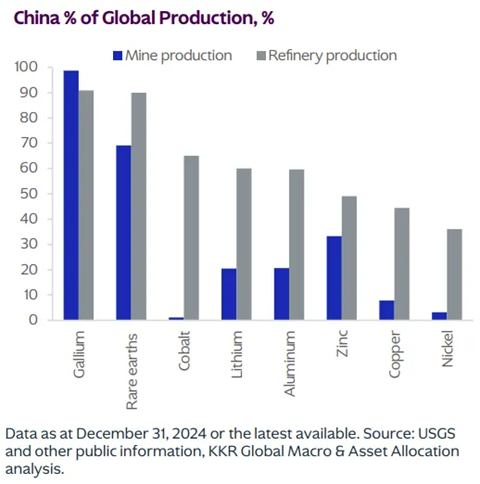
As you can see, China dominates the global supply of mined rare earth elements and is even more dominant when it comes to the refining of REEs. Gallium, which a lighter REE that is vital for smartphones and LEDs, provides an important case study as the only way to actually get Gallium is through the refining and procession of aluminum. In other words – if you do not have aluminum processing capacity, you will have no Gallium. China controls roughly 2/3rds of global aluminum production and thus controls nearly all of the world’s supply of Gallium. Thus, China controls ~70% of global mine production of REEs, but closer to 90-95% of global refined REEs. Consider that during the oil embargo of 1973, OPEC controlled ~55% of global oil supply and you start to get a sense of the market power that China currently enjoys as it relates to rare earths.
How did we get here? Thank Xu Guangxian
If you have never heard the name Xu Guangxian, he is basically the man most responsible for the current state of global REE supplies. Guangxian, educated at Columbia University, returned to China in the 1980s and became the pioneer of Chinese research and eventually investment in REEs. He convinced the government to adopt policies that encouraged domestic production and refining of REEs. This required a very long view as it can take years of investment in order to achieve anything close to economically viable REE production, but over a period of ~30-years, China was able to get there, while the rest of the world focused on other things.
Partying like it’s 1996
The simplistic U.S. response to the above would be – let’s take Greenland and build our own REE supplies. The problem with this is (and there are numerous problems, but we will focus on those that are less galactically stupid) that Greenland’s REE supplies are generally thought to be fairly poor in quality. That is – while Greenland has abundant REEs, they tend to be in lower quantities per mineral mined and thus you would have to mine an enormous amount of rock just to get anything approaching an economically feasible amount of REEs. In other words, taking Greenland for REEs would be silly.
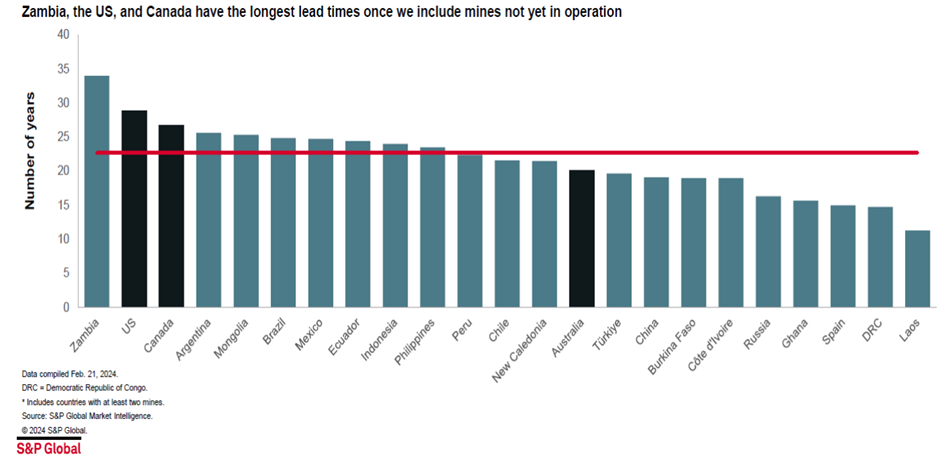
The U.S. actually made a massive REE discovery of its own in 2024 at Halleck Creek in Wyoming; although, estimates on the size of the range widely (some estimates are more than 50x Chinese reserves, while even low-end estimates would move the U.S. to the top three globally in terms of reserves). Of course, having reserves of REEs and actually getting to fully separated and refined REEs are two entirely different things. U.S. mine development has historically been very slow, with the average completion time from soup to nuts estimated at an unfathomable 29-years! In other words, a discovery made when Jerry Maguire first had us at “hello” would, on average, only be reaching production today (the kid in Jerry Maguire is now retired and living at La Boca Vista, by the way).
Further, as mentioned, the mining of REEs is just the first step. The much bigger step is investing in enormous amounts of refining and processes capacity, which could literally cost in the hundreds of billions if not trillions of dollars to build. With a ten-year timeframe, the U.S. and/or the rest of the world could probably get there, but that requires future leaders continue to follow the path established by their predecessors (a problem that China does not have to deal with), which is not something that we would bet on happening any time soon.
Final Thoughts: The world, ex-China, is desperately short refined rare earth elements. Whether it’s through a version of Operation Warp Speed or the Manhattan Project, the U.S., Canada and the rest of the non-Sino world should consider the massive investment (both in dollars and time) that it would take to ramp up strategic supplies. China currently enjoys a 1970s-style OPEC-like supply stranglehold on REEs and is increasingly likely to use this strategic advantage as a cudgel going forward. While there are no easy or fast solutions (certainly invading Greenland is not one of either), the long-term benefits would be immeasurable.