

March 2025 Market Commentary
Navigating Volatility: When the Storm Hits, Stay the Course
Last Saturday morning, I walked down to my basement and heard that dreaded sound again—drip, drip, drip. Another atmospheric river, another leak. This was the second time in two months. Not to mention the two washing machine floods in the past six months (a long story—just ask me next time we chat).
As I stood there watching the water drip from the ceiling, frustration boiled over. This house is a dud. Sell it and move on! My mind raced. The anger, the helplessness—it felt good, in a strange way, to at least entertain the idea of doing something. After all, taking action feels like control.
Then I took a breath. I called the restoration company (who I now have on speed dial and we’re on first name basis…) and had some roofers come check it out. Was this the same issue as before? Was my roof just a disaster waiting to happen? Should I rip the whole thing off and start fresh?
The professionals arrived, took a look, and gave me the real story: My roof is actually in great shape. A small seam near the chimney had been exposed, allowing water in. A minor fix, not a catastrophe. And it had nothing to do with the last flood. That one? A completely different seam, on the other side of the house—just an unlucky fluke.
That moment of clarity reminded me of how investors react to volatility. When the market takes a hit, emotions surge. The instinct to do something—to sell, to rotate, to abandon the plan—feels like regaining control. But more often than not, reacting emotionally leads to costly mistakes.
Market Volatility and the Urge to Act
After years of strong market returns and a decade of near-zero interest rates, the current environment is a wake-up call. The S&P 500 has pulled back 7.5%, and many are wondering: Is this just the beginning? Should I make big moves to avoid more pain?
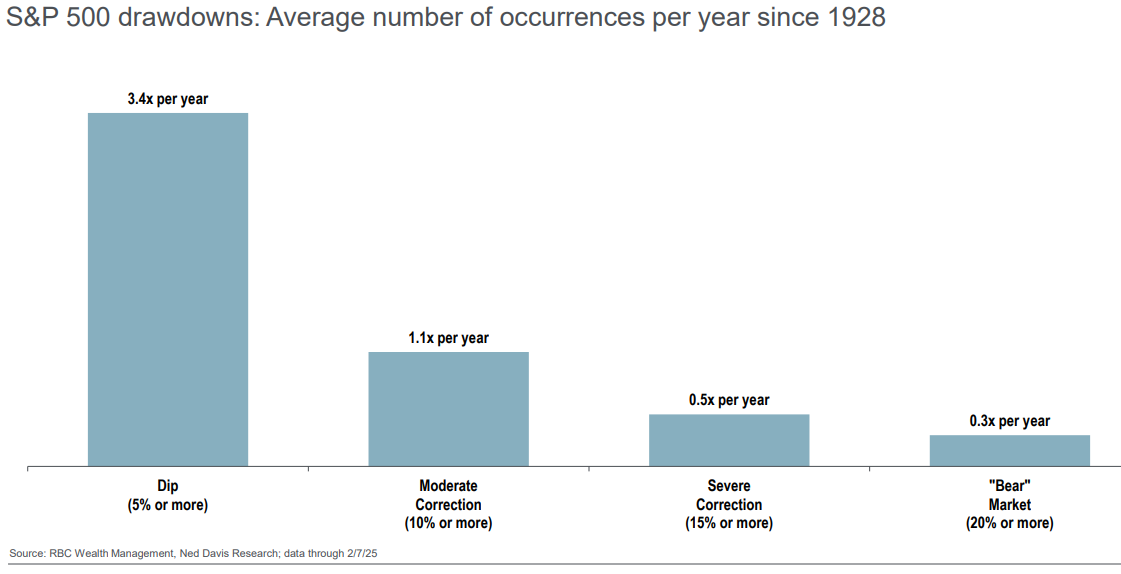
The reality? Volatility is normal. Historically, the S&P 500 experiences three to four declines of 5% per year and at least one 10% correction annually1. The market’s movement isn’t a crisis—it’s part of how investing works.
What’s Different This Time? Trump’s Economic Attacks & Inflammatory Rhetoric
This isn’t just a standard market correction—this is something else. Trump isn’t just influencing markets through policy; he’s actively attacking economic stability, using trade wars and inflammatory rhetoric to disrupt businesses and stir uncertainty.
In recent weeks, he has:
-
Escalated economic tensions with Canada – Pushing for tariffs and restrictions that threaten cross-border supply chains.
-
Suggested Canada should become the 51st state – Not a passing remark, but a continuation of his confrontational approach to U.S.-Canada relations.
-
Inflamed emotions – Using nationalism as an economic weapon, creating divisiveness in trade, business, and global markets.
This isn’t just about policy—this is deliberate disruption, and markets are responding accordingly.
Volatility Drivers
The #1 Driver of Volatility: Trump Uncertainty
This isn’t just a run-of-the-mill market pullback—this volatility is driven by Trump uncertainty. His policies, his tariff flip-flops, his broader economic stance, and the sheer unpredictability of his decision-making have markets on edge.
2. Trade Wars: Tariffs On, Tariffs Off
Trump’s approach to trade remains aggressive and unpredictable. After months of promising a "hard stance" on China, he suddenly softened his position. USMCA tariffs were expected to stay, but then he reversed course. Markets don’t like uncertainty, and this back-and-forth is injecting real volatility.
This isn’t new—markets went through similar shocks in 2018 when Trump imposed tariffs on steel and aluminum. The result? Supply chain disruptions, price volatility, and significant equity swings. We may see a repeat of this.
3. Government Restructuring and Chaos
Trump’s second-term agenda is focused on government overhaul, and he’s already making deep cuts. Entire agencies are being downsized or restructured. Some of this is political showmanship, but the real-world effects—potential job losses, disruptions in economic data collection, and shifts in regulatory frameworks—are creating instability.
4. Musk, Indiscriminate Cuts, and the Economic Fallout
Trump’s administration has enlisted Elon Musk to lead sweeping efficiency measures across government agencies, aiming to slash spending and reduce bureaucratic waste. While fiscal responsibility is an important goal, Musk’s approach—often described as a blunt-force hatchet job—is raising concerns.
With government spending accounting for nearly 30% of U.S. GDP, these rapid and indiscriminate cuts could have widespread consequences. Government-funded sectors, including healthcare, infrastructure, and defense, could see mass layoffs. Entire divisions of federal agencies are already being disbanded, creating uncertainty for workers and businesses that rely on government contracts.
History shows that aggressive public sector job cuts have ripple effects. If thousands of jobs vanish overnight, unemployment rises. As incomes drop, so does consumer spending—lowering economic output and weakening overall growth. Markets are forward-looking, and investors are already pricing in the risks of an economic slowdown triggered by these policy shifts.
The economy is not just numbers on a spreadsheet—it’s people, jobs, businesses, and confidence. When that confidence wavers, volatility spikes.
What History Tells Us About Market Uncertainty
Periods of political or policy-driven market volatility tend to follow a pattern:
-
Short-Term Overreactions – Markets drop on headlines and policy announcements before assessing the real impact.
- Repricing of Risk – Investors adjust expectations based on the likelihood of extreme scenarios actually happening.
- Recovery and Focus on Fundamentals – Over time, earnings, economic data, and corporate resilience take over as the dominant drivers of returns.
We've seen this playbook before—Brexit, the 2016 election, the debt ceiling crises. Each time, knee-jerk reactions proved costly.
Are Markets Overvalued?
There’s always data to support any narrative, bullish or bearish. But looking at the bigger picture, the Equal-Weighted S&P 500 (where every stock gets the same weighting) is trading near its 15-year average valuation. That suggests that while some stocks are overpriced, the market as a whole isn’t wildly overvalued.
Some pockets—AI-driven names, high-growth speculative tech—are showing signs of froth. But a broad-based collapse? Unlikely.
Portfolio Positioning: Thoughtful Adjustments, Not Panic Moves
Just like my roof situation, a measured response is key. Instead of overhauling everything, we’re making thoughtful adjustments:
Avoiding Tariff Impacted Cyclicals – We’re steering clear of autos, steel, aluminum, and speculative AI companies where risks outweigh rewards.
- Trimming Overextended Positions – Taking profits on stocks that ran too far too fast, like Boston Scientific and Costco.
- Gold Exposure – Franco-Nevada remains a core holding, providing leveraged exposure to gold, a defensive asset that continues to hit new highs. Also, direct price exposure through gold backed ETFs as an alterative investment.
- Consumer Defensive Play – Dollarama benefits from consumers trading down in uncertain times.
- Tech with Real Moats – Amazon, Google, and Microsoft remain core holdings due to their durable competitive advantages.
- AI Infrastructure – ASML and Cadence Design continue to be key holdings, providing the backbone for AI-driven growth.
Final Thoughts – Don’t Rip Off the Roof When a Small Fix Will Do
When the market gets rough, the instinct to act is strong. But just like with my roof, not every problem requires a drastic solution. The best investors stay calm, assess the real issue, and take measured steps—not emotional ones.
Successful investing is about discipline, patience, and maintaining focus amid the noise. We’re committed to staying the course and making strategic decisions that benefit you over the long term.
As always, if you have questions or concerns, we’re here to help.
Let’s weather this storm together.
References
- Global Macro Perspectives CIC Feb 2025: PowerPoint Presentation
Disclaimer
This commentary is based on information that is believed to be accurate at the time of writing, and is subject to change. All opinions and estimates contained in this report constitute RBC Dominion Securities Inc.'s judgment as of the date of this report, are subject to change without notice and are provided in good faith but without legal responsibility. Interest rates, market conditions and other investment factors are subject to change. Past performance may not be repeated. The information provided is intended only to illustrate certain historical returns and is not intended to reflect future values or returns. This information is not investment advice and should be used only in conjunction with a discussion with your RBC Dominion Securities Inc. Investment Advisor. This will ensure that your own circumstances have been considered properly and that action is taken on the latest available information. The information contained herein has been obtained from sources believed to be reliable at the time obtained but neither RBC Dominion Securities Inc. nor its employees, agents, or information suppliers can guarantee its accuracy or completeness. This report is not and under no circumstances is to be construed as an offer to sell or the solicitation of an offer to buy any securities. This report is furnished on the basis and understanding that neither RBC Dominion Securities Inc. nor its employees, agents, or information suppliers is to be under any responsibility or liability whatsoever in respect thereof. The inventories of RBC Dominion Securities Inc. may from time to time include securities mentioned herein. RBC Dominion Securities Inc.* and Royal Bank of Canada are separate corporate entities which are affiliated. *Member-Canadian Investor Protection Fund. RBC Dominion Securities Inc. is a member company of RBC Wealth Management, a business segment of Royal Bank of Canada. ® / TM Trademark(s) of Royal Bank of Canada. Used under license. © 2025 RBC Dominion Securities Inc. All rights reserved.