

What Type of Recession Will We Have?
Interest Rates Near Their Peak
Market Review: Q3 2023
The S&P/TSX Composite Index (TSX) representing the Canadian stock market traded within a range from January to September this year, finishing up 0.8% as of September 30 – see the red line in the chart below. The S&P 500 Index (S&P 500) rallied for the first seven months but took a turn in August and September, giving up some earlier gains. The S&P 500 was up 11.7% by end of Q3 2023 – see the blue line in the chart below.
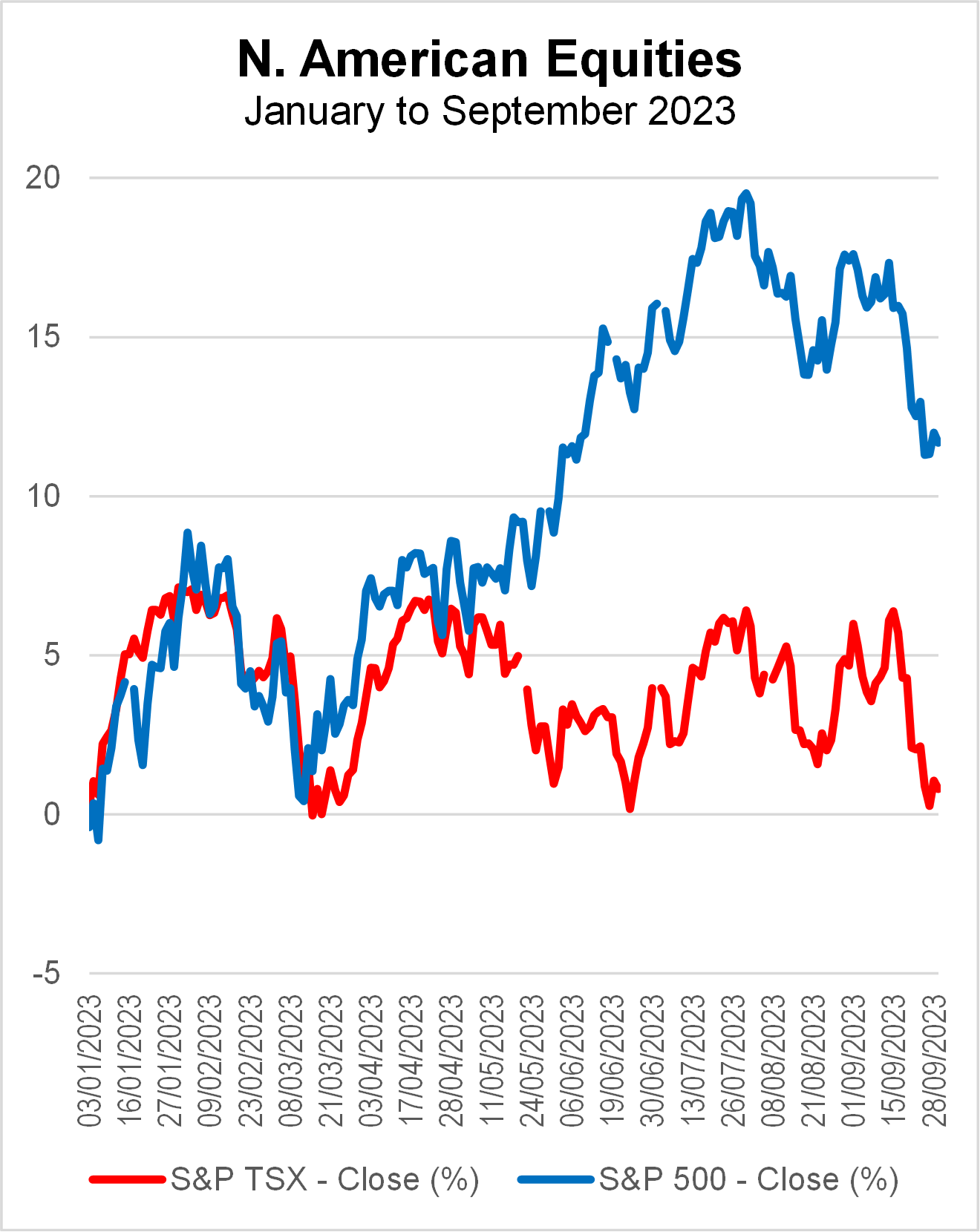
Source: FactSet September 29, 2023
There are many factors that determine the price of any single stock at any one time. A company’s sales growth, profitability or interest rates can all affect its stock price. The current consensus amongst observers is that inflation expectations and associated direction in interest rates are key drivers of the equities market.
Interest Rates
Higher rates helps lower inflation
When the economy re-opened after the pandemic lockdown, the sudden surge in demand for goods and, in particular, services led to a spike in inflation. The Federal Reserve started raising its policy rates in March 2022 from effectively zero to just over 5% as of the time of writing. Higher interest rates is a central bank tool to dampen consumer demand, although there is usually a lag of up a year to 18 months for higher rates to work their way through the economy.
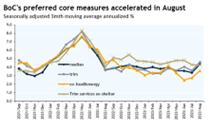
Source: Statistics Canada, RBC Economics
Higher rates are working. The above chart shows that inflation has dropped since it’s peak in May 2022. The latest reading of the consume price index (CPI) in Canada was 4.0% in August 2023.
Higher rates for longer
After the latest statements from the Bank of Canada and the Federal Reserve in the U.S., it is clear that central banks see inflation as a problem that has not yet gone away. They remain vigilant and are likely to maintain interest rates at their current levels until they are certain that they see “convincing evidence” that inflation is under control.
Recession – Type and Timing
Inflation is a sign of consumers’ appetite for spending exceeding supply, thus sending prices higher. For inflation to return to former levels (the Bank of Canada target inflation rate is 2.0%) consumption will need to decline. This will usually lead uncertain economic outlook, lower job security, or higher unemployment.
Leading indicators
As reported in Smart Investor 2023 Q2 edition, of the seven indicators RBC tracks two are firmly in recession territory and three are in neutral but trending towards a slowdown. Only two are still considered expansionary including the employment rate. “Weighing up the current positioning of all seven indicators and projecting their likely paths over the next couple of quarters, points to a growing probability the U.S. will enter a recession later this year, in our view” according to Jim Allworth, Strategist, RBC Wealth Management who wrote in Global Insight, September 2023.
Soft landing
It is somewhat counter intuitive and perturbing to realize that there needs to be some bad news of economic slowdown and/or higher unemployment, so that inflation will come under control, before we see better times ahead. Central banks are trying to engineer lower inflation without causing too much economic pain, an ideal condition referred to as a “soft landing”. This is the best case scenario.
Worst case scenario
If central banks leave interest rates high for too long, we may experience a significant slowdown in the economy and stubbornly high unemployment. It will take longer to recover from such a scenario.
What follows a recession?
Once the Bank of Canada is satisfied that inflation is under control they will likely start to cut their policy rates. The cost of borrowing will fall and economic activity will pick up, and the next growth cycle will begin.
Building Resilience
Invest in quality businesses
In past economic downturns, equities have started to advance some months before the recession is over. This makes trying to time the market difficult, if not impossible. Therefore, we recommend our clients to stay invested in businesses that have strong balance sheets and relatively stable earnings through good and challenging times. This may not be the best time to make big bets.
Keep enough bonds
Amidst the dark clouds surrounding high inflation, elevated interest rates and the possibility of an impending recession, bonds are the silver lining. More times than not, bonds provide a diversified portfolio with stability during periods of volatility or a correction in stocks. There are several reasons that they are the silver lining, making them attractive for investors.
First, higher yields have restored the “income” within fixed income. At the time of writing a one-year Government of Canada bond yields 5.3%—the same bond yielded just 0.13% in January 2021. Second, many of the bonds available today were issued when coupons were much lower, therefore they trade at a discounted price now when interest rates are higher. This means that when bonds mature, investors will reap a capital gain also. Third, if and when we enter a recession, interest rates will likely drop. We know that bond prices and rates move in opposite directions. Therefore, when rates come down, bond prices will move up, improving returns.
Be Patient
In behavioural finance there is a term called “recency bias”. We are prone to be affected most by recent events rather than complete history. If markets are down, we forget that they would normally recover over time. We need to remind ourselves that over time, the chances of positive investment performance is higher than we may remember.
Shiuman’s Corner
Riding for a cause – to find a cure for cancer
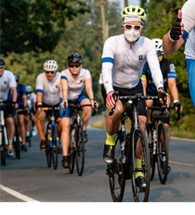
Photo: Shiuman with Team RBC
The Tour de Cure took place over the final weekend in August. It was my fifth participation in this event to raise funds for BC Cancer Foundation. 1,500 riders set off from Cloverdale in Surrey on a cool Saturday morning, heading east passing farms that grow a lot of our food. Our destination was Chilliwack some 100km to the east in the heart of the Fraser Valley. The pace was like a Sunday coffee ride, with rest stops every 25 km or so where we filled up our water bottles or loaded up with calories. Daytime temperatures reached 30 degrees Celsius so it was important to stay hydrated and cool. An additional challenge was the smokey air from wildfires; hence my donning a N-95 mask as seen in the photograph. After a hearty dinner and a good night’s rest we set off the following morning towards Hope. Although we were forewarned that if the air quality deteriorated to a certain level the ride would be cancelled, we were disappointed when that happened just 35km shy of the finish. But we were all happy that the event raised $7.1 million for cancer research and treatment.