

Below is a summary of some of the relevant news items from the Capital Markets and the Economy from the past week extracted from RBC Global Insights and FactSet Research.
Markets
Market scorecard as of close on Friday December 2nd, 2022.
| Equity Indices | Level | 1 week | YTD |
| S&P/TSX Composite | 20,486 | 0.5% | -3.5% |
| S&P 500 | 4,072 | 1.1% | -14.6% |
| NASDAQ | 11,461 | 2.1% | -26.7% |
| Euro Stoxx 50 | 3,998 | 0.9% | -7.0% |
| Hang Seng | 18,675 | 6.3% | -20.2% |
Source: Bloomberg, RBC Wealth Management
-
TSX ended slightly lower in Friday afternoon trading. Canadian equities recorded a 0.5% weekly gain with the TSX now down only 3.5% YTD heading into final weeks of 2022. Canadian dollar lower against USD and declined 0.7% for the week (C$1.0=US$0.741).
-
US equities mixed Friday and mostly higher for the week. Semis, banks, builders, autos, restaurants, rails among laggards. Industrial metals, machinery, E&C, waste, A&D, trucking, retail, China tech and drug distributors outperformed.
-
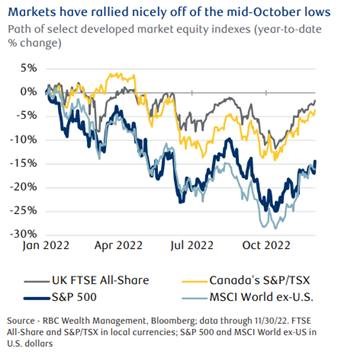
The S&P 500 has rallied 14.1 percent since mid-October, and Canada’s S&P/TSX have bounced 12.3 percent. As a result, the S&P 500 is down “only” 14.6 percent year to date compared to being down 25 percent at its worst point (see chart below).
-
According to RBC Wealth Management’s Global Portfolio Advisory Committee, this is not a phantom move, in our assessment, as the four key factors behind the rally are notable.
-
After spiking in 2021 and earlier this year, the headline and core inflation rates have come down closer to their longer-term ranges since 2010.
-
The end of the Fed tightening cycle seems in sight. We expect any subsequent hikes to be in 25 basis point increments, and only if justified by the incoming data, with the fed funds rate reaching no higher than 5.00 percent by Q1 2023.
-
The S&P 500 Q3 reporting season was better than feared, and we think the results were relatively good compared to previous periods when economic headwinds were blowing.
-
The S&P 500 has historically performed best when power in Washington was shared between a Democratic president and a split Congress.
-
-
Regardless of how 2023 plays out, we think developed equity markets’ swift moves off the mid-October bottoms, which came amid very negative headlines and bearish investor sentiment, are prime examples of why attempting to time the market is such a precarious exercise for long-term investors.
Economy
Canada
-
The November Labour Force Survey showed Canada added 10K jobs last month, roughly matching consensus.
-
Global oil prices are well off their year-to-date highs, driven in part by the slowing economic outlook. All else equal, we acknowledge that the pullback in commodity prices represents a headwind for Canadian energy producers. However, we also highlight that energy producers have been far more prudent in their capital allocation priorities this time around compared to past business cycles.
-
Higher interest rates and sustained inflationary pressures in the economy have dampened consumer sentiment meaningfully and driven retail sales to experience another month-over-month (m/m) contraction in September. Headline retail sales fell by 0.5% m/m.
U.S.
- Recession concerns are growing, according to the Fed’s Beige Book, a qualitative survey of economic conditions across the country. The majority of Fed districts reported unchanged or declining economic activity during the past six weeks, with companies across the U.S. reporting increased uncertainty and rising economic pessimism.
- Federal Reserve Chair Jerome Powell that indicated the central bank is likely to moderate the pace of rate hikes to 50 basis points (bps) from 75 bps beginning at this month’s meeting. Powell’s additional remarks on the likely endpoint for rate hikes—“somewhat higher” than the Fed’s prior 4.6% projection.
- Stronger November nonfarm payroll and wage growth was the big story on Friday. It plays into concerns about upside risk to terminal rate and Fed's heightened emphasis on higher-for-longer rate policy. However, labor market resilience also provides some cushion against the hard-landing and earnings risk themes that have been flagged as big headwinds for stocks in 2023.
Further Afield
- The yen continues to strengthen against the U.S. dollar since hitting a four-decade low in October. The gains are being driven in part by market jitters around China’s deteriorating COVID-19 situation, which is driving moves toward currencies that investors typically consider to have a stronger risk-reward proposition, where the yen is overtaking the greenback to be the currency of choice.
- In Europe, mixed ECB comments with President Lagarde warning some fiscal policies in Europe could fuel excess demand, while chief economist Lane said real rates have already moved quite a bit.
Notes About Companies in Model Portfolio
- Royal Bank of Canada (RY) reported on Wednesday net income of $15.8 billion for the year ended October 31, 2022, down $243 million or 2% from the prior year. Diluted earnings per share (EPS) of $11.06 remained unchanged from the prior year. Pre-provision, pre-tax earnings8 of $20.6 billion were up 4% from a year ago, mainly reflecting higher net interest income driven by strong volume growth and higher spreads in Canadian Banking and Wealth Management. These factors were partially offset by lower revenue in Capital Markets, including the impact from loan underwriting markdowns in Q3 2022, largely driven by challenging market conditions.
- RBC announced on Tuesday it has entered into an agreement to acquire HSBC Bank Canada. Under the terms of the agreement, RBC will acquire 100% of the common shares of HSBC Canada for an all-cash purchase price of $13.5 billion. All of HSBC Canada's earnings from June 30, 2022 through close will accrue to RBC
- TD Bank Group (TD) Reported fourth quarter and fiscal 2022 results on Wednesday. Reported earnings were $6.7 billion, up 76% compared with the fourth quarter last year, and adjusted earnings were $4.1 billion, up 5%. TD’s adjusted EPS was $2.18, above our (RBC Capital Markets) estimate of $2.11 and consensus of $2.06. On a segmented basis, Canada and U.S. P&C as well as Corporate had better-than-expected results. TD declared an increase to its dividend to $0.96 per common share, a 7 cent increase.
Feel free to contact me with any questions and/or to discuss investment ideas.
I appreciate the opportunity to serve you and look forward to continuing to help you accomplish your long-term financial goals.
Regards,
Shiuman