

Below is a summary of some of the relevant news items from the Capital Markets and the Economy from the past week extracted from RBC Global Insights and FactSet Research.
Markets
Market scorecard as of close on Friday June 24, 2022.
| Equity Indices | Level | 1 week | YTD |
| S&P/TSX Composite | 19,063 | 0.7% | -10.2% |
| S&P 500 | 3,912 | 6.4% | -17.9% |
| NASDAQ | 11,608 | 7.5% | -25.8% |
| Euro Stoxx 50 | 3,533 | 2.8% | -17.8% |
| Hang Seng | 21,719 | 3.1% | -7.2% |
Source: Bloomberg, RBC Wealth Management
-
TSX finished higher Friday, near best levels. All sectors higher led by health care, tech, energy, industrials, staples and materials. Friday’s rally helped offset a big Wednesday-Thursday slide with Canadian equities posting a 0.7% weekly gain. However, TSX remains down ~13% in Q2, on track for first quarterly decline since the ~27% drop in Q1'2020. WTI crude ended up 3.2%. Canadian dollar sharply higher against USD.
-
US equities were sharply higher in very quiet Friday trading, finishing near session highs and capping off big weekly gains after suffering largest pullback since the depths of the pandemic in March 2020 in prior week.
-
A very uneventful session with nothing new behind bounce in stocks, which continued to be chalked up to oversold conditions following back-to-back 5%+ weekly declines in the S&P, something that has happened only seven other times since WWII. Some sentiment and positioning indicators continue to offer contrarian buy signals. Also some heightened focus on the "bad news is good news" theme as negative macro surprises and ramp in growth/recession fears (and accompanying calls for negative earnings revisions) have put some renewed traction behind the peak Fed and peak inflation narratives.
-
Excerpt from Global Insight Weekly by RBC’s Global Portfolio Advisory Committee (June 23, 2022) regarding the recent market volatility:
-
We think it’s a fruitless exercise for long-term investors to try to time the market and pick the bottom. During all except one of the aforementioned recessions, the S&P 500 bottomed before the recession officially ended, and often when the economic headlines were the scariest.
-
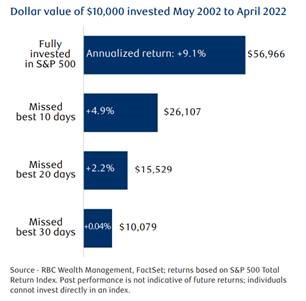
Furthermore, being out of the market on big rally days—which can occur just as abruptly and unexpectedly as big selloffs—can negatively impact long-term returns, as the chart illustrates.
-
Economy
Canada
-
Canadian CPI inflation is exceeding expectations. With monetary policy at center stage of the investment world, and policymakers focused on the challenge of bringing multi-decade-high inflation back under control, perhaps no single data point is as impactful as the Consumer Price Index (CPI). Canadian headline CPI inflation hit 7.7% y/y in May, 40 basis points above consensus expectations. Food and energy costs (particularly gasoline prices) continued to be major drivers pushing the headline figure higher.
-
But despite inflation running consistently hotter than expected in 2022, the Bank of Canada appears to have regained a great deal of market credibility regarding its inflation-fighting abilities, as inflation breakevens (a market-implied measure of future inflation expectations) have declined meaningfully over the past three months.
U.S.
-
Fed Chair Jerome Powell struck a cautious tone on the U.S. economy during congressional testimony. Powell emphasized the central bank’s focus on curtailing inflation through higher rates, even as he acknowledged the risk of Fed policy tipping the economy into recession. Powell’s remarks made clear, however, that the central bank is committed to achieving price stability and that it views entrenched inflation as a more significant long-term concern than failing to achieve a so-called soft landing.
-
He did not directly address the potential for the Fed to repeat a 75 basis points (bps) hike at its next meeting, although he did say that market pricing for the path of rate hikes was “appropriate.”
Further Afield
-
Russia has reduced gas supply in recent days, via the Nord Stream 1 pipeline into Germany, by around 60% amidst the ongoing sanctions dispute and EU restrictions on equipment to support pipeline maintenance.
-
The continued gas supply issues, coupled with continued supply chain disruptions, are likely key factors driving the weakening of euro area economic activity indicators and weighing on business sentiment. Despite slowing economic activity, the European Central Bank is set to start hiking the deposit rate next month to combat inflation.
-
The Chinese government stressed the importance of boosting China’s economy. Pro-growth policies under review include front-loading stimulus to accelerate the implementation of existing policies and enhancing the adjustment of macro policies as part of the effort to keep economic growth within a reasonable range. In addition, on June 21, Finance Minister Liu Kun stated that fiscal spending and the sale of special local government bonds are going to be increased. Banks are also being urged to step up lending for infrastructure projects.
Feel free to contact me with any questions and/or to discuss investment ideas.
I appreciate the opportunity to serve you and look forward to continuing to help you accomplish your long-term financial goals.
Regards,
Shiuman