


With the global economy in the doldrums, the stock market’s booming performance seems to reflect a totally different reality, leaving many investors to wonder why.
Disconcerting disconnect
The economic damage wrought by lockdowns and measures to control the spread of COVID-19 has been deep and sustained, leaving the global economy in a severe recession. Although most economists agree the global economy will bounce back in 2021, this outlook is being tempered daily in the face of the recent resurgence in global infection rates and continued signs of a softening in the economic recovery.
And yet, despite the pandemic-induced economic woes, global equity markets have largely soared, including a 46% surge in the S&P 500 Index* from the low reached on March 23. This performance has left many investors baffled as to the cause of this apparent disconnect between the performance of the economy and that of the markets.
Looking back to the future
Historically, the apparent disconnect between the markets and the economy is fairly normal. That’s because stock prices tend to reflect the outlook for the future earnings and prospects of a specific company. What the broader economy is doing at any given time can influence stock prices, but there’s not always a direct correlation. Looking at the current situation, while the overall economy is struggling, certain companies have actually prospered during the pandemic.
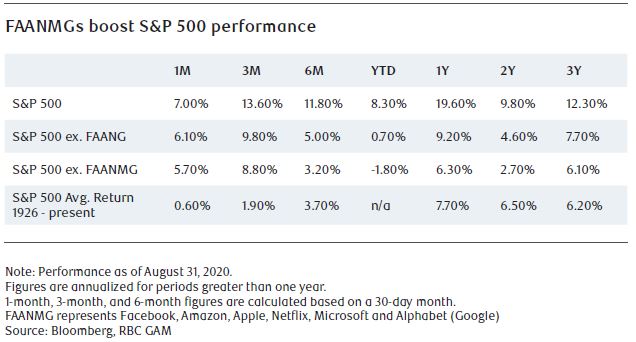
Another important factor is that the performance of an index – such as the S&P 500 – does not necessarily reflect the performance of all or even the majority of stocks that make up that index. If one or a few sectors of an index surge high enough, they can pull the overall index up with them, covering the poorer performance of the rest of the market.
Tech-tonic shift
And that’s exactly what’s happened: there’s been a massive surge in technology share prices. In fact, as the chart above shows, if we strip away the performance of key technology company shares – specifically Facebook, Amazon, Apple, Netflix, Microsoft and Alphabet (the parent company of Google) – the S&P 500’s year-to-date return is actually negative.
Yet, this support for technology stocks even during the economic slowdown is reasonable. Their services and products are almost perfectly aligned with what their customers need in a socially distanced and locked-down world, including work-from-home support, telecommunications, online entertainment and education, web-based support, and point-and-click delivery services.
Seeing the forest for the trees
Now, as much as ever, it’s important to keep a long-term perspective and remain well-diversified across all sectors of the market, as well as different asset classes such as stocks, bonds and cash, within your portfolio to help reduce risk. While markets and the economy work their way through these unpredictable and volatile days, an eye on the horizon seems the best way to "square the circle" that is sometimes the market vs. economy conundrum.
*S&P 500 Index performance from March 24 to September 30. Return in U.S. dollars. Source: RBC Global Asset Management.