

Watch our video here:
The type of account you invest through can be just as important as the investment itself. Think of investment accounts as the “home” your money lives in, each with different rules, benefits, and purposes. Let’s explore the different account options Sarah can use to invest the 20% of her annual salary she’s set aside for the future. Sarah’s current salary is $50,000 as a paralegal; however she knows that she will soon be making significantly more, likely in the highest tax bracket.
Because Sarah dreams of buying her first home in the next 5-10 years, she opens a FHSA (First Home Savings Account) as her first investment account. As she learns more about how it works, she’s excited to discover that contributions to the FHSA are tax-deductible just like with an RRSP—allowing her to lower her taxable income and pay less in taxes now, with an annual contribution limit of $8,000. Even better, when she’s ready to buy her first home, she can withdraw the money tax-free, similar to how a TFSA works, as long as it’s used for a qualifying home purchase.
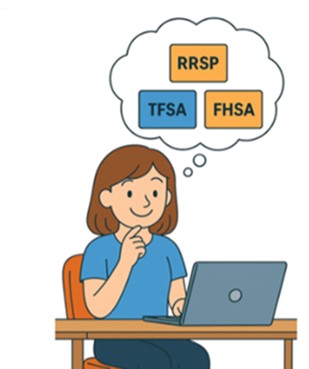
Next, Sarah opens a TFSA (Tax Free Savings Account). She discovers that money invested in a TFSA grows entirely tax-free and withdrawals are tax-free too—all with an annual contribution limit of $7,000. She doesn’t get a tax reduction for contributing; however she appreciates the flexibility. She can withdraw money at any time for any reason, whether it be a car, emergency fund, or vacation.
Sarah prioritizes the RRSP last because she knows the tax savings are greatest when she’s in the highest tax bracket, so she chooses to carry forward the contribution room. Sarah lastly opens an RRSP (Registered Retirement Savings Plan) to begin saving for her long-term retirement goals. She learns that contributions are tax deductible, which helps lower her taxable income and reduces the amount of tax she owes now. Investments in her RRSP grow tax-deferred, meaning she will only pay taxes when she withdraws the money in retirement. As Sarah’s income increases throughout her career, contributing to her RRSP becomes even more valuable by providing greater tax savings!
Let’s look at an example:
Sarah earns $50,000 a year and decides to contribute $10,000 to her RRSP.
Because RRSP contributions are tax-deductible, Sarah’s $10,000 contribution lowers her taxable income from $50,000 to $40,000.
This reduces the amount of income tax she owes for the year. Paying $5,668.25 compared to $7,726.80 saves Sarah $2,058.55!
If she were to pay tax without the RRSP contribution ($50,000 income):
Federal Tax: $50,000 x 15% = $7,500
Subtract Federal Basic Personal Amount: ~$15,705 x 15% = $2,355.75
Net Federal Tax: $7,500 - $2,355.75 = $5,144.25
BC Provincial Tax:
First $47,937 x 5.06% = $2,423.70
Remaining $2,063 x 7.7% = $158.85
Total BC Tax: $2,582.55
Total Tax owing at $50,000: $7,726.80
If she were to pay tax without the RRSP contribution ($40,000 income):
Federal Tax: $40,000 x 15% = $6,000
Subtract Federal Basic Personal Amount: $2,355.75
Net Federal Tax: $6,000 - $2,355.75 = $3,644.25
BC Provincial Tax:
Total BC Tax: $40,000 x 5.06% = $2,024
Total Tax owing at $40,000: $5,668.25
That $10,000 stays invested in her RRSP and grows tax-deferred. Let’s say it grows to $50,000 by the time she retires.
She won’t pay any taxes on that growth until she withdraws the money in retirement.
This information is not investment advice and should be used only in conjunction with a discussion with your RBC Dominion Securities Inc. Investment Advisor. This will ensure that your own circumstances have been considered properly and that any action is taken based upon the latest available information.
The strategies and advice in this newsletter are provided for general guidance. Readers should consult their own Investment Advisor when planning to implement a strategy. Interest rates, market conditions, special offers, tax rulings, and other investment factors are subject to change.