

The 2022–2026 bull market is in full swing, and intact after a 100 % rebound by the S&P 500 and 150 % rally by the Nasdaq 100 from the Q4 2022 lows.
While valuations remain a headwind, U.S. equity markets remain above key technical support levels with potential for further sector rotation developing heading into Q2.
The major U.S. equity indexes are at an important technical inflection point. Following a 100 % rebound by the S&P 500 and a 150 % rally by the Nasdaq 100 from their cycle lows in Q4 2022, it is important to watch the market’s technical profile for signs a top may be developing.
Both the S&P 500 and Nasdaq 100 have traded sideways in a narrow range since Q4 2025 as investors reallocated capital away from Technology toward other equity sectors and markets.
The tech-heavy Nasdaq 100 is particularly noteworthy given that it is at a key technical “make or break” point following 4+ months of trading in a narrow range, coinciding with its 200- day moving average.
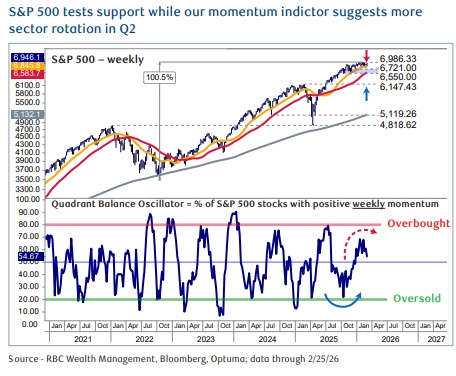 Interestingly, the weekly momentum indicators we follow to identify potential turning points over a 1–2 quarter time frame transitioned from overbought (high) levels in late Q3 2025 to oversold (low) levels moving into the end of February.
Could growth stocks rally?
It is premature to conclude a rotation back to Technology stocks is underway. The technical backdrop does suggest a rebound is likely. Semiconductor stocks show early signs of stabilizing near important support at rising 200-day moving averages.
Meanwhile, the “waterfall declines” in software stocks over the past few months have left them at oversold levels near support bands where we expect many to begin establishing a bottoming pattern.
The bottom line is that although the 2022–2026 market cycle has rallied a long way since its Q4 2022 lows, and while elevated valuations remain a concern, technically it is premature to turn overly cautious on equities.
In any given year, equity leadership ebbs and flows between sectors over a roughly 1–2 quarter time frame. Given most of the non-Technology sectors have surged to technical levels well advanced over the past 4+ months, a rotation to growth stocks that have pulled back to support levels appears likely.
What would turn the technical backdrop negative?
A break below 6,721 and the 200-day moving average for the S&P 500 and below 24,000 and the rising 200-day moving average for the Nasdaq 100 would indicate that the Q4–Q1 trading ranges are resolving to the downside and likely suggest a peak for the 2022–2026 cycle uptrend.
While our indicators were oversold (low) in Q4, it has built steadily to the upside through Q1 reflecting the broad rebound in most sectors outside of Technology, notably Financials, Utilities, Consumer Staples, Health Care, Industrials, Materials, and, more recently, Energy.
Now, with most stocks in those sectors having rallied strongly, the indicator is transitioning back to overbought (high) levels with the risk a pause/pullback could develop moving through late Q1 into Q2.
Investors should remain cautiously optimistic, as we continue to monitor downside risk control levels.
The bottom line is that it will be important for growth stocks that have either paused or pulled back since Q4 to begin stabilizing and rallying to keep the overall market cycle intact.
While a rotation back to growth appears likely, an inability to do so would lead to the S&P 500 and Nasdaq 100 breaking below the key support levels highlighted above, viewed to be useful downside risk control levels.
A well-diversified portfolio remains prudent moving through 2026, which we continue to expect will be volatile consistent with the pattern of many U.S. midterm election years
If you have any questions or comments, please feel free to let me know.