

China’s economy, faced with structural and cyclical challenges, is now growing more slowly than in its glory days.
Let’s explore the monetary and fiscal measures undertaken thus far.
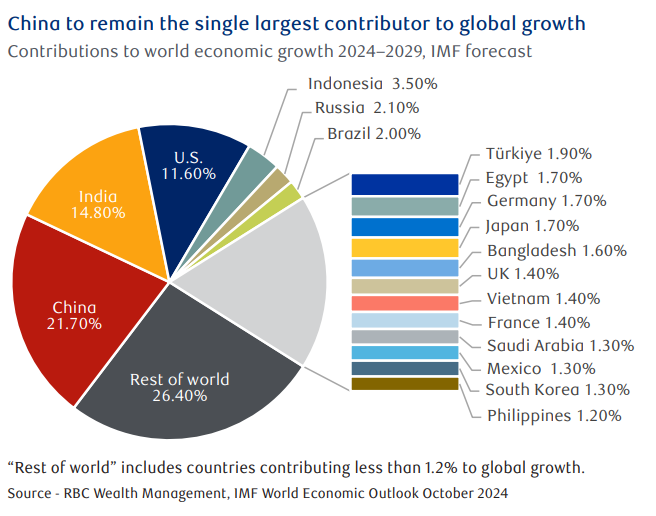
Despite slower growth, the country should be in good stead to remain the main contributor to global growth.
The authorities seem determined to draw a line under the debilitating housing crisis and have announced a coordinated stimulus.
National Challenges
The Chinese economy, which grew at an average annual rate of some 9 % in the three decades to 2020, is now growing much more slowly. This should not be entirely surprising, as the economy is more mature and much larger than it was years ago.
These challenges pertain to:
- Ageing Population: China’s population has been declining since it peaked at 1.426 billion people in 2020, with a median age of 39.6 years, compared to 23.7 years in 1990.
- Housing Market: Home sales and prices have declined. The housing market’s troubles have impacted consumption and investor sentiment, as the property sector accounted for up to 25 % of GDP at its 2022 peak, with significant household wealth tied to it.
- State vs. Private Sector: The authorities have in the past prioritized state-owned enterprises over the private sector, viewing them as vital to maintaining economic stability and ensuring strategic control and sovereignty. This preference has often resulted in private businesses facing more stringent regulations.
Legitimate or Overblown ?
Concerns regarding China’s prospects are thus legitimate, but RBC Global Asset Management, Inc. Chief Economist Eric Lascelles has long believed that the struggles of the Chinese economy have been exaggerated.
He points out that while the housing and consumption of goods and services are weak, traditional sources of Chinese strength, such as exports and industrial production, remain relatively strong.
GDP growth for the first three quarters of 2024 reached 4.8 % relative to the same period a year earlier….yet, local governments are in a precarious position.
Banks may need further support, and the property sector is still weak.
After implementing a number of targeted measures to stimulate certain areas of the economy over the past few years, the country’s policymakers unveiled significant initiatives in late September 2024.
Government officials also hinted at a coordinated effort to enhance economic growth through both monetary and fiscal policies, which include:
- An additional 50 basis points (bps) cut to 6.6 % to the average Required Reserve Ratio, the monetary policy tool used by the People’s Bank of China to control the money supply.
- A range of cuts to related interest rates, including a 50 bps reduction in mortgage rates;
- A reduction to 15 % from 25 % in the minimum downpayment on second properties
- A total of 800 billion renminbi (US$112 billion) in liquidity backing to support stock market purchases by major Chinese financial institutions and companies.
The Ministry of Finance announced that fiscal spending would increase before year-end and next year, though details have been lacking. Delays may indicate that reaching a consensus on the amount of borrowing required and how it should be spent has been difficult.
Details are widely expected when the National People’s Congress Standing Committee, China’s legislature, convenes November 4–8. Possible measures include support for local governments burdened by significant debt, a move that could also aid banks that extended loans to these local entities.
Steps to bolster demand are also likely, potentially including an expansion of the national safety net, according to Lascelles. Chinese households tend to save rather than spend, with the country’s national savings rate exceeding twice that of the U.S. Gross national savings as a percentage of GDP stands at 43 % compared to 17 % in the United States.
Caixin Global, a media group, reports that, overall, China’s central government may borrow six trillion renminbi (US$842 billion), or the equivalent of a substantial 5 % of GDP, though a more modest amount may be announced. By comparison, to mitigate the impact of the global financial crisis in 2008, China launched a stimulus program of more than US$575 billion, which represented then 12.5 % of GDP.
Overall, Eric explains that expectations need to be managed carefully given that the Chinese economy is unlikely to ever return to its prior glory days of 6 % plus growth. He believes that given the demographic challenge and China’s advanced stage of development, a gradual deceleration to annual growth of 3 % or 4 % is the most likely scenario.
Furthermore, economic development is no longer the sole focus for the authorities, as they now also place a high priority on national security, food security, energy security, and tech self-sufficiency.
As always, please let me know if you have any questions or comments.