

The current yield curve inversion, a potential recession indicator, looks out of line with record equity markets and robust commodity pricing.
Let’s examine some reasons investors are accepting lower yields on longer-maturity bonds.
 The relationship between a bond’s tone and yield is typically positive—longer maturities have higher yields. This makes intuitive sense; longer time frames are associated with greater uncertainty, which has historically earned investors a premium. This baseline condition of higher yields for longer maturities is referred to as a “normal” yield curve.
Sometimes the typical relationship is inverted, and shorter maturities command a yield premium, a circumstance that is—predictably, if unimaginatively— called an “inverted” yield curve.
By that measure, the curve is currently inverted by 45 basis points, with 2-year yields of 4.87 % and 10-year yields of 4.42 %.
More significant than the size of the current inversion is its duration—it’s been nearly two years since normalcy prevailed in the yield curve, exceeding the prior record of 623 days set back in 1978 and dwarfing the average 92-day inversion of the past half century.
Recession Forecasts
Curve inversions are watched closely as recession predictors, and there are two paths to connect economic slowdowns with yield differentials.
- Inversions reflect excessively tight monetary policy. Under this view, restrictive monetary policy causes growth to slow, which in turn prompts the Fed to lower rates. These cuts can hurt investors in shorter-maturity bonds as they are forced to reinvest at these lower future rates. This rollover risk makes longer maturity bonds more attractive, pushing prices up and yields down on 10-year bonds.
- Inverted yield curves and slowing economic activity stems from cross-asset class performance.
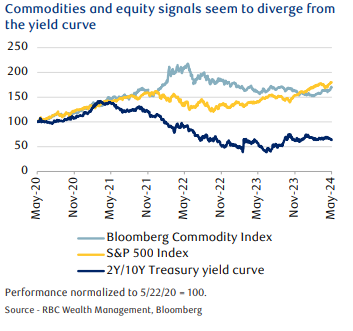 In a slowing economic environment, growth-sensitive assets such as stocks can face headwinds, while fixed income offers investors a more stable set of cash flows.
Both of the factors above have played a role during the current inversion.
Private and public sector forecasters have seen elevated risks of a recession in the past two years, making longer maturities more attractive. Investors have also had at times quite aggressive forecasts for Fed rate cuts, most notably at the end of last year and beginning of this year. Neither seems particularly relevant at the moment, however.
Equity prices are at or near record highs while growth-sensitive commodities are showing very strong year-to-date performance. Copper, for instance, is up nearly 25 % in 2024. This type of performance is inconsistent with the idea that investors are expecting a near-term recession or meaningful growth slowdown.
Back in January of this year interest rate futures were pricing in 6 rate cuts. That made the path to curve normalization quite simple—the Fed was going to do all the work and get shorter-maturity yields below long-maturity yields. That math, however, no longer works as well.
RBC Capital Markets is projecting only 3 rate cuts this cycle, for instance, and multiple Fed members have already highlighted the prospect that this rate cut cycle will leave rates higher than their post-global financial crisis norm.
If correct, short-term rates may not fall enough to allow for an easy curve normalization
What Is Normal ?
Against these market signals of stronger growth and higher-for-longer short-term rates, one would typically expect 10-year rates to rise, re-establishing the typical relationship between longer maturities and higher yields. That hasn’t happened yet. Nor will it any time soon if current bond prices are to be believed.
The existing yield-maturity dynamic implies roughly another two years of inversion in the 2Y/10Y relationship.
One reason is the relatively high absolute level of bond yields. High-quality corporate bond indexes yield north of 5.7 %, while some municipal bonds offer tax-equivalent yields of nearly 7.5 %, depending on an investor’s tax status.
For those who take a longer-term perspective, securing that type of yield can be attractive, particularly from a portion of the portfolio that is often considered mere ballast for equities. Adding to the level of yield is the potential asymmetric risks of owning longer-maturity bonds.
Recent Fed commentary has emphasized the high hurdle for the central bank to resume rate hikes, while inflation is driven by an increasingly narrow set of components. At the same time, labor market data has shown some initial cracks. This comes as lower-income households have run down savings and run up debt, leaving them heavily reliant on wage income.
The combination of downside risks to growth and a Fed that is reluctant to hike could be a tailwind for longer-term bond prices. Risks around inflation and policy remain, and we do not want to suggest there is no risk to owning bonds—there is risk at every maturity available.
Investors could reasonably view the combination of today’s higher yields and the trends in economic data to conclude that longer-term bonds may deserve a price premium.
One final implication of the inverted yield curve is that it gives meaningful comfort that the U.S. will be able to fund its budget deficits for the immediate future.
Right or wrong, investors are currently paying a premium to lend to the U.S. for a longer time. That bodes well for the market’s ability to absorb the large amounts of bonds the U.S. plans to sell.
Historical Lessons
The current inversion boils down to two realities: economic uncertainty remains high, and short-end rates are either set by or heavily influenced by a government institution while longer-term yields are set by the market.
This combination has led to the disruption of historical relationships, as the Fed focuses on relatively few short-term factors and the market prices in a wide range of longer-term scenarios.
It is logical to assume investors will return to their typical behavior of demanding higher yields for longer maturities, and the yield curve will normalize.
As always, please let me know if you have any questions or comments.