


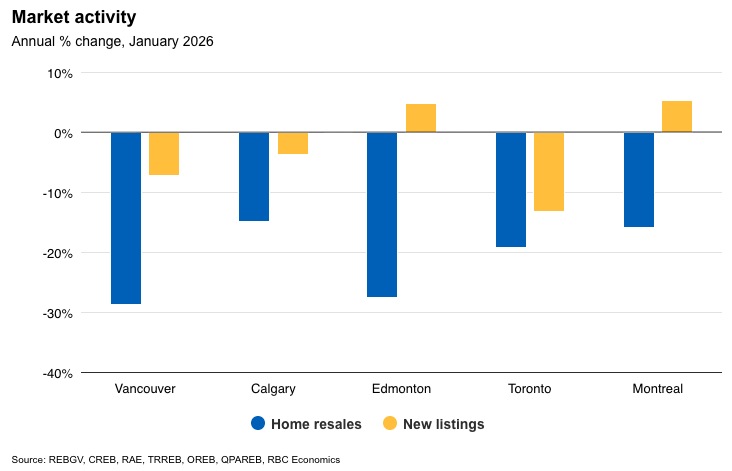
Supply-demand conditions weakened further in most large Canadian markets as January unfolded.
Potential buyers remained cautious despite elevated inventory giving them the upper hand. Severe winter weather likely contributed to the slowdown, with significant precipitation in several regions keeping prospective buyers on the sidelines.
Recent activity patterns were also muddied by calendar distortions. January 2026 contained more working days compared to a year ago, while December’s working day count aligned unusually with January’s—a rare occurrence that likely exaggerated trends.
Still, demand plummeted in several markets—particularly Vancouver and Fraser Valley, while Edmonton, Winnipeg and Saskatoon posted notably weak results. Toronto and Montreal continued to soften as well. Calgary and Regina were among the few outliers to see an increase in buying activity.
Inventories, however, continued climbing higher across most regions—taking a toll on prices. Several markets posted largest year-over-year price declines in years.
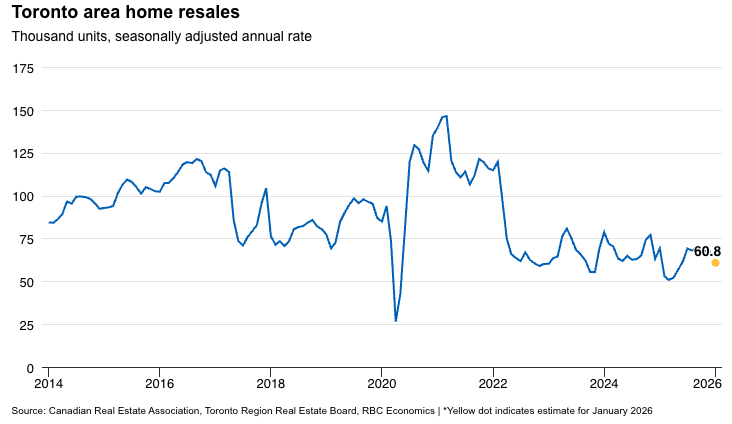
Toronto area: Market not thawing yet
January data revealed continued softness in the Greater Toronto Area with sales contracting 9.9% seasonally adjusted from December.
The downturn extends challenging conditions that characterized 2025, marking the fourth consecutive monthly decrease and the largest such contraction in almost a year.
Ontario’s severe winter weather—including one of the largest snowfalls in years—was likely a contributor to suppressed activity as soft market conditions left prospective buyers with little urgency to venture out.
New listings picked up marginally (1.1% SA), adding to the stockpile of inventory sitting idle. Year-over-year growth in active listings has moderated in recent months, but inventory remains stubbornly elevated relative to historical norms.
Supply-demand conditions continue to favour buyers, maintaining downward pressure on prices. The MLS Composite Home Price Index remained on a downtrend through January, dropping 8% from a year ago—the 22nd consecutive decline and sharpest drop in three years.
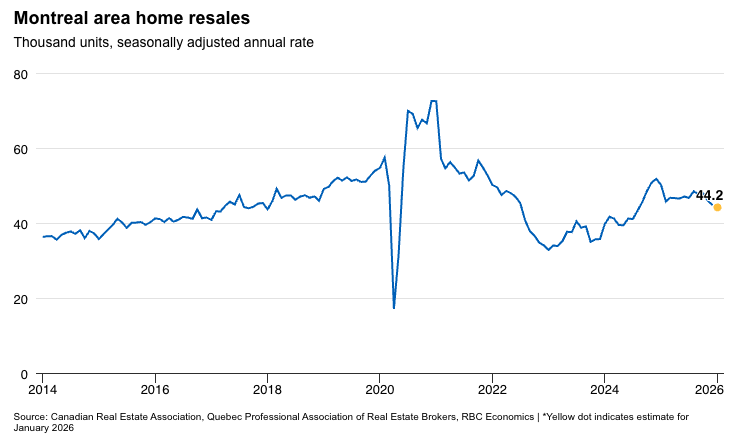
Montreal area: Soft patch extends into January
The slowdown that ended 2025 in the Montreal area persisted into January. We estimate sales decreased 1.4% seasonally adjusted from December, but a significant influx of new listings—driven primarily by condos—is finally rebalancing the market. The sales-to-new listings ratio has settled into an equilibrium for the first time in months.
This shift is already tempering price growth. Median single-family home prices moderated with annual gains slowing from 7.8% in December to roughly half that pace in January as the market moves into balance. Condo appreciation remains the slowest of the three property types with the median price increasing by 2% from a year ago.
Notwithstanding January’s supply increase, active listings remain relatively subdued—limiting buyer choice. Constrained inventory will likely pave the way for larger price appreciations in the year ahead as buyer confidence slowly strengthens.
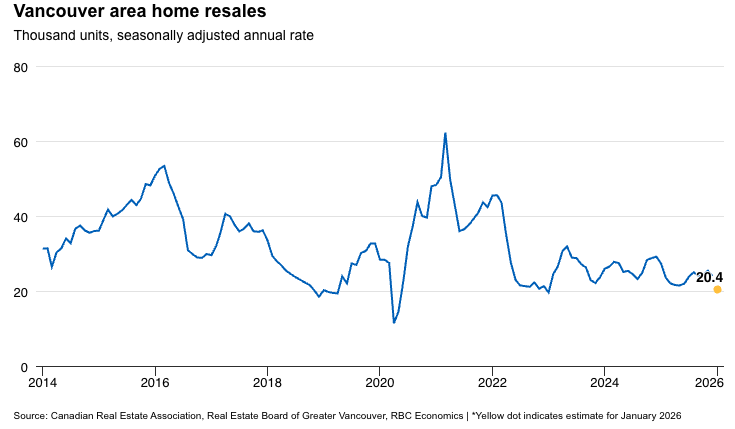
Vancouver area: Sharp pullback halts Q4 momentum
January interrupted a string of improvements over recent months in the Vancouver market.
Sales plummeted nearly 30% seasonally adjusted from December, erasing three consecutive months of modest gains—exposing just how fragile recent improvement had been. While seasonal adjustment factors may be exaggerating some of the weakness, the underlying picture remains decidedly challenged.
Resales continue to lag well below the 10-year seasonal average, while listings sit significantly above historical norms. It’s a combination that keeps leverage in buyers’ hands, and prices on a downtrend. Greater Vancouver’s MLS HPI benchmark fell 5.7% year-over-year in January, marking nearly a year of annual declines.
Tentative signs of stabilization capped off 2025, but the market continues to face poor affordability and elevated supply for buyer demand. We see this dynamic keeping prices relatively soft in the months ahead.
Calgary: Supply dominance continues
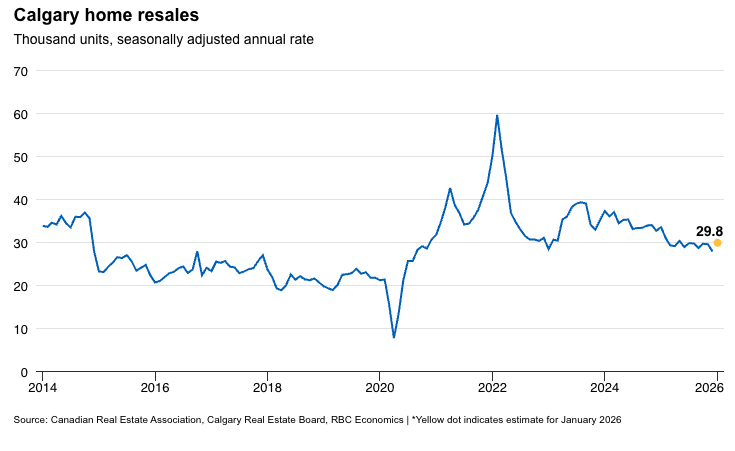
Sales rose 7.3% seasonally adjusted in January from December in Calgary—a notable uptick after a sluggish finish to 2025.
Gains, however, were overshadowed by an even larger jump in new listings, reinforcing supply dominance that continues to define the market.
Elevated inventory is keeping home prices on a downtrend. The composite HPI benchmark tumbled 4.7% year-over-year, though the deterioration wasn’t distributed evenly across property types. Detached homes are holding up better than higher-density units, resisting steeper price declines.
Lots of residential construction in the pipeline suggests inventory will remain elevated, preventing dynamics from shifting into the seller’s favour without an adequate increase in demand.
Rachel Battaglia is an economist at RBC. She is a member of the Macro and Regional Analysis Group, providing analysis for the provincial macroeconomic outlook.