

Good Morning & Happy New Year !
We are happy to be back. I hope that you had a great holiday season with loved ones.
Given today’s strong employment data in both Canada & The U.S., let’s highlight 5 reasons why equities capped off a banner year in 2024, and why investors benefited from staying invested.
2025 Portfolio Positioning
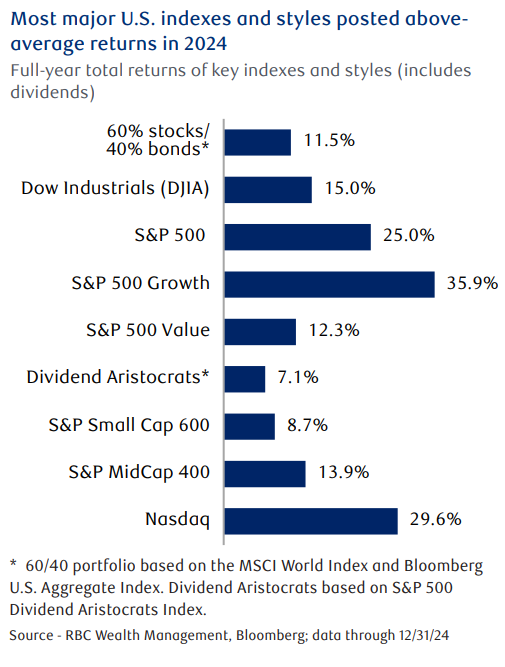
The S&P 500 charged ahead in 2024 with the second straight year of 20 % or better returns, bringing the total gain since the bull market began in October 2022 to 70.1 % including dividends. This represents above-average annual returns in 6 of the last 8 years.
Economic Growth Stronger Than Expected
The strong economy was a key reason why most major U.S. indexes and styles posted above-average gains again. Wall Street economists started 2024 with a meager 1.2 % annual GDP growth forecast, which was barely positive.
However - month after month - economic momentum built, and the forecast ended December at 2.7 %, (Q4 2024 GDP growth results will be announced in late January.)
Employment was sturdy during the year, wages grew faster than inflation, consumer spending rose at a healthy clip. The services sector expanded notably. The main laggard was manufacturing, but this represents only a small share of domestic economic activity.
Toward year end, however, a few things had changed.
Following the hawkish comments from the U.S. Federal Reserve in early December, equity market participants have kept a close eye on rising Treasury yields. While RBC economists and most others expect GDP growth to persist in 2025, there is now a strong debate about how high Treasury yields can rise before they dent the economy and equity market.
There is no line in the sand, but if the 10-year Treasury yield pushes closer to 5 % or above, the S&P 500 and other major U.S. equity indexes could retreat further.
AI Enthusiasm
While 7 of 11 S&P 500 sectors delivered handsome double-digit returns in 2024, the market was once again led by stocks leveraged to the artificial intelligence theme, otherwise known as the “Magnificent 7” (Alphabet, Amazon, Apple, Meta, Microsoft, NVIDIA, and Tesla) and Broadcom, another AI-oriented stock.
NVIDIA surged 171 % for the year and contributed by far and away more to S&P 500 returns than any other stock, representing 22 % of the index’s gains.
Six other stocks represented another 33 % of the S&P 500’s return for the year. That left the other 511 stocks in the index making up the rest.
 Six of the biggest AI firms are estimated to have plunked down more than $165 billion in capital expenditures on the technology in 2024, a 50 % jump from the very elevated 2023 level, (Bloomberg Intelligence). This spending fueled optimism about future revenue and earnings growth. AI is a foundational leap in technology and many believe that multiple industries can benefit from it.
Wall Street does often get ahead of itself when pricing in groundbreaking technologies, and long-term winners can differ from those that initially lead the pack.
There will be a greater focus on AI return on investment in 2025 and beyond. Easier money and falling inflation Fed rate cuts and a further retreat in inflation also helped the equity market in 2024.
From September through December, the Fed cut its benchmark rate by 1%. The Consumer Price Index declined from 3.4 % at the start of the year to 2.7 % by November.
As equity market participants largely declared “victory” over inflation, other factors contributed to a broad group of sectors rallying during the year.
In recent weeks, there are signs market participants are having second thoughts.
There are concerns that inflation might at the very least remain elevated above the Fed’s 2 % target for longer or the inflation rate could increase, especially if the incoming Trump administration’s tariff policies are aggressive.
Earnings Growth Estimates
Normally, S&P 500 consensus earnings growth estimates decline somewhat throughout the year, but in 2024 they increased, and this occurred even though most strategists viewed earnings expectations as elevated or even overly optimistic when the year began.
But here again, the AI stocks played an outsized role.
2024 earnings growth estimates for the six biggest AI stocks increased almost 33 % from June 2023 through year-end 2024, while estimates for the rest of the S&P 500 declined 5.7 % during the same period.
The earnings estimate trends for three large-cap categories—the biggest AI stocks, other technology stocks, and the rest of the S&P 500—will play a key role in shaping overall S&P 500 and sector returns in 2025.
As things stand now, the consensus forecast is for other technology stocks to grow earnings slightly faster than the biggest AI stocks, and for both of those categories to exceed the earnings growth of the rest of the market.
Again, as has been the case before, estimates can change a lot between categories as the year progresses.

U.S. Election Read-Through
The S&P 500 and other major indexes extended their gains following Donald Trump’s election victory and the Republican sweep of Congress. Investors embraced the notion that low tax rates on individuals could be extended and rates could be cut a bit more in some areas, and that corporate tax rates could at least remain low or be cut further for domestic manufacturers.
Optimism about deregulation also fueled the move.
Last year, the equity market largely ignored Trump’s other major policy proposals such as tariff hikes and deportations, although both topics started to be considered and debated more toward year end.
While Washington policy rarely is the main factor in determining economic outcomes and equity market returns, market participants will be much more focused on this topic in 2025 than usual.
How To Proceed
RBC Capital Markets anticipates mid-single-digit gains for the S&P 500 in 2025. Already-premium valuations and frothy investor sentiment readings argue that the appropriate positioning for the year ahead in a global balanced portfolio would have equities at long-term target weights. This approach that is “watchful, cautious, but invested.”
Please let us know if you have any questions or comments.