

After biding its time, the Fed finally kicked off its monetary easing cycle with a strong start out of the rate cut gates.
While investors may harbor some concerns the Fed is getting ahead of itself and that more aggressive cuts could reignite inflationary pressures, let’s highlight the many reasons to be encouraged by the Fed’s proactive move.
As markets widely expected, the Federal Reserve finally joined the global policy easing cycle with a 50 basis point (bps) rate cut this week, bringing its target rate down to a range of 4.75 % to 5.00 % from 5.25 % to 5.50 %.
While there was an unusual level of uncertainty heading into this week’s policy meeting with respect to the size of the cut—25 or 50 bps— the feel is that the Fed made the right call.
 Back at the July meeting, according to the minutes, there was already an open discussion among policymakers of whether to cut rates.
Since then, inflationary pressures have only cooled further while the two payroll reports released have been much softer than the Bloomberg consensus expected.
While Fed Chair Jerome Powell during his press conference wouldn’t go so far as to characterize the larger rate cut this week as an effort to play catch up to a labor market that may be cooling faster than policymakers expected, it is very obvious.
Whether this is a classic case of “too little, too late” remains to be seen—in both 2001 and 2007 the Fed kicked off easing cycles with outsized rate cuts, which, of course, are not great periods to be benchmarked to.
The Fed’s proactive decision this week, at a time when policymakers could have easily justified so-called soft economic landing, while reducing risks of a hard landing. That, of course, remains highly uncertain, and highly dependent on how the economic data develops.
1st Cut Is The Deepest ?
Given that the Fed chose to cut rates this week by more than consensus surveys had expected, and that its own revised rate projections also show more rate cuts in the pipeline than anticipated, investors may harbor some concerns that the Fed is getting ahead of itself, and that more aggressive rate cuts could reignite inflationary pressures.
 While the Fed’s headline policy rate garners much of the attention, everything is relative.
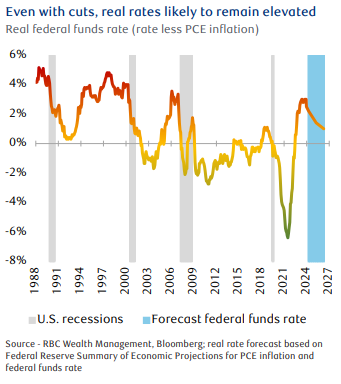
What actually matters in terms of economic activity, inflation, and employment is the level of real interest rates—or the Fed’s policy rate adjusted for inflation.
Real rates peaked around 3 % in recent months. A fed funds rate of 5.5 % and a headline personal consumption expenditures (PCE) inflation rate of 2.5 % as of the latest reading in July—a level consistent with those reached in recent decades.
But as that chart also shows, those points also tended to be followed by recessions. The Fed’s updated Summary of Economic Projections shows that the central bank expects to take the upper bound of its target range down to 4.50 % by the end of this year, to 3.50 % in 2025, and to 3.00 % in 2026.
Policymakers also expect inflation to fade back to target over that horizon, which would leave real rates at a still relatively high level of 1.00 % (3.00 % fed funds rate minus the 2.00 % target inflation rate).
At the same time, if you believe that the Fed’s moves could shore up the economic outlook, you’d have to acknowledge that a slightly better economic outlook could also mean that inflationary progress could slow.
Looking Abroad For Clues
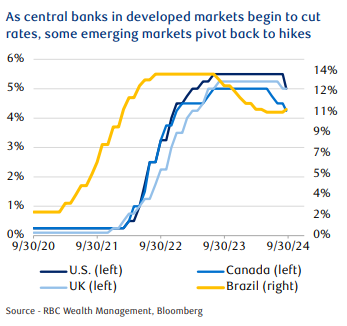
Back in 2023, and amid still high uncertainty that inflation would cool to the point to allow Fed rate cuts in 2024, let’s look to emerging markets for clues.
The general thinking is that inflation tends to be more of a problem for emerging markets, and therefore the central banks of those nations must be more attuned to inflationary risks.
For instance, the Central Bank of Brazil began raising rates in early 2021, about one year before developed market central banks followed suit. In the summer of 2023, the Central Bank of Brazil began cutting rates as inflationary pressures dropped.
If that same lead time held, then it seemed reasonable that developed market central banks could be easing by this summer, which they have.
So, and with that in mind, just as the Fed delivered a 50 bps rate cut on Wednesday, the Central Bank of Brazil moved to raise its policy rate by 25 bps, its first rate hike since it began lowering rates in August 2023.
Policymakers in Brazil cited growing risks around higher inflation forecasts as one reason to add back some policy restrictiveness, and noted that more rate hikes could be on the table.
To be clear, a second wave of inflation in the U.S. or globally is not widely expected. However, one always has to be cognizant of potential risk factors.
Using emerging market central banks as leading indicators for rate cuts, you’d be remiss if you didn’t keep one eye on how other easing cycles have transpired.
Therefore, Fed rate cuts should help to ease currency pressures in Brazil, and therefore inflationary pressures as well—so this may not be an explicit warning sign on resurgent inflationary risks for developed markets.
Life In The Present
The proactive decision by the Fed this week should help to shore up the economic outlook, and we are encouraged that the Fed has chosen to do so when it has historically been too reactive, and therefore often too late in dialing back monetary policy restrictiveness.
Plenty of economic and policy-related uncertainty will undoubtedly remain. However the strong start out of the rate cut gates by the Fed should go a long way toward staving off intermediate-term recessionary risks, or at a minimum material further weakness in U.S. labor markets.
As always, please let me know if you have any questions or comments.