

A gulf exists between Vice President Kamala Harris and former President Donald Trump on policy issues.
What follow is an executive summary of key policy differences that matter most to the economy and stock market.
It has been long held that the stock market doesn’t march to the president’s drum—or Washington, D.C.’s for that matter. Quite often other factors supersede developments inside the Beltway.
In reality, many campaign proposals don’t see the light of day because of the checks and balances built into the system.
Yet it’s still useful to consider candidates’ economic proposals given that some presidential decisions can impact the market overall or select industries, even if just for a short time.
Tax Plan
The large tax cuts on individuals, investments, and estates that were implemented in 2018 during Trump’s presidency, known as the Tax Cuts and Jobs Act (TCJA), will expire at the end of 2025. If nothing is done, they will automatically revert to higher levels previously in place.
Trump proposes to extend all of the low tax provisions in the TCJA beyond the year-end 2025 sunset date, regardless of household income, and he wants to cut taxes on Social Security retirement benefits.
Harris seeks to extend the low tax rates for most taxpayers but is in favor of raising taxes on households with incomes above $400,000 per year, and increasing the long-term capital gains tax for those earning $1 million or more. She would boost the TCJA child and small business tax credits and would introduce a new tax credit for certain first-time homebuyers.
The corporate tax rate, which the TCJA cut to 21 % from 35 %, does not sunset at the end of 2025—it will stay in place until it is proactively raised or lowered.
Harris advocates raising the corporate tax rate to 28 % from 21 %. While Trump had previously called for lowering the corporate rate to at least 20 %, more recently he proposed reducing it to 15 % for companies that manufacture goods in the U.S., with some restrictions.
Impact Of Tax Code Changes
Regardless of who is elected president in 2024, the congressional election results will play an important role in determining tax and other fiscal policies.
Major tax code changes on individuals or corporations are likely not factored into stock market sentiment at this point.
Corporate tax rate change is also probably not factored into S&P 500 consensus profit margin forecasts, which are currently near the upper end of the range since 1990.
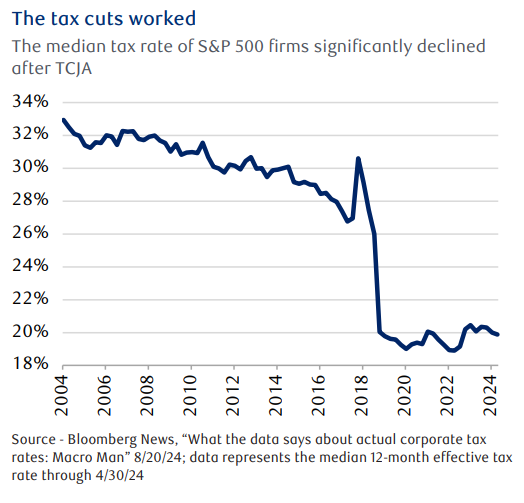 A Bloomberg study found, “Over the long run there has been essentially zero correlation between the effective corporate tax rate and the performance of the S&P 500…”
Investors should keep in mind that before we get to the “long run,” the policy debate between the next president and Congress (and lobbyists) about tax rates and other fiscal issues could have a short-term impact on U.S. stock market volatility following the election, including at times during 2025.
Price Plans vs Politics
Despite the significant decline in the year-over-year consumer inflation rate, the presidential candidates and most voters are still focused on the fact that overall prices remain very elevated.
Harris proposes to tackle high prices by targeting “price gouging.”
Any new, comprehensive price gouging legislation would likely go nowhere in the next session of the Senate and would also struggle to gain support in the House of Representatives, no matter which party wins control of these two congressional chambers.
Nevertheless, expect that a Harris administration to more aggressively investigate and prosecute federal antitrust and consumer protection cases compared to the Biden administration and previous Trump administration.
Trump’s strategy to bring prices down focuses on incentivizing more domestic oil and natural gas production and energy exports, with the aim of substantially lowering energy and power prices overall, which are key cost inputs of many goods and some services.
Even if this were to dampen global oil and goods prices, some of Trump’s other policies, namely tariff increases, could partly or fully wipe out the benefits that lower energy and power prices would bring.
Tariffs
Many of Trump’s tariff policies are more sweeping than those he implemented during his previous term, and they differ greatly from those of Harris.
Trump supports across-the-board tariffs on all imports of 10 % or more, and high tariffs on Chinese imports of 50 % or more. He would levy tariffs on goods of U.S.-based companies that are produced overseas and imported into the country, and would use tariffs against domestic companies that outsource American jobs. He has also threatened to use tariffs against countries that trade outside of the U.S. dollar system.
Harris does not support across-the-board tariff increases and views such tariffs as “in effect a national sales tax.” She also does not support significantly raising tariffs on Chinese imports but would likely keep in place the China tariffs and sanctions that Trump and President Joe Biden implemented.
RBC Global Asset Management Inc. Chief Economist Eric Lascelles contends that tariffs “undeniably hurt the country that has tariffs levied against it…” However, he cautions, “Less intuitively, tariffs usually also hurt the country levying them.”
Regulations And Law
The widespread perception among market participants that Trump is likely to have a more business-friendly regulatory regime than Harris rings true to us, except there are nuances.
While the Biden-Harris administration added 11 % more “economically significant regulations” in almost 3.5 years than Trump did in his full four-year term, Trump’s administration ended up implementing more regulations than President Barack Obama did in his first term.
A Harris administration would implement more proactive and stringent environmental regulations. She would look for opportunities to advance the ball on climate-related issues, whereas Trump stated he would roll back existing climate regulations and targets.
Despite multiple presidential candidates’ pledges to “cut the red tape” in campaign after campaign, a heavy regulatory load on businesses has been the norm for decades.
Only a concerted, laser-focused effort on reducing regulations would change this. For deregulation to work for both the business sector and society, we think a scalpel would be needed rather than a sledgehammer.
As always, please let me know if you have any questions or comments.