

We are going to have a bit of a change of pace this week.
Our usually writings centre on financial markets and the economy at large. Today we will examine the efforts made through science to extent longevity, and what this could mean for our society.
Emerging technological advancements are driving innovations all around us, transforming how we live, work, and interact with one another.
RBC Wealth Management’s “Innovations” series examines these agents of change and how they can open compelling investment opportunities.
This is a summary of the inaugural report in the series which focused on scientific advancements related to ageing. We dive into a few of the most promising advances and explore the link between scientific breakthroughs and intriguing investments.
From lifespan to healthspan
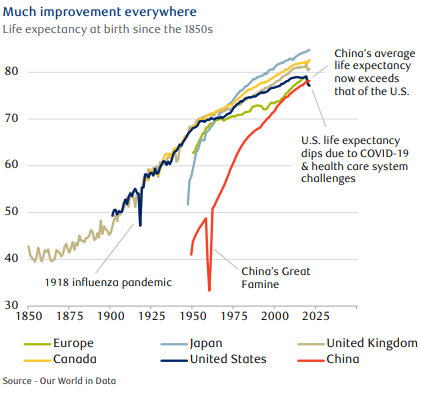
Life expectancy has doubled over the past 150 years thanks to medical and social progress. Today, children born in developed nations can expect to have an even chance of living past their 80s.
Living longer has brought with it a bevy of conditions that past generations—who were prone to die from war, accidents, famine, or epidemics—had virtually no experience with.
Scientists’ attention has thus turned to extending healthspan, or the number of healthy years before the end of life.
Successfully lengthening healthspans could alleviate cost pressures on both governments and households while adding more years of satisfying life.
What is ageing?
In “The Hallmarks of Aging,” Carlos López-Otín, professor of biochemistry and molecular biology at the University of Oviedo in Spain, led a team that produced a widely used list of the characteristics of ageing. In a nutshell, some of the ageing hallmarks include:
- Genetic mutations accumulating
- Chromosome ends crumbling
- Tissues being blocked with debris
- Cells becoming cancerous while others enter a zombie-like state, harming healthy cells
- Stem cells no longer dividing and becoming unable to create new cells
- Mitochondria, the powerhouses of cells, falling into disrepair
- Chronic inflammation creeping through the body
- Gut microbiome becoming less healthy
Eventually, age-related damage enhances the body’s vulnerabilities and can lead to chronic disorders such as heart disease, osteoporosis, cataracts, and neurodegenerative illnesses.
DIY healthspan extension (biohacking)
A culture of “do-it-yourself” healthspan extension has emerged. “Biohackers” are people who explore using existing pills and supplements in the hope of improving their healthspan, and largely operate outside the medical sphere.
Stem cell regeneration and cellular reprogramming
Another approach focuses on rejuvenating or reprogramming the cells, capitalizing on recent developments in stem cell science.
Stem cells are the reserves from which new cells can be produced to regenerate tissue, and are already widely used in regenerative medicine.
 Telomerase reactivation
Telomeres are segments of DNA at the end of each chromosome.
Every time a cell copies its chromosomes and divides, telomeres become slightly shorter.
When telomeres get too short or wear out completely, cells may stop dividing and become senescent.
Scientists are focusing on an enzyme, telomerase, which can lengthen telomeres.
They are exploring whether it is possible to reactivate the enzyme which the body deactivates as part of the ageing process.
It’s recently become commonplace to carefully calibrate what one eats to improve the health of one’s microbiome.
Intermittent fasting is an increasingly popular method that aims to induce autophagy, the waste disposal system that cells use to rid themselves of damaged components. Many scientists are concerned there is a too much hype around biohacking and its unconventional approaches.
Most promise
In his recently published book “Why We Die: The New Science of Aging and the Quest for Immortality,” Venki Ramakrishnan, co-winner of the 2009 Nobel Prize in Chemistry, highlights three approaches which he judges as most promising: Senolytics This class of drugs is designed to target senescent cells— those that have ceased dividing and have entered a zombie-like state.
Senescent cells secrete inflammatory molecules, dripping destructive compounds into nearby tissue and inhibiting the proper functioning of healthy cells in proximity. The natural clearing-out of senescent cells become less efficient with age. Science suggests that senescent cells are at the root of many ageing-related diseases.
Good things come to those who wait
While Ramakrishnan is optimistic about these cutting-edge methods of combating ageing, it could take at least a couple of decades to create the necessary and successful therapeutics, in his view.
RBC Capital Markets, LLC Senior Biotechnology Research Analyst Luca Issi points out that healthspan can be materially expanded via better diagnostics, earlier intervention, and improved therapies for diseases such as cancer and heart disease. So close, yet so far Investing in the “combating ageing” theme can be implemented via the biotech industry.
Other industries may experience shifts in demand as the population ages and play into the theme as well, including wealth management, home builders, and life science real estate.
With scientists having clearer insight into the biological pathways of ageing, the prospects for positive healthspan outcomes appear more promising than 20 years ago.
Medical breakthroughs are possible, as the recent drugs targeting obesity—a condition which eluded treatment for decades—have demonstrated. In the meantime, a good diet, exercise, and sound sleep seem to be the best strategy for those aspiring for a long and healthy life.