

 While the U.S. stock market rally continues its impressive run, several factors make for a more toned-down backdrop.
Today we’ll discuss drivers of the rally and how to position equity portfolios.
The S&P 500 has continued to surge amid rather low volatility, making new high after new high—31 of them in 117 trading days so far this year.
It’s beautiful on the one hand - who doesn’t like a year-to-date rally of 15.0 % (15.8 % including dividends) that has unfolded in less than six months? This is almost 1.5 times the average annual price gain of the past 40 years.
On the other hand, it’s frustrating for some holders of well-diversified portfolios that include individual U.S. equities.
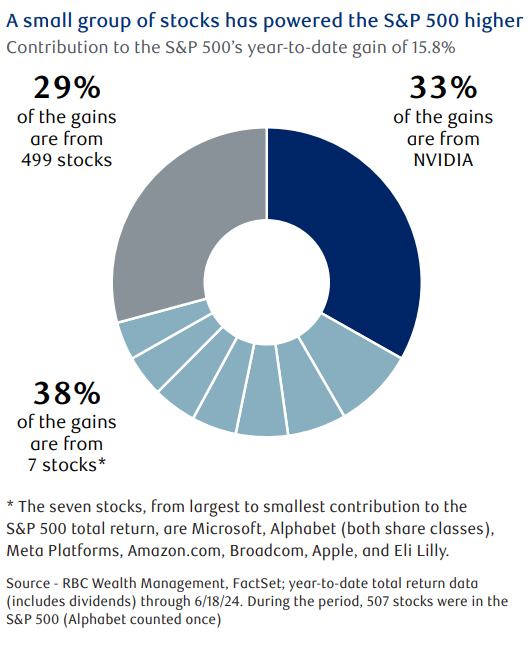
A small group of stocks has dominated, with the overwhelming proportion of them tied to artificial intelligence (AI) earnings optimism and hype:
- AI chipmaker NVIDIA represents 33 % of the S&P 500’s year-to-date gain.
- Seven stocks make up another 38 % of the gain, six of which are also leveraged to AI (pharmaceutical company Eli Lilly being the exception).
- The other 499 stocks in the index during this period represent only 29 % of the total return.
Much More To Consider
The complete group of Magnificent 7 stocks is no longer driving performance, as was the case much of last year. The market has been driven by just four Magnificent 7 stocks (NVIDIA, Apple, Microsoft, Alphabet) and chipmaker Broadcom.
Since the mid-April low, these five AI-leveraged companies have accounted for an outsized 67 % of S&P 500 gains—a very lopsided rally.
In addition to the AI theme, the news associated with slower economic growth has played a role.
Stocks with secular (long-term) growth characteristics have historically outperformed when economic growth is below average, mainly because their earnings growth prospects are viewed by the market as more secure.
“FOMO” the psychological phenomenon known as the “fear of missing out” has been powering these five AI-leveraged stocks. This happens when some institutional and individual investors chase the biggest winners, especially when the hype about a particular investment theme becomes larger than life, like AI has.
While FOMO periods can last a lot longer than one might think is rational, they can also change shape or end when least expected.
 Price Is Only An Issue When Value Is Absent
There is concern that the rally has pushed valuations higher. This isn’t as troubling as it might seem.
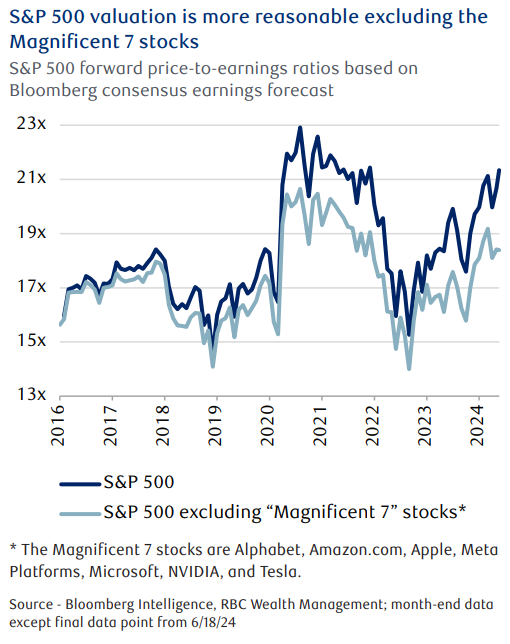
The S&P 500’s 21.3x forward price-to-earnings ratio is now well above the 18.5x average since early 2016. Statistically, this is around 1.2 standard deviations above the mean, according to Bloomberg Intelligence.
This is certainly a stretched level, although not yet near the 2.0 or above level that would be considered excessive.
When the AI-leveraged Magnificent 7 stocks are stripped out, the valuation is lower at 18.4x, (adjacent chart). This is likely less problematic and more reasonable as it is around 0.7 standard deviations above the mean.
Bloomberg Intelligence points out that the valuation gap between the S&P 500 and S&P 500 ex-Magnificent 7 stocks is abnormally high at about 1.8 standard deviations above the mean. While currently not a problem, we are moving too close for comfort to the 2.0 standard deviation level that can be considered as excessive.
Market Rallies Always Include Retreats
The U.S. market is likely due for a normal pause or pullback in the coming weeks or months. Now is not the time to chase the biggest winners.
Heading into the Q2 earnings season, which will begin in mid-July, consensus earnings forecasts for this year and next seem dependent on average or better GDP growth, yet recession risks still linger.
The U.S. presidential election campaign could stoke volatility as institutional investors start to focus on the debates and political party conventions this summer.
A smart recommendation would be to hold a Market Weight exposure to U.S. equities. Amid what we perceive as FOMO activity, individual investors should stick to their long-term investment plan.
As always, please let me know if you have any questions.