

Our U.S. Recession Scorecard saw an important negative shift in May, when a third of seven leading indicators was re-rated from cautionary yellow to recessionary red. A fourth may undergo a similar shift in the coming months.
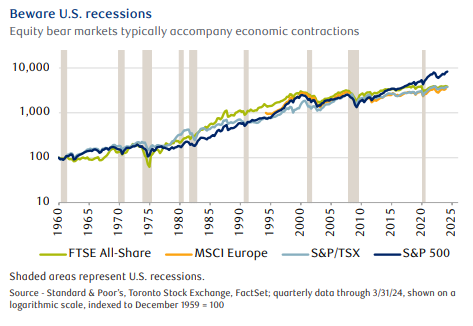
 Equity investors should take note that risks of the U.S. economy slipping into recession during the second half of 2024 are rising.
Just two years ago, our Recession Scorecard was flashing nothing but green lights for the U.S. economy. That rating began to deteriorate in the summer of 2022.
First, in July 2022, the Treasury yield curve inverted when the 1-year Treasury yield rose above the 10-year yield, signaling that credit conditions were tightening in a serious way. Every recession in more than 100 years has been preceded by such a yield shift.
A couple of months later another of our seven indicators— the Conference Board’s Leading Economic Index—went red by falling below where it had been a year earlier. This has occurred before the onset of every U.S. recession since the late 1950s, or for as long as this indicator has been around.
In the months that followed, three more Scorecard indicators shifted out of the positive green zone and into cautionary yellow territory. Now, a third Scorecard indicator has been rerated to the recessionary red column: as of Q1, the growth rate of U.S. nominal GDP has fallen below the federal funds rate.
Such a crossing point has occurred either before or just after the start of every recession going back to the 1950s.
The notional economic linkage for this indicator is with categories of spending—primarily residential construction, business capital investment, and consumer spending on durables—for which the cost of borrowing is an important determinant. While not the largest component of GDP, at about 25%, spending on fixed assets and durables is highly cyclical.
 It is often a major contributing factor to recessions, usually going into outright decline under pressure from high interest rates, restricted availability of credit, and falling consumer demand.
One other Scorecard indicator—the unemployment rate—could be poised to flip into the red column, perhaps as early as next month. U.S. unemployment has risen in three of the past four months and now sits at 4.0%, its highest reading in almost two-and-a-half years. That has been enough to turn our trend-smoothing line for this data series upward for the first time since the onset of the COVID-19 pandemic.
As things stand, three of the seven indicators are rated “Recessionary,” and two are set at “Cautionary,” while two remain at “Expansionary” green. If the unemployment rate shifts to red next month, the count will become 4, 2, and 1.
While there is no score that makes a recession unquestionably inevitable, today’s levels portrays a decidedly different risk profile for the U.S. economy than the wall of green that prevailed in the decade following the global financial crisis.
A noted tilt in our Scorecard should keep investors alert to a riskier, more challenging environment for equities that might arrive in the coming quarters.
As always, please let me know if you have any questions or comments.