

Investors have become more confident that a “soft landing” is the most probable outcome over the next 12 months.
We’ll provide an update on the macro environment and its implications for portfolios.
 The Global Economy
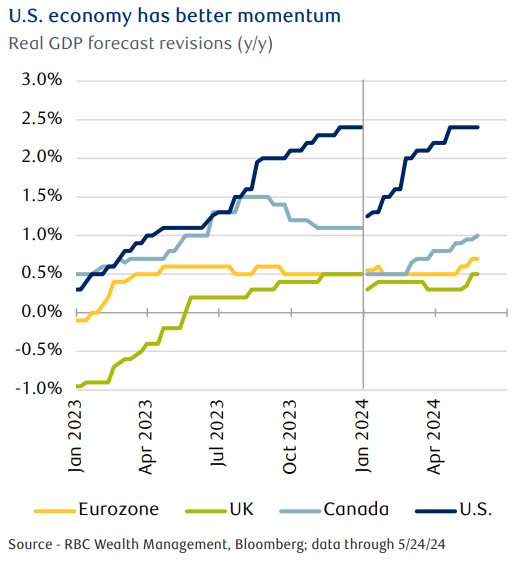
The world economy remains in expansion, though growth expectations for major countries are uneven. The U.S. economy continues to lead the pack in terms of momentum.
Following the same script as 2023, U.S. real gross domestic product (GDP) growth estimates have seen the most significant upward revisions since the beginning of this year (chart at right).
The sustained strength of the U.S. economy can be mainly attributed to resilient household spending, which constitutes roughly 70% of GDP.
Reinforcing robust consumer activity is a labour market that is whipping out new jobs at a solid pace, accompanied by higher wages.
As incomes grow, consumers tend to spend more. The “wealth effect” from substantial gains in home and financial asset prices has likely also bolstered household spending.
 Erratic Inflation
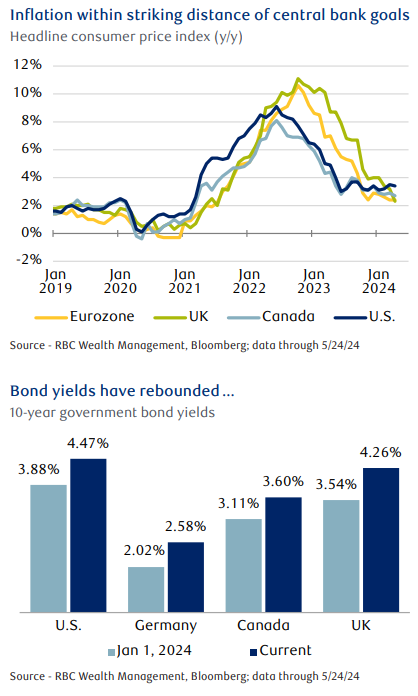
Inflation has retreated sharply in major developed economies. But much like the economic outlook, the progress of inflation returning to central bank targets has been varied and, in some instances, slower than expected.
This trend is most evident in the U.S. where inflation figures have surprised more frequently on the upside this year.
While the “last mile” of excess inflation will still take some time to navigate, most remain confident that inflation in most economies, including the U.S., is on a downward trajectory over the coming quarters.
This outlook is supported by expectations of an easing in the lagging components of the inflation basket— most notably housing categories—and labour market conditions moving into a better balance between supply and demand of workers that can help moderate upward wage pressures.
Another promising disinflationary signal comes from the corporate sector: The number of S&P 500 companies citing inflation on their earnings conference calls declined for the seventh consecutive quarter in Q1 2024 and is on track to be the lowest since Q2 2021, according to FactSet.
Central Bank Actions
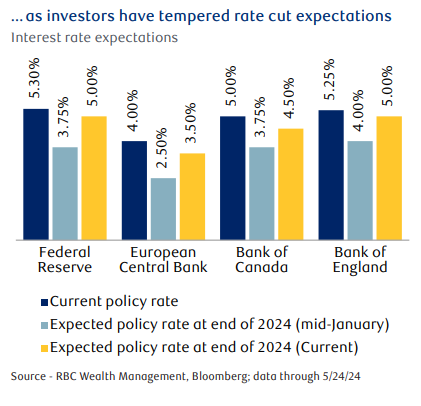 With inflation taking longer to normalize, central bankers are counseling patience regarding a pivot towards less restrictive monetary policy. Policymakers have emphasized their desire to see more evidence of well-behaved inflation at or near target levels before implementing rate cuts.
Amongst the four major central banks, the European Central Bank and Bank of Canada will lead in initiating the easing cycle, according to RBC Capital Markets, with the first rate cut expected in June. The Bank of England is projected to follow in August, and the Federal Reserve in December.
These forecasts align closely with current probabilities reflected in interest rate futures and, in our view, appear reasonable. Growth momentum and price pressures in the eurozone and Canada have softened more visibly.
 Recent UK macro data has exhibited a sturdier tone, hinting the economy is faring better than policymakers had expected. The resilience of the U.S. economy affords the Fed the luxury of time to await greater conviction on the path of inflation.
With mixed growth and inflation trends clouding the monetary policy outlook, the “higher-for-longer interest rates” story seems likely to persist in the near term.
 The Sum Of The Parts
Despite uncertainties surrounding inflation, borrowing costs, geopolitical tensions, and the economy, global equities have delivered worthwhile gains.
Year to date, the MSCI All-Country World Index has risen roughly 8.5% on a total-return basis. Two fundamental drivers have been at play. First, the economy has continued to progress steadily.
A growing economy has allowed for an improving outlook for corporate earnings. The combination of durable economic growth, expense control, and share buybacks can enable profits to advance further, providing a foundation for stocks to move higher in the quarters ahead.
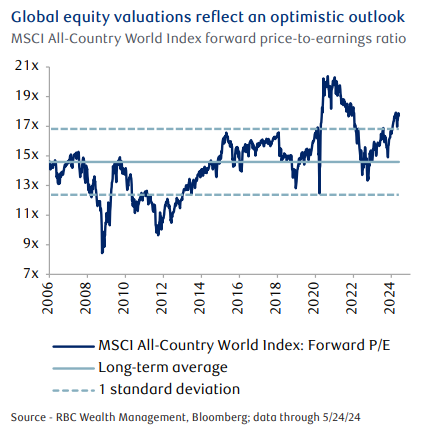
Nevertheless, elevated starting stock valuations suggest to us that consistently strong earnings delivery and sustained investor willingness to pay above-average multiples for those profit streams will be crucial for keeping equity markets on an uptrend.
Bloomberg estimates show earnings for the MSCI All-Country World Index to increase by approximately 8% this year. Meanwhile, renewed inflation volatility has led markets to push back the timing and amount of potential central bank rate cuts this year.
While the uptick in bond yields this year has dampened returns in fixed income markets, we continue to see a range of opportunities with adequate risk-reward profiles for investors with a multi-year horizon to deploy capital. Given the current environment of limited compensation for taking credit risk, we advocate a selective, quality-oriented approach to fixed income exposure.
As always, please let me know if you have any questions or comments.