

Over the past weeks, questions have arisen regarding the U.S. administration’s recent rhetoric, including references to Canada potentially becoming the 51st state. While this topic has generated significant attention, we aim to provide clarity based on current information. The U.S. President has made statements about territorial expansion, including acquiring Greenland and integrating Canada as a state.
An annexation of Canada would be technically possible but not a feasible outcome. Our understanding is that American legislation does allow for a relatively simple process of adding states to the union, but a myriad of hurdles exist to do so.
Legal Process: Adding a new state requires Congressional approval, including a supermajority in the Senate (60 votes). Given the Senate’s current composition, this would require all Republican members to approve (an unlikely scenario) with 7 additional votes from Democratic or Independent Senators.
Canadian Opposition: For statehood to occur, Canada would need to apply willingly. Polls consistently show Canadians strongly oppose this idea.
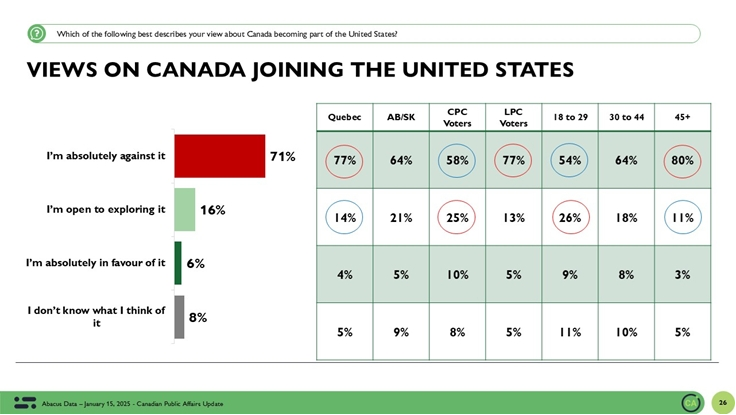
Integration Challenges: Incorporating 13 provinces and territories with distinct identities would be complex and politically divisive. Which begs the question:
Would there be a preference for this in America?
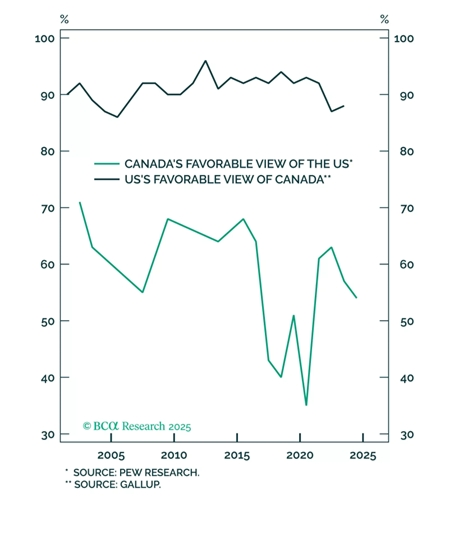
The American public broadly views Canada favourably (see exhibit below).
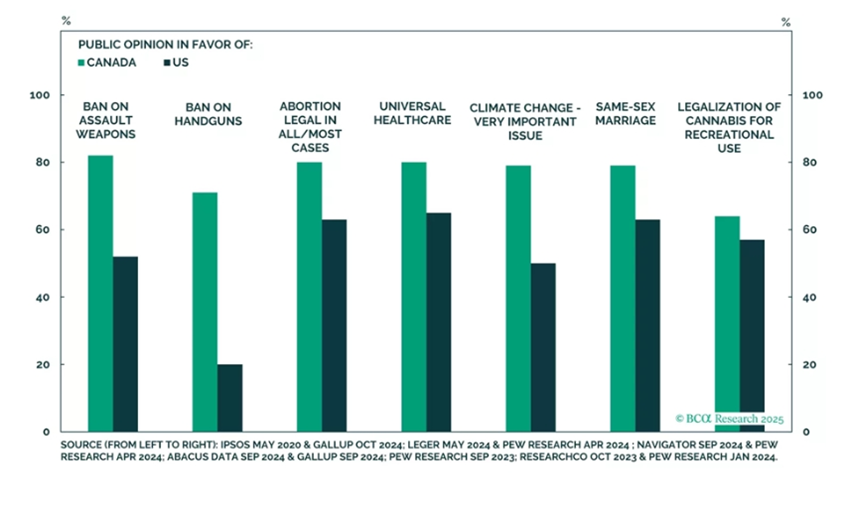
U.S. Political Landscape: U.S. Republican policymakers, who have a majority in government, are likely to reject any legitimate attempt to amalgamate the countries given a significant leftward-leaning tilt in Canada on most sensitive political issues relative to the American political spectrum (see exhibit below).
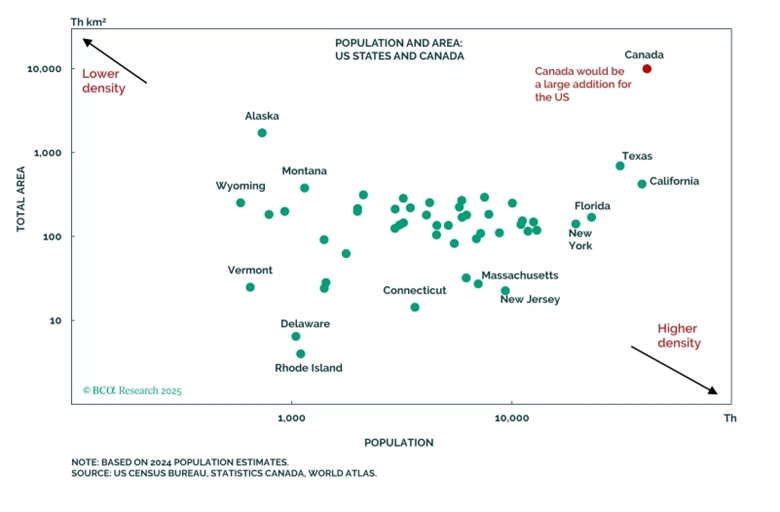
Moreover, were it to happen, Canada would become the largest state (see exhibit below), with a population that would allow it to claim approximately 10% of seats in the House of Representatives and lead to a rearrangement of the American political landscape that conservative policymakers, and President Trump, are unlikely to find palatable.
While these discussions may add to market uncertainty, experts agree that the likelihood of Canada becoming the 51st state remains extremely low. Canadian leaders, including Prime Minister Trudeau, have unequivocally rejected this notion. We will continue monitoring developments and remain available to address any concerns about your wealth management strategy amidst geopolitical events.