

In early November, Hamilton Foss Wealth sponsored and attended qConnect 2025, a two-day quantum computing industry event organized by the University of Calgary. Through the Quantum City hub and lab, the university is driving the creation of a quantum computing ecosystem right here in Calgary. As supporters and enthusiasts of this emerging technology, we wanted to get to know more about the people, companies, and organizations involved in the industry, and to share our experience at qConnect 2025.
Welcome reception
The evening before the conference, the organizers hosted a welcome reception for the sponsors and speakers on campus at Quantum City. Early in 2025, Quantum City opened qHub, a 17,000 sq. ft open space for work and collaboration on quantum ideas, and the venue for the reception. The other section, qLab, is under construction, and will ultimately be used as a testbed for research and business ideas.
We spoke with a number of interesting people from different parts of industry, including Saeed Neyshabouri, program manager of QAI Ventures Canada. QAI Ventures runs a startup accelerator program at Quantum City to help guide, grow, and fund quantum startups through the university. For emerging technology, it is a critical function to bridge the gap between research and business, and to have access to venture capital. Most of the startups are involved in the areas of quantum sensing and quantum cryptography, which we heard about in detail over the course of the conference.
Nokia was a company that was well represented at the event. Many of us know Nokia from early mobile phones, but they are actively involved in quantum cryptography and network security for national defence and corporations. Nokia brought an interactive display to visually demonstrate how quantum cryptography is used to defend against hacking attempts at the corporate and national level.
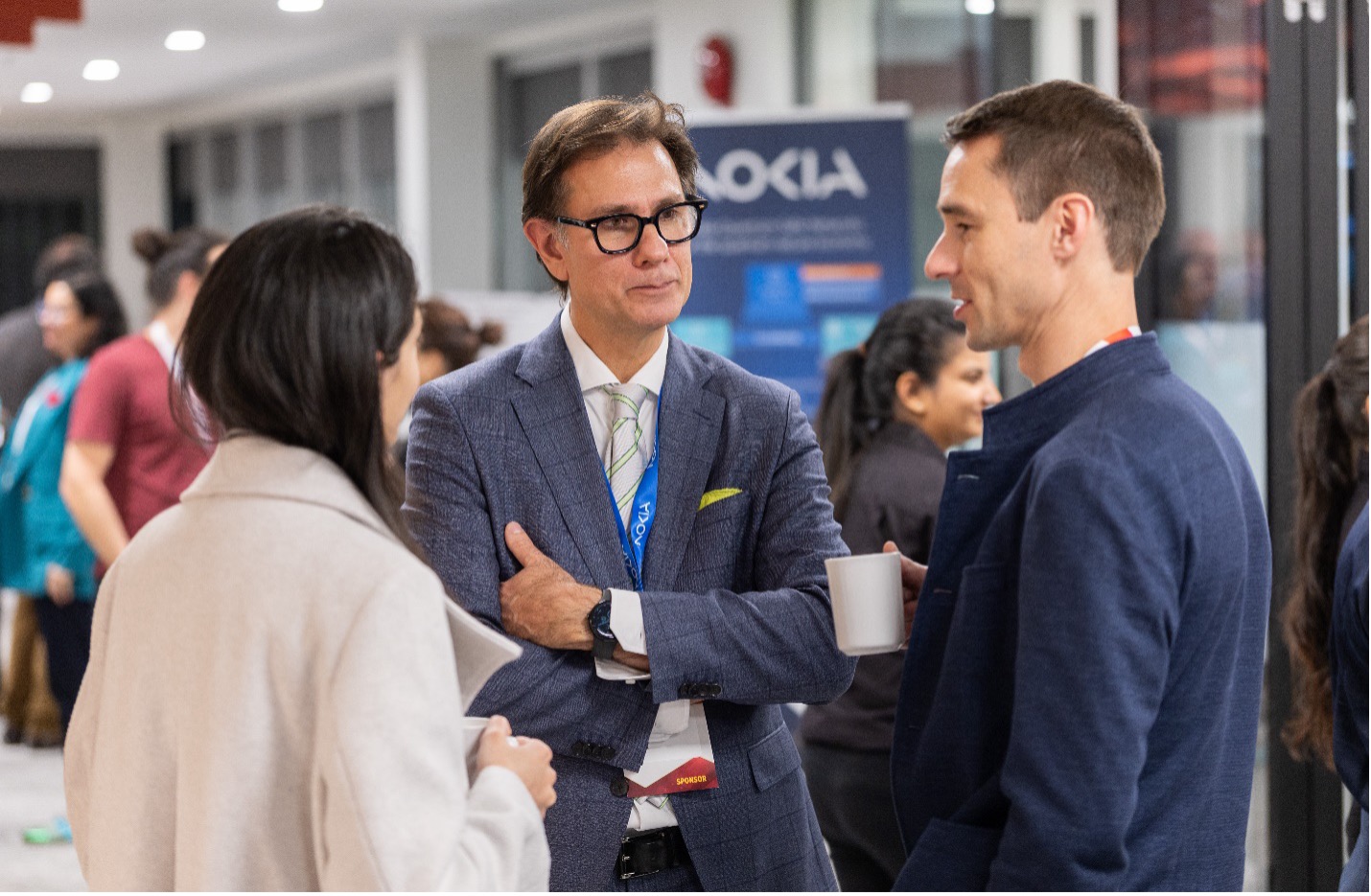
Evening welcome reception at Quantum City Photo Credit: Quantum City
Day one
The main conference took place at the Telus Convention Center. Adam Bene Watts made the opening presentation with a cursory overview of basic quantum concepts. Adam is an assistant professor at the University of Calgary and a Quantum Fellow at Quantum City. Adam’s presentation was entertaining and made the underlying concepts digestible to those in the audience who did not have a background in quantum mechanics. This was really the only time that the physics was touched on, and that speaks to the objective of the conference, which was to bring together many people from different industries to talk about business use cases and policy considerations, rather than explaining the technology.
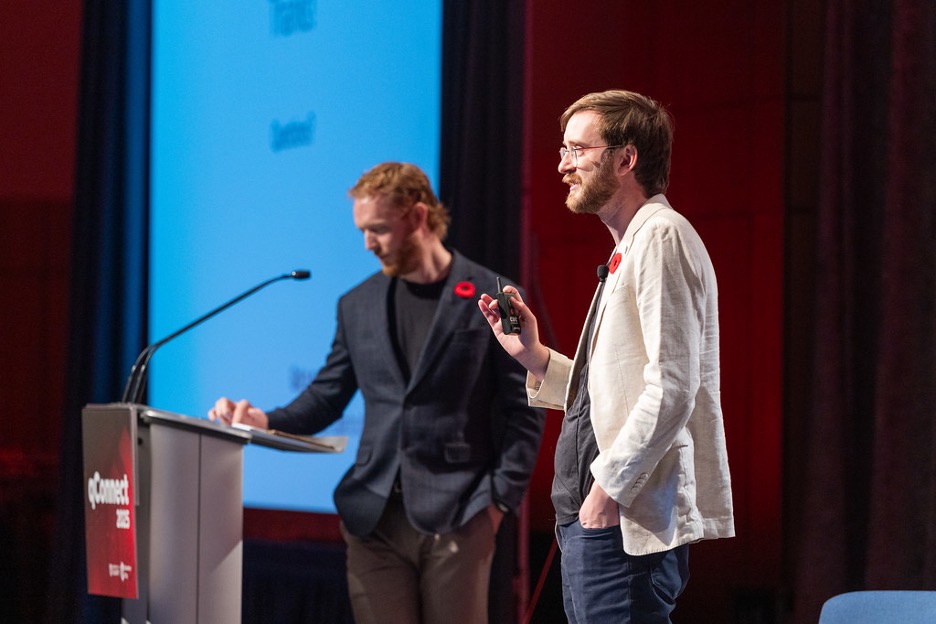
Ryan Kresevic and Adam Bene Watts of Quantum City Photo Credit: Quantum City
A local highlight was the panel conversation on the City of Calgary’s approach to safeguarding infrastructure and data in the face of these forthcoming changes. A notable theme to quantum technology is the ability of quantum computers to break the current encryption methods used to protect digital information. Panelists from Numana, Nokia, and Quantum Bridge discussed the City’s implementation of a ‘sandbox’ where the effectiveness of quantum technology can be tested on real infrastructure, without directly compromising the energy grid or data systems.
Another panel discussion was focused on business and investment and how Canada can stay competitive in this global race. Quantum computing presents significant economic opportunity as well as complex national security concerns, and there is a need to balance the two. People at the conference were talking about the recent announcement that Canadian quantum computing company Xanadu will be publicly listed in 2026, making it the first of its kind in Canada. Panelist Samuel Miguel, CTO of Multiverse Computing, emphasized that as a Spanish company looking to maintain competitiveness, they saw Canada as a necessary place to have corporate operations and this led to their decision to open an office in Toronto.
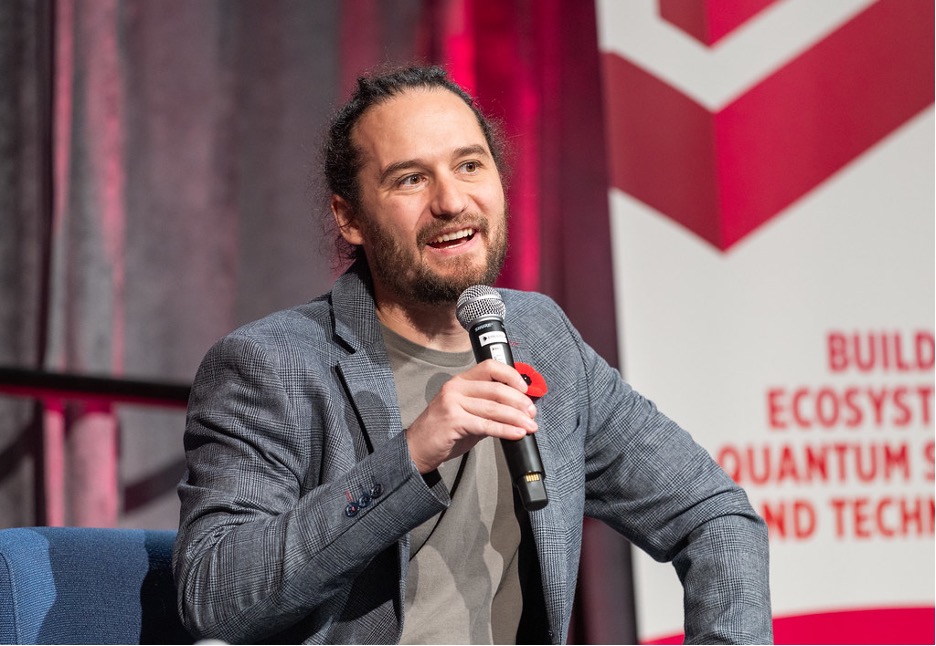
Samuel Miguel of Multiverse Computing Photo Credit: Quantum City
In between presentations, we had the opportunity to hear short presentations from Canadian startups like Calgary-based Quantized Technologies Inc., as well as Zero Point Cryogenics and Q-Block Computing. We also spoke to reps from US-based companies like IONQ and IBM, both in the business of selling whole quantum computing systems. Price tags are eight figures, but there’s a very robust level of interest—especially from government defense programs and national technology accelerators. Corporate partnerships are also accelerating, with the early use cases for quantum focusing on materials and chemistry. (Think batteries, pharmaceuticals, and aerospace materials.)
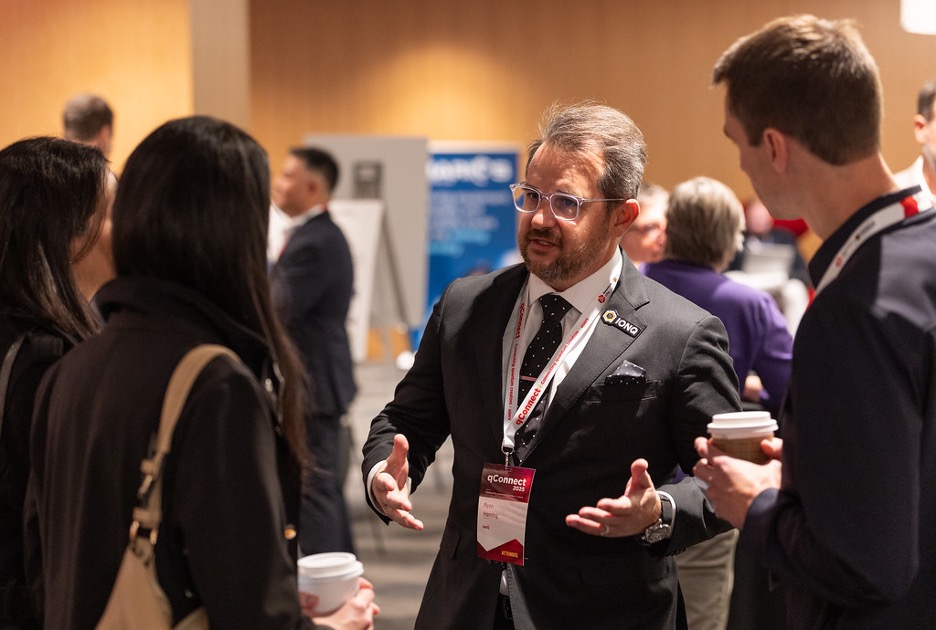
Ryan Harring of IONQ Photo Credit: Quantum City
Day two
Day two was a morning of presentations before wrap-up at lunchtime. One morning panel discussion focused on the topic of quantum sensing, which is an area with real use-cases today. Eric Henderson of the National Research Council moderated a conversation with representatives from Defense Research and Development Canada, SilQ Connect, as well as Itzel Lucio Martinez of Quantized Technologies here in Calgary. Quantum sensing is the use of quantum mechanical principles to develop technology with greater sensitivity and stealth. Adjacent areas are items like quantum RF antennas, key distribution, and clocks for use in navigation. Atomic clocks are used to increase accuracy and reliability for GPS navigation. This is of critical importance as GPS jamming and satellite disruption is becoming a more common security concern.

Itzel Lucio Martinez of Calgary-based QTI Technologies Photo Credit: Quantum City
This plays into the idea that was reinforced consistently throughout the conference, which is that this is not a technology of the distant future. Quantum sensing is already being deployed and companies are selling products in this area.
We also heard from Nipun Vats, assistant deputy minister of science and research at EDC. The message was that quantum science and technology was a government priority, crucial for sovereign defense and for societal benefit. The federal budget, released on the opening day of qConnect, earmarked $334 million over five years for quantum technology development.
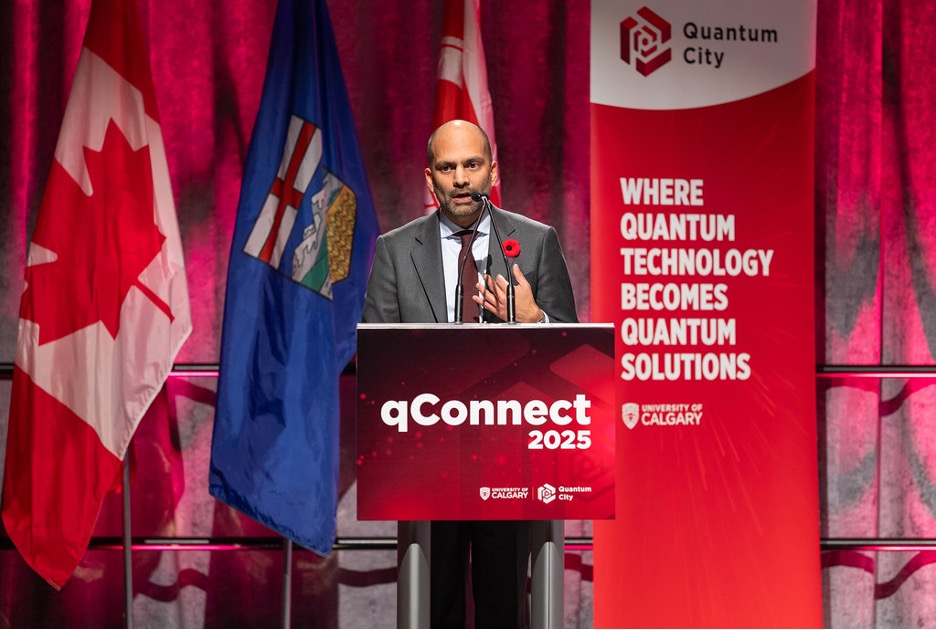
Nipun Vats, Assistant Deputy Minister of Science and Research Photo Credit: Quantum City
Takeaways
The conference was incredibly interesting and well-organized, and congratulations are in order for the people at Quantum City for putting on a world-class industry conference. They have done a tremendous service to position the city of Calgary at the forefront of national and international quantum hubs, and for qConnect as an annual event that all interested participants need to attend in order to make connections and conduct business.
Quantum computing is an exciting growth technology with deep implications for businesses, countries, and societies. While quantum computers are not yet able to replace the modern supercomputers powering everything we do today, they are very close, and there is significant investment being made to drive these technologies forward. The benefits will permeate all areas of the market and lead to new areas of innovation.
We are proud to support qConnect as a sponsor and grateful to attend as enthusiasts, and we will certainly be back next year. Please reach out if you want to chat with us about quantum computing or qConnect.